Meta Reels Ads for Fashion Brands: The Short-Form Video Playbook That Drives Conversions in 2026

Fashion brands that are still treating Reels as an afterthought are paying for it - literally. In 2026, Meta's algorithm rewards Reels with significantly better reach and lower CPM than static images or carousels. The brands in our client base that shifted 40-60% of their creative budget toward Reels have seen real efficiency gains. The ones that did not are watching their cost-per-result climb.
This is not a trend. It is a structural shift in how Meta distributes content. Reels are natively short-form, natively mobile, and natively addictive. If your fashion brand is not producing Reels ads that stop thumbs in the first 3 seconds, you are starting every campaign at a disadvantage.
Here is what we have learned running Reels campaigns across 40+ fashion clients.
Key Takeaways
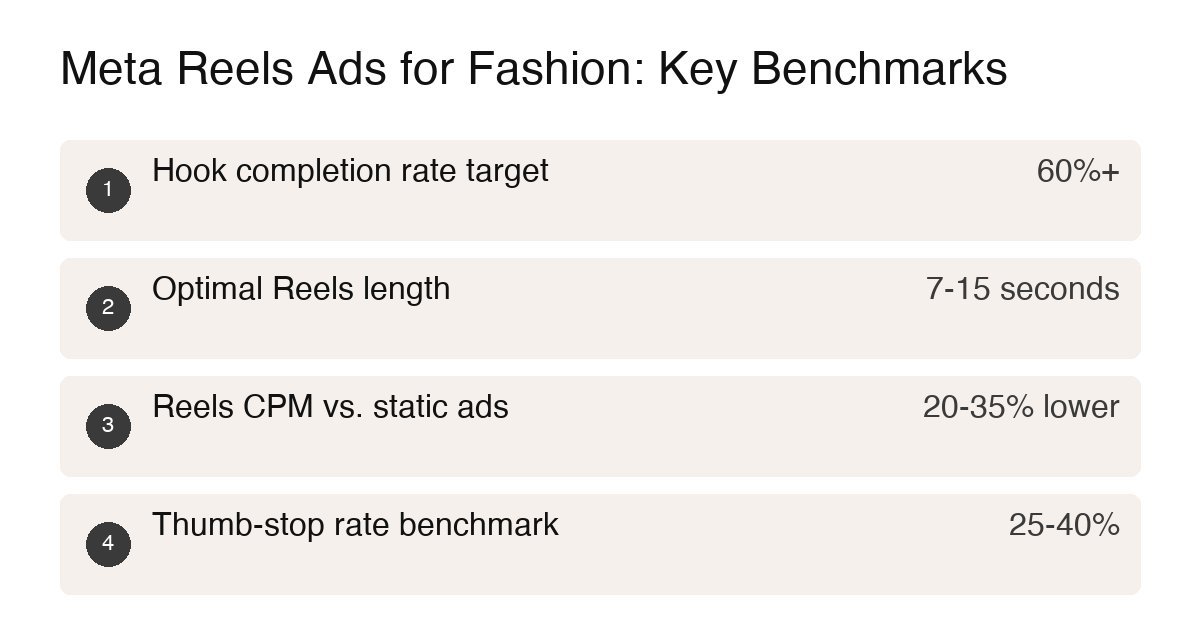
- •Reels deliver 20-35% lower CPM than static ads for fashion brands when done well
- •The first 3 seconds determine everything - hook completion rate should target 60%+
- •7-15 seconds is the optimal range for fashion Reels ads; 30 seconds rarely outperforms
- •UGC Reels outperform branded studio Reels in cold audiences in most fashion subcategories
- •Hook, middle, and CTA each have a specific job - most brands get the middle wrong
- •Test hooks first, then visuals; scaling without testing is expensive
Why Reels Have Become the Dominant Meta Format for Fashion
Meta's internal data has been consistent for over a year: Reels generate more time-on-platform than any other format. That matters because Meta's business model is built on attention. When Reels generate more attention, Meta gives them more reach. When they get more reach, advertisers who use Reels access cheaper inventory.
For fashion brands specifically, this creates a meaningful advantage. Fashion is a visual, aspirational product category. A 10-second video of an outfit in motion tells a story that a static image cannot. The way fabric moves, the way a look is styled in a real-world setting, the confidence of the person wearing it - these are signals that convert browsers into buyers.
What the data shows across our client base:
Fashion brands running Reels as their primary paid format consistently see lower CPM compared to static-first campaigns. The spread is not trivial - we typically see 20-35% lower cost per thousand impressions on comparable audiences. That translates directly into lower cost per click and, when the creative is right, lower cost per purchase.
Across our fashion client base in 2026, Reels ads deliver 20-35% lower CPM compared to static image ads on comparable audiences - and when hook completion exceeds 60%, cost-per-purchase drops further.
The caveat is the phrase 'when done well.' A badly produced Reels ad will underperform static because the algorithm punishes low-engagement video content harder than low-engagement static content. The bar is higher. But so is the reward.
The Anatomy of a Winning Fashion Reels Ad
Every high-performing fashion Reels ad has three distinct parts. Most brands focus almost entirely on the visual middle section and neglect the two parts that matter most: the hook and the CTA architecture.
Part 1: The Hook (0-3 seconds)
This is the make-or-break zone. Meta measures hook completion rate - how many people watch past the first 3 seconds. If that number falls below 50%, the algorithm pulls back distribution. If it exceeds 60-70%, it pushes more aggressively.
For fashion, the hook has one job: stop the scroll and create enough curiosity or desire that the viewer does not swipe. This is not the place for your logo, your brand name, or a gentle product shot. It is the place for the most visually compelling or emotionally interesting frame in your entire video.
Part 2: The Middle (3-12 seconds)
Once you have the viewer, the middle section has to deliver on the hook's promise. If the hook was an outfit reveal, the middle should show the outfit from multiple angles, in motion, styled in a real context. If the hook was a styling tip, the middle is the tip.
This is where most fashion brands lose viewers. They fill the middle with generic footage, logo overlays, or slow transitions that bleed energy from the video. **Every second of the middle should earn the viewer's continued attention.**
Part 3: The CTA (last 2-3 seconds)
The CTA in a Reels ad does not have to be subtle. Clear, direct CTAs ('Shop now', 'See the collection', 'Link in bio') consistently outperform clever or indirect ones. The viewer who has watched 12+ seconds is already interested - do not make them work to figure out what to do next.
Not sure if your Reels creative is built for conversion or just for views? We audit Meta accounts for fashion brands and identify exactly where the creative is leaking performance. Book a free call to find out what to fix first.
5 Hook Formulas That Generate High Thumb-Stop Rates for Fashion
After testing hundreds of Reels hooks across fashion clients, five patterns consistently outperform the rest. These are not scripts - they are structural formulas you adapt to your brand and product.
1. The instant outfit reveal
Start mid-transition: the viewer enters the video as the outfit is being completed or revealed. No slow build-up. The visual payoff arrives in the first second. Works best for contemporary womenswear and streetwear where the styling is the story.
2. The direct-to-camera hook
A person (founder, model, or creator) looks directly at camera and says something specific. 'This is the only thing I've worn for three weeks' or 'I wore this to three different events and nobody knew it was the same dress.' The specificity is what stops the scroll. Vague statements ('You need to see this') no longer work.
3. The problem-first open
Start with a relatable problem that your product solves: 'I can never find work trousers that actually fit properly' - then the outfit is the answer. Particularly effective for niche fashion products addressing specific wardrobe problems.
4. The before/during transition
Show a casual or neutral starting point, then cut or transition to the styled look. The contrast is the hook. Fashion buyers respond to transformation narratives. Keep the transition crisp - slow crossfades kill this format.
5. The social proof hook
Start with a comment, DM, or text overlay of someone else's reaction: '37 people asked where I got this outfit.' Instantly frames the product as desirable before a single item is shown. Works well for brands with genuine community engagement.
In our A/B tests across fashion Reels campaigns, hooks that lead with social proof or a direct-to-camera specific statement consistently outperform generic product shots in the opening frame by 30-50% on thumb-stop rate.
Optimal Length: 7 Seconds, 15 Seconds, or 30 Seconds?
The short answer is 7-15 seconds for the majority of fashion Reels campaigns. Here is the longer answer.
**7-second Reels** work when the product is visually self-explanatory and the hook and CTA are the entire story. A stunning outfit in motion, correctly framed and lit, with a direct CTA at the end. No middle section needed. These tend to win in cold audience prospecting where attention is at a premium.
**15-second Reels** are the workhorse format for fashion. Long enough to tell a mini-story (hook, outfit context, styling detail, CTA), short enough to hold attention. This is the format we default to when building a Reels creative suite for fashion clients.
**30-second Reels** rarely outperform 15-second in paid fashion campaigns, despite performing well organically. In our experience, the additional time tends to get filled with padding rather than substance. The exception is complex product explanation (technical fabrics, sizing systems, care instructions) or strong UGC testimonials where the person naturally takes longer.
The practical implication: shoot for 15 seconds, cut ruthlessly to 7 seconds, and use 30 seconds only when you have material that earns every additional second.
If you're building a Reels creative strategy from scratch and want to know what length and format mix to start with for your specific brand, book a free creative audit. We will review your current ad account and give you a concrete recommendation.
UGC vs. Branded Reels: When Each Format Wins
This is one of the most common questions we get from fashion clients, and the honest answer is: both, in different situations.
When UGC Reels outperform branded studio content:
Cold audiences - people who have never heard of your brand - respond better to UGC in most fashion categories. The reason is trust. A real person talking about a product in a natural setting triggers a different credibility response than a polished studio production. For fashion specifically, seeing the clothes on a real body in a real context reduces purchase risk.
UGC also tends to have lower production costs, which means you can test more hooks and formats without the budget constraint of studio shoots.
When branded studio content outperforms UGC:
Retargeting audiences, where the viewer already knows your brand, respond better to polished branded content. At this stage, you are converting consideration into purchase - and the editorial quality of a studio shoot signals that this is a serious brand worth buying from.
Luxury and premium fashion brands also tend to see branded content outperform UGC across the funnel. The aspirational quality of the product requires aspirational visual treatment.
For cold prospecting in contemporary and streetwear fashion, UGC Reels from micro-creators (5,000-50,000 followers) outperform branded studio Reels in cost-per-purchase in the majority of accounts we manage - often by 25-40%.
The practical approach:
Build a creative suite that has both. Run them against each other. Let the data decide for your brand and audience - do not assume either format wins without testing.
Branded Reels vs. Spark Ads: Understanding the Difference
Spark Ads are Meta's format for running ads using existing organic posts - either from your own page or, with permission, from a creator's account. They look identical to organic Reels in the feed, which is a significant advantage for fashion brands trying to avoid the 'this is clearly an ad' response.
The distinction matters for fashion brands building a Reels strategy:
**Branded Reels** (ads created directly in Ads Manager) give you full control over targeting, budget, and creative. They can be built specifically for paid performance - optimised hooks, direct CTAs, the right length. The trade-off is that they carry your brand handle and are visibly promoted.
**Spark Ads** run from the creator's or your organic page's handle. They carry the creator's social proof (their follower count, existing engagement on the post) and feel more native. When a creator already has engagement on a post, Sparking that post into an ad compounds the social proof.
For most fashion brands, the answer is to use both: branded Reels for retargeting and structured testing, Spark Ads for cold audience prospecting using your strongest organic and creator content.
Creative Testing for Reels: What to Test First
Testing without a framework is expensive. The order in which you test elements matters because it determines how quickly you find winning combinations.
**Test hooks first.** The hook is the highest-leverage variable in a Reels ad. A winning hook on mediocre middle content will outperform a mediocre hook on perfect middle content. Run 3-5 different hooks against the same middle and CTA. Give each at least 3-5 days and meaningful spend before judging.
**Then test visual formats.** Once you have a winning hook concept, test whether it works better as a direct-to-camera moment, a montage, a transition reveal, or a static person speaking. Often the hook concept is right but the visual execution can be improved.
**Then test CTA and offer.** Copy, CTA button, and whether you mention a specific offer (new collection, limited stock, free shipping) affect conversion rates significantly. But testing CTAs before you have a winning hook is premature - fix the top of the funnel first.
How much budget to allocate to creative testing:
We recommend 15-20% of monthly Meta ad budget for creative testing in fashion accounts. This is not wasted spend - it is the investment that protects your scaling budget from creative fatigue and keeps your best performers fresh.
Every brand's Reels strategy looks different depending on your product, price point, and existing creative assets. If you want to know the right testing framework for your specific situation, book a free call with our team.
Benchmarks: What Good Looks Like for Fashion Reels
Benchmarks are a reference point, not a target. Your actual numbers will vary based on price point, product category, audience temperature, and creative quality. That said, these are the ranges we see across our fashion client base:
**Thumb-stop rate (percentage watching past 3 seconds):** 25-40% for cold audiences. If you are below 20%, the hook needs to change before anything else.
**Hook completion rate (watching past 3 seconds):** Target 60%+ to trigger algorithmic distribution boost. Below 50% and you are fighting the algorithm.
**Video completion rate (full watch):** 15-30% for 7-15 second fashion Reels. Shorter is almost always higher.
**CTR (click-through rate):** 1.5-3.5% for fashion Reels in cold prospecting. Well-optimised hooks combined with clear CTAs push the upper end.
**CPM:** Depends heavily on audience and season, but Reels typically deliver 20-35% lower CPM than static on comparable targeting.
**ROAS:** Varies significantly by brand and category. Reels are not magic - if your store does not convert, cheaper traffic still does not convert. Fix the store before you scale Reels spend.
The Most Common Reels Mistakes Fashion Brands Make
We audit a lot of Meta accounts. The same mistakes appear repeatedly.
**Starting with the logo.** The first second is the most valuable real estate in your ad. Putting your logo there is the equivalent of starting a sales pitch by handing someone your business card. Nobody cares about your logo in the first second - they care about whether the video is worth watching.
**Slow transitions and music intros.** Fashion brands with strong brand identities often open with an ambient music fade-in over a logo reveal. This is a habit from TV advertising. In Reels, it burns your hook window. Start at full speed.
**No CTA or a buried CTA.** 'Shop the look' in small text in the bottom corner of the final frame is not a CTA. Make it explicit, make it visual, and if you are using voice-over, say it out loud.
**Producing one version and scaling it.** The brands that win on Reels test continuously. Creative fatigue happens faster with video than with static - especially for fashion, where the audience sees your content frequently. Build a production rhythm, not just a production moment.
**Optimising for views instead of conversions.** Reels can generate enormous view counts with zero commercial value. Make sure your campaign objective is purchases or add-to-cart, not video views. The algorithm will optimise for whatever you tell it to optimise for.
Frequently Asked Questions
Every fashion brand's Reels strategy will look different based on your product, budget, and existing creative assets. What the format requires is consistent: strong hooks, clear CTAs, continuous testing, and enough creative volume to stay ahead of fatigue. If you want to know what the right Reels structure looks like for your specific brand, book a free call with our team.