Meta Ads for Skincare and Beauty Brands: Benchmarks, Creative Strategy and What's Different
Key Takeaways
- •Beauty brands on Meta face higher compliance risk than fashion - ingredient claims and skin result promises get flagged fast
- •ROAS for beauty typically runs lower in the first 60 days, then catches up as social proof accumulates
- •Before/after creatives work - but require careful framing to stay within Meta policy
- •Targeting now depends on first-party data, not interest stacking - your email list is your competitive advantage
- •If your webshop does not convert organic traffic, scaling Meta spend will not fix it
If you run a skincare or beauty brand and you've tried copying what fashion brands do on Meta, you've probably noticed it doesn't quite translate.
The audiences are different. The purchase psychology is different. The compliance risk is entirely different. And the creative formats that drive the highest CVR for fashion brands - lifestyle, lookbook, editorial - rarely hit the same way for beauty.
We work with beauty brands alongside our fashion clients, and over time we've built a separate Meta creative playbook for how Meta advertising works in this space. Many brands also combine Meta with Google Ads for skincare and beauty ecommerce — the two channels complement each other when set up correctly. This article shares what we've learned: the real benchmarks, the creative formats that convert, the policy traps to avoid, and the conditions that need to be in place before you scale.
Why Beauty Is Different in Meta
Fashion is an emotional impulse category. You see something, you want it, you buy it. The purchase cycle is short and visual.
Beauty is more considered. A skincare buyer is weighing ingredients, reading reviews, checking if a product works for their skin type. The trust barrier is higher. And that changes everything about how you structure your Meta campaigns.
Three differences that reshape your entire strategy:
First, beauty is review-dependent. A fashion piece can look great in an editorial shot and convert well. A moisturiser without visible social proof - reviews, testimonials, before/after - struggles to close the gap between curiosity and purchase, especially for new brands.
Second, the ingredient-driven purchase decision creates an education requirement that fashion doesn't have. If your product contains niacinamide, retinol, or peptides, a significant share of your audience will want to understand why that matters for their skin. Ads that skip the education step leave conversion on the table.
Third, Meta's compliance framework for beauty is stricter. You cannot promise specific skin results. You cannot use before/after imagery in a way that implies medical treatment. You cannot make health claims. Fashion brands rarely think about compliance. Beauty brands have to build compliance into every creative brief.
Beauty brands that invest in education-led creatives - explaining ingredients, demonstrating routine use, building trust before the CTA - see significantly stronger retargeting performance than brands that go straight to the offer.
Benchmark: ROAS, CPM, CTR and CVR for Beauty Brands on Meta
The numbers below are drawn from our work with beauty clients. They are ranges, not guarantees. A luxury facial oil brand with a €120 AOV will look different from a mass-market body care brand at €25. What matters is the pattern.
ROAS by phase:
In the first 60 days of running Meta ads, a beauty brand typically sees lower ROAS than an equivalent fashion brand at the same stage. This is because the trust cycle is longer - you're building social proof while spending. By months 3 to 6, as your retargeting audiences grow and your review library deepens, ROAS stabilises and improves. Patience here is a financial discipline, not a sign the strategy isn't working.
CPM:
Beauty audiences on Meta are competitive. Skincare, haircare, and cosmetics are heavily advertised categories globally. Expect higher CPM than niche fashion categories - particularly in Q4 when beauty gift purchases spike. The brands that win on CPM are the ones with strong creative hooks that earn high relevance scores.
CTR:
Click-through rates in beauty depend heavily on creative format. Ingredient hero videos and routine demonstrations consistently outperform static product shots. A beauty brand running only catalogue-style product images will see lower CTR than one running educational video content. The hook matters more in beauty than in most categories - the first 3 seconds of a video have to answer 'is this for my skin type?'
CVR:
Conversion rate on the webshop side is where beauty brands often struggle. If the product page doesn't resolve the core objections - ingredient trust, skin type fit, expected results, return policy - traffic will not convert regardless of how well the ads perform. Fix the page before you scale the spend.
The pattern we see across beauty accounts: top-performing brands treat Meta as a trust-building channel in the first phase, not just a direct-response channel. They convert on the second or third touchpoint, not the first.
Want to know what your beauty brand's Meta benchmarks should look like at your specific stage? Book a free Meta audit - we'll review your account and give you honest numbers.
Creative Formats That Work for Beauty Ads
Beauty advertising has a different creative hierarchy than fashion — and the format you lead with determines whether cold audiences convert or scroll past. Here's what we've tested (for the full creative testing framework, see our Meta ad creative playbook):
Before/after creatives
The highest-intent format for skincare - and the most compliance-sensitive. Before/after works because it demonstrates the product outcome visually. But Meta has specific rules: you cannot show dramatic medical-style transformations, you cannot imply treatment of a medical condition, and you cannot use imagery that could be seen as exploiting insecurities.
What works: subtle, natural comparisons over time, framed around experience and routine. What gets flagged: dramatic lighting changes between before and after, wound-like skin imagery, explicit claims in the caption alongside the visual.
Ingredient hero videos
Short-form videos (15 to 30 seconds) that explain what a key ingredient does and why it matters for a specific skin concern. These perform well in cold audiences because they build credibility before asking for the sale. A video that explains why your ceramide formula works for dry, barrier-damaged skin will outperform a generic product shot for that specific audience.
Routine demonstrations
How-to and routine content - showing the product in use as part of a morning or evening skincare routine - builds trust and answers the practical objection. These work well as Reels-format content, even for brands without an established creator network.
UGC testimonials
User-generated content is arguably more important for beauty than any other category. A real customer talking about their skin change after using your product, captured on a phone in natural light, outperforms polished studio creative for cold audiences. Specificity is everything - 'my redness went down after two weeks' outperforms 'I love this product' by a significant margin. For brands looking to go beyond UGC into expert-led credibility, dermfluencer and expert creator partnerships consistently strengthen cold traffic performance.
Not sure which creative format your beauty brand should prioritise? Book a free call - we'll review what you're running and tell you exactly what to test next.
What You Cannot Say in Beauty Ads
This is the section most beauty founders learn the hard way - usually after an ad rejection or an account flag.
Meta's advertising policies for health and beauty products prohibit claims that imply medical treatment, disease cure, or guaranteed physical transformation. The line is not always obvious, which is why beauty accounts get restricted at a higher rate than most other categories.
Claims that get ads rejected or accounts flagged:
Any claim that implies your product treats a medical condition - including acne, eczema, psoriasis, or rosacea - when framed as treatment rather than skincare. The word 'treats' is almost always flagged. 'Helps soothe', 'supports', and 'visibly reduces' tend to pass review.
Before/after imagery that implies dramatic medical-level transformation - even when the copy is compliant, the visual alone can trigger a review.
Claims about guaranteed results: 'your skin will be clearer in 14 days', 'removes dark spots permanently'. Any guaranteed outcome is a policy risk regardless of whether you can prove it.
Imagery that focuses on or exaggerates skin flaws in a way that could be seen as exploiting insecurities - this is a separate Meta policy violation from the health claims rules.
What works instead:
Describe the experience, not the medical outcome. 'Skin feels smoother and more hydrated after two weeks' versus 'treats dry skin'. Lead with the ritual, the texture, and the sensory experience. Show the product being used, not just the problem it solves.
Account suspensions in beauty are largely preventable. The brands we work with that have stable, long-running ad accounts are the ones who built a compliant creative library and refresh cycle from the start - not the ones who pushed boundaries and rebuilt after a suspension.
Targeting Strategy: Building Beauty Audiences Without Third-Party Cookies
The old playbook for beauty targeting - stacking skincare, natural beauty, and organic lifestyle interests with age and gender demographics - is less effective than it used to be. Interest audiences on Meta have become broader and less precise as third-party cookie signal declined.
First-party data as the foundation. Your email list, your past purchasers, your website visitors with Klaviyo or Shopify data flowing into Meta Custom Audiences - this is your most accurate targeting input. Beauty brands that have invested in list building have a structural targeting advantage over brands relying on cold interest audiences alone.
Lookalike audiences from your best customers. If you have 500 or more past purchasers, a 1% lookalike from that seed audience will almost always outperform interest-based cold targeting. The quality of the seed list matters more than the lookalike percentage.
Broad targeting with strong creative signals. For beauty brands with limited first-party data, minimal demographic restrictions let Meta's algorithm find the buyers - but only if your creative signals are strong enough to self-select the right audience. Ingredient-specific hooks naturally attract the right viewers even in broad targeting.
Retargeting as the conversion layer. Cold audiences for beauty brands are primarily trust-building. Retargeting audiences - people who have watched your ingredient videos, visited your product pages, or added to cart - are where direct-response conversions happen. This funnel structure matters more in beauty than in impulse-purchase categories.
Retargeting for Beauty: How the Funnel Works
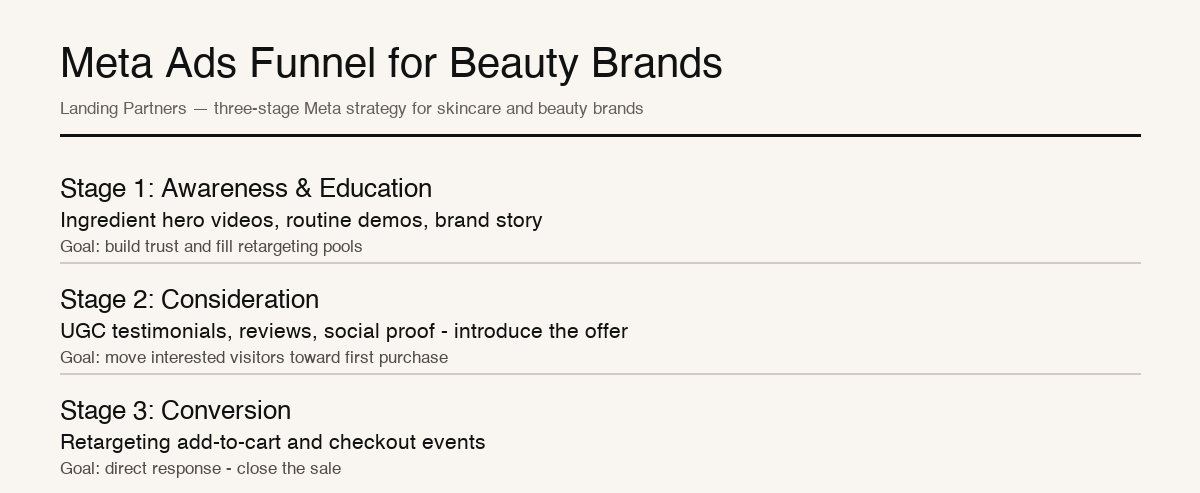
A beauty brand's Meta funnel typically has three distinct stages. Running direct-response creative to cold audiences - the most common mistake we see - collapses these stages into one and wastes budget on audiences that aren't ready to buy.
Stage 1: Awareness and education
Reach cold audiences with ingredient hero content, routine demonstrations, and brand story. Goal: earn trust and build retargeting pools. No aggressive CTA at this stage. The metric that matters here is not ROAS - it's video view rate and landing page traffic quality.
Stage 2: Consideration
Retarget video viewers and page visitors with UGC testimonials, reviews, and social proof content. Introduce the offer here - starter kits, bundle pricing, first-order incentive. Goal: move the interested but unconverted prospect toward the first purchase.
Stage 3: Conversion and retention
Retarget add-to-cart and checkout initiated events with direct-response messaging. Urgency works at this stage if it's real - limited stock, end of a promotion. Goal: close the first purchase and hand the customer off to your email flows for retention.
When Is a Beauty Brand Ready to Scale Meta?
The conditions we look for before recommending that a beauty brand scales its Meta spend:
Your webshop converts organic and email traffic above your category baseline - if it doesn't, paid acquisition will amplify the problem, not fix it
You have at least 20 to 30 reviews on your core products - beauty buyers check reviews before purchasing, and a product page with 2 reviews will not close cold traffic
Your product photography and lifestyle imagery are strong enough to compete in a visual feed - weak imagery is a conversion killer in beauty
You have a basic email capture and welcome flow in place - Meta spend without email retention means you pay for every repurchase. See our Klaviyo benchmark data to set realistic expectations.
You have at least one UGC or video creative asset ready - beauty brands that launch Meta with only static product images are starting at a disadvantage
Your copy and creative library has been reviewed for compliance - one account flag early on can stall your entire growth phase
If you're missing any of these, the right move is to fix the foundation first. It's a harder conversation to have, but it's what we tell every beauty brand we onboard.
Want us to look at where your beauty brand actually stands before you scale? Book a free webshop and ad account review - no pitch, just honest feedback on what needs to happen first.
Frequently Asked Questions
Every beauty brand's Meta situation is different. Your ROAS targets, creative strategy, and funnel structure all depend on your margin, price point, review base, and growth stage. What works for a premium multi-step skincare brand is not what works for a single-hero-product launch.
If you want to know what the right Meta approach looks like for your specific beauty brand, book a free call with us. We'll review what you're running and give you a clear picture of what to change and in what order. For the Google Shopping and PMax side of your beauty brand's channel mix, see our guide to Google Ads for beauty and skincare brands.