TikTok Shop for Fashion Brands in Europe: How to Set Up, Sell, and Scale

Key Takeaways
- •TikTok Shop and TikTok Ads are two different systems. One drives discovery, the other enables direct in-app purchase. Brands that treat them identically will underperform both.
- •In Europe, TikTok Shop is live in the UK and actively rolling out in Belgium and the Netherlands in 2026. Early movers have a structural advantage.
- •Fashion categories that perform: accessible price points (under €80), impulse-friendly products, strong visual appeal on a 9:16 screen. Luxury and high-AOV categories do not convert well in-app.
- •LIVE shopping works for fashion - but only when you have the right presenter and enough product variety. Without both, skip it.
- •The smartest approach runs TikTok Shop and Meta in parallel: different funnel stages, same audiences. Not competitors - complements.
TikTok Shop arrived in Europe with less fanfare than it deserved. Most fashion founders we talk to have heard of it, but very few have a clear picture of what it actually is, how it differs from TikTok Ads, and whether it makes sense for their brand right now.
That ambiguity is creating a gap. A small number of early-moving fashion brands are capturing real in-app revenue - while the majority are either ignoring TikTok Shop entirely or running it incorrectly and drawing the wrong conclusions.
We run TikTok campaigns for fashion clients across Belgium, the Netherlands, and the UK. This is what we are seeing.
TikTok Shop vs. TikTok Ads: Two Different Systems
The confusion starts here. TikTok Ads and TikTok Shop both live inside the TikTok app, but they operate in fundamentally different ways.
TikTok Ads is the paid advertising system. You create campaigns, set budgets, and drive traffic to your website or Shopify store. The purchase happens off-platform. Attribution flows through the TikTok Pixel. This is what most fashion brands already do.
TikTok Shop is a native commerce layer built directly into TikTok. Products are listed inside the platform. Consumers browse, add to cart, and complete the purchase without ever leaving the app. Inventory, orders, and fulfilment are managed through TikTok's Seller Centre backend.
The critical difference: with TikTok Shop, the friction of leaving the app disappears. For impulse-driven fashion categories - accessories, jewellery, trend pieces under €60 - this frictionless purchase path can meaningfully improve conversion compared to sending traffic to a website.
For higher-consideration products - premium fashion at €150+, luxury, or items that require detailed fit information - TikTok Shop's in-app checkout typically underperforms. Buyers want the reassurance of a full product page, reviews, and a familiar store environment.
Both systems can and should run simultaneously. But they serve different purchase intents, and the creative you build for each needs to reflect that.
Based on our client data: TikTok Shop outperforms website click-through for fashion products under €80 AOV with strong visual appeal. Above €120 AOV, directing traffic to the website consistently wins.
TikTok Shop in Europe: What Is Actually Available in 2026
TikTok Shop launched in the UK in 2023 and has been expanding steadily across Europe. As of mid-2026, here is the realistic picture.
United Kingdom: Fully live. TikTok Shop UK is mature - seller tools are robust, affiliate creator programmes are active, and fashion is one of the top-performing categories. UK fashion brands not on TikTok Shop are already operating at a disadvantage.
Belgium and the Netherlands: In active rollout. We are working with brands in both markets who have early access. The product catalogue and checkout functionality are live, but some seller tools - particularly the affiliate creator marketplace - are still rolling out. Brands that register now will be positioned before the general availability push.
Germany, France, and Italy: Phased expansion expected in the second half of 2026. No confirmed dates, but TikTok has been hiring aggressively in these markets.
If your brand ships to the UK, setting up TikTok Shop UK is a straightforward decision in 2026. If you are based in Belgium or the Netherlands and can access early seller registration, set it up now. The advantage window will not stay open.
Not sure if TikTok Shop is the right next step for your brand right now? Book a free call - we will give you a straight answer based on your product, price point, and current channels.
Which Fashion Products Actually Sell on TikTok Shop
Not every fashion product is a good TikTok Shop candidate. We have seen enough early data to give clear direction.
Strong performers on TikTok Shop:
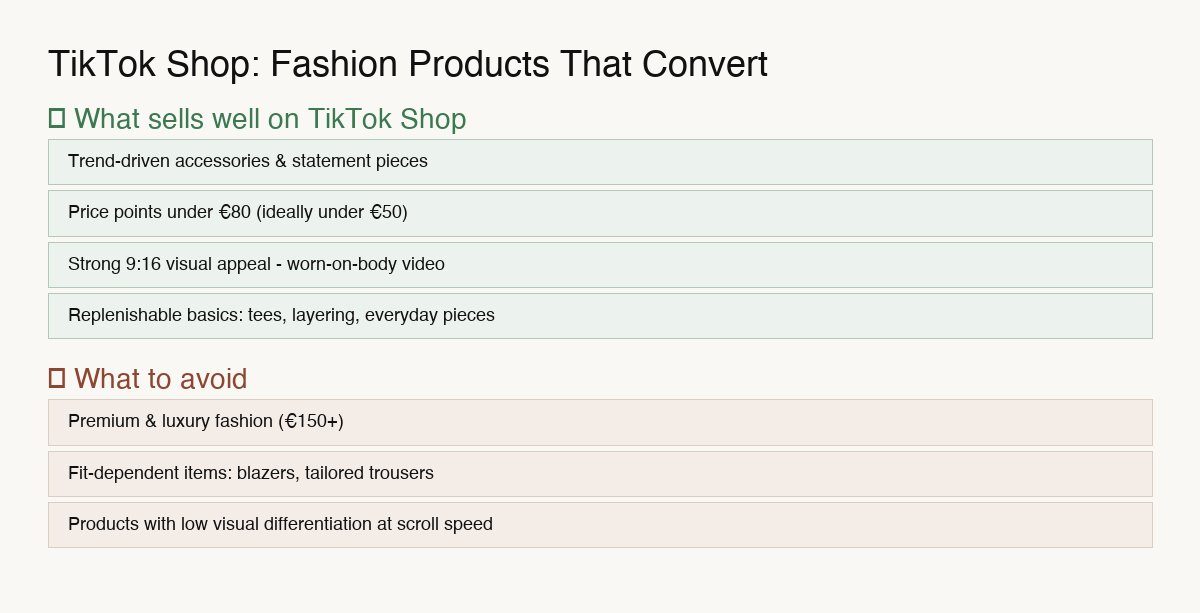
Trend-driven items perform well - seasonal accessories, statement pieces, and colour-of-the-moment styles. The TikTok feed is a trend accelerator. If a product is already getting organic traction, TikTok Shop amplifies purchase intent before the trend fades.
Accessible price points convert. Under €80, ideally under €50 for true impulse purchases. At these levels, in-app checkout removes real friction that a website redirect would kill.
Products with strong 9:16 visual presence work. Items that film and photograph well on a vertical mobile screen - worn-on-body video, close-up texture shots. Flat lay and editorial content performs significantly worse in-app than lifestyle video.
Replenishable basics also hold up well - plain tees, everyday accessories, layering pieces. These benefit from TikTok's repeat purchase mechanics and are a natural fit for the affiliate creator model.
Weaker performers on TikTok Shop:
Premium and luxury fashion (€150+) consistently underperforms in-app. Buyers want reassurance that TikTok's checkout experience does not fully provide. High return rates are also harder to manage through TikTok Shop's logistics layer.
Fit-dependent categories - structured blazers, tailored trousers, items where sizing is complex - generate higher in-app return rates. Without accurate size guides embedded in your Shop product listing, this compounds quickly.
Products with low visual differentiation at scroll speed struggle. If a viewer cannot identify what they are buying in the first two seconds of a video, they will not buy it.
The single strongest predictor of TikTok Shop conversion we have seen across fashion clients: a viewer can identify the product - material, colour, fit category - within the first three seconds of the video, at full scroll speed. Everything else is secondary.
LIVE Shopping for Fashion: When It Works, When It Does Not
LIVE shopping is TikTok Shop's highest-performing format and the most misunderstood. A brand goes live, presents products in real time, and viewers can purchase directly from the stream without leaving the app.
In the UK, LIVE shopping fashion brands are generating serious revenue. We have observed sessions from fashion brands - run by founders or hired presenters - that move between 50 and 200 units in a two-hour live. The variables that determine success are not complicated, but they are non-negotiable.
What makes LIVE shopping work for fashion:
A presenter with personality, not just product knowledge. Audiences follow people. The best performing LIVE sessions feel like shopping with a friend who genuinely knows the brand. Scripts and stilted presenting kill the format immediately.
Enough product variety to sustain momentum. You need a minimum of 15 to 20 SKUs to keep a session moving for 90 minutes. Running a LIVE with 4 or 5 products is not a LIVE - it is a product demo, and audiences will leave within ten minutes.
Urgency or exclusivity built into the session. LIVE-only pricing, limited stock drops, or session-exclusive bundles drive the in-stream purchase impulse. Without urgency, viewers watch without buying.
Consistency over one-off events. TikTok's algorithm rewards regular LIVE sessions. Brands going live twice a week build cumulative audiences that follow and convert. One-off sessions rarely break through.
When to skip LIVE shopping: if you do not have someone who can present on camera with energy and genuine product knowledge, do not start. A low-energy live session actively damages brand perception. Build the presenter capability before committing to LIVE.
If you are considering LIVE shopping and unsure how to structure it, we help fashion brands build their TikTok Shop strategy from setup through to the first live session. Book a free call to talk through your setup.
Creative Briefing for TikTok Shop: Different From Regular TikTok Ads
Most brands repurpose their TikTok ad creative for TikTok Shop. This is a mistake. The formats look identical - vertical, short-form video - but the purchase intent and mechanics are fundamentally different.
In a TikTok Ad, the video is a hook. Its job is to stop the scroll and drive a click to your website. The website does the actual selling.
In TikTok Shop, the video is both the hook and the store. The viewer needs to understand the product, trust the seller, and make a purchase decision in the same session - without visiting your website.
What this means for your creative brief:
Product clarity above everything. Show the item from multiple angles in the first five seconds. Fit, texture, colour accuracy - if a viewer has to guess what they are buying, they will not buy it. The product must be the unambiguous subject of the video.
Seller credibility replaces website trust signals. On a website, a buyer is reassured by reviews, returns policy, and brand imagery. On TikTok Shop, that trust comes from the person presenting the product. Authentic, unpolished content often outperforms high-production video here - because it feels like a real recommendation, not an ad.
Include the price explicitly on screen. TikTok Shop content that shows pricing in-video converts measurably better. Viewers who know the price before tapping are higher purchase intent.
End with a direct purchase call to action. Saying 'tap the product below to buy' is not cringe - it converts. TikTok Shop content is retail content, and it should close like retail.
For organic and affiliate creator content, brief creators differently than you would for Spark Ads or brand awareness campaigns. The objective is a purchase in the session - not brand discovery.
TikTok Shop + Meta: Running Both Channels in One Funnel
TikTok Shop and Meta Ads are not competing for the same job. Used together, they serve different parts of the same purchase funnel - and the fashion brands getting the best combined results understand this clearly.
Discovery - TikTok organic and Spark Ads: Fashion content on TikTok drives initial product discovery. A new collection piece gains organic traction, a creator affiliate post reaches a new audience, or a LIVE session builds a following. This is top-of-funnel, and it is TikTok's structural strength.
Consideration and retargeting - Meta Ads: Viewers who discover a product on TikTok will often visit the website before purchasing. Meta's retargeting captures that intent - website visitors, video viewers, and product page browsers become addressable audiences via the Meta Pixel. A well-structured Meta retargeting campaign converts the warm traffic that TikTok generates.
In-app impulse purchase - TikTok Shop: For the right product categories, TikTok Shop captures the in-session buyer who would not click through to a website. This buyer segment is additive, not cannibalistic - these are purchases that would not have happened via your website.
The practical setup: run Meta for retargeting and prospecting at scale. Use TikTok organic and paid to generate discovery and feed TikTok Shop. Use attribution data from both platforms to understand where each channel actually sits in the path to purchase - not just what each platform claims to have driven.
Fashion brands running TikTok Shop alongside Meta retargeting consistently show a lower blended CAC than brands running either channel alone. Discovery and conversion are different jobs. Let each platform do the one it is built for.
Early Results From Fashion Brands That Moved First
We are careful about presenting early data as benchmarks - TikTok Shop in Europe is still maturing, and what works in the UK today may look different in Belgium and the Netherlands as the platform develops. But directionally, here is what we observe.
The fashion brands getting the best early results share a few traits. They moved fast - setting up TikTok Shop before the broader market caught up, when affiliate creators were less expensive and organic reach was higher. They picked the right products - a curated selection of items under €70 with strong visual appeal, not their full catalogue. And they committed to consistency - regular LIVE sessions, Shop-specific video content, and a structured creator briefing process.
Patterns we are seeing across clients:
TikTok Shop performs significantly better when it runs alongside an active TikTok organic presence. Brands with no organic TikTok content see weaker in-app conversion across the board.
Affiliate creators - micro-influencers with TikTok Shop commission links - are outperforming brand-owned content in several product categories. The authenticity gap is real, and the economics work when commission rates are managed correctly.
Return rates on TikTok Shop orders are higher than website orders in fit-dependent categories. Building accurate size guides into product listings is not optional - it directly affects your net margin per in-app order.
The brands that struggled early listed their full catalogue without curation, used website-format creative without adapting it, and expected in-app conversion without building any TikTok audience first.
If you are a fashion brand in Belgium or the Netherlands, the advantage window is genuinely open right now. In 12 months, TikTok Shop will be significantly more competitive in these markets.
Every brand's situation is different. Whether TikTok Shop makes sense for you depends on your product, price point, current TikTok presence, and operational setup. If you want a straight answer for your specific brand, book a free call with our team.