
Every ad channel claims credit for your sales. Meta reports a 4.2x ROAS. Klaviyo shows 28% of revenue from email. Google says it drove 340 conversions last month. Add them up and you are generating 180% of your actual revenue. This is the attribution problem - and it affects every fashion brand running multi-channel marketing.
Why Attribution Is Especially Hard for Fashion Brands
Fashion buyers rarely convert in a straight line. A customer might discover your brand on Instagram, search your brand name on Google two days later, click an email campaign three days after that, and then purchase directly. Every platform that touched that journey wants full credit.
This is the multi-touch attribution problem. It is not unique to fashion - but fashion makes it worse for several reasons.
Decision cycles are longer for fashion than for commodity products
A 200 euro dress is a considered purchase. The customer needs to be sure about fit, quality, and price. They might visit your site four or five times before buying. Each visit resets attribution clocks differently depending on which platform is measuring.
Fashion has strong seasonality - and platforms take credit for it
In peak periods - January sales, summer sales, BFCM - organic demand spikes. Customers who were already planning to buy will purchase regardless of whether your ads were running. Meta and Google both claim credit for those purchases. This makes every channel look better during peaks and worse during low periods. Your ROAS should be seasonal - if it looks flat year-round, something is wrong with how you are measuring.
iOS 14+ broke the tracking infrastructure
Since Apple's App Tracking Transparency update, Meta lost visibility on a significant share of iOS conversions. Meta responded with Aggregated Event Measurement and modelled conversions - estimates of what they think happened based on statistical patterns. These models are sometimes accurate, sometimes not.
Across our client base, we regularly see Meta report 20-40% more conversions than Shopify direct data in some accounts - and 20-30% less in others, depending on the iOS mix of the audience.
The honest answer: Meta over-attributes in some cases and under-attributes in others. The direction of the error is not predictable. This is not a reason to ignore Meta - it is a reason not to manage your business to Meta's reported ROAS alone.
Not sure what your real Meta performance looks like before or after iOS impact? Book a free campaign audit and we will show you the gap between what Meta reports and what your Shopify data actually shows.
The Problem with ROAS as Your Primary Metric
ROAS is easy to manipulate. Not fraudulently - but structurally. And that is a problem when you are using it to make budget decisions.
If you set your attribution window to 7-day click and 1-day view, your ROAS will look higher than on a 1-day click window. If you optimise campaigns for Add to Cart instead of Purchase, Meta reports more activity against cheaper events. If you run retargeting campaigns to your own email list, you will see high ROAS because you are targeting people who were already going to buy.
None of this is dishonest. It is how the system works. But it means ROAS is only meaningful when you know exactly how it was calculated - and what you are comparing it against.
Every agency can make ROAS look good if that is what they are optimising for
This is something we tell every new client: we report ROAS, but we do not manage to it as the primary metric. An agency that optimises for reported ROAS above all else will find ways to make the number look good without necessarily growing your business.
The metric that is much harder to inflate: Marketing Efficiency Ratio.
MER = Total ad spend / Total revenue. Cross-channel, simple, and almost impossible to inflate. If your MER is 0.12, you are spending 12 cents in ads for every euro of revenue. Add a channel and watch the MER. If it drops, the channel is earning its place.
How We Measure Attribution Across Our Client Base
Across 40+ fashion brands, we use a three-layer approach. Each layer serves a different purpose - and using the wrong layer for the wrong decision is where most attribution errors happen.
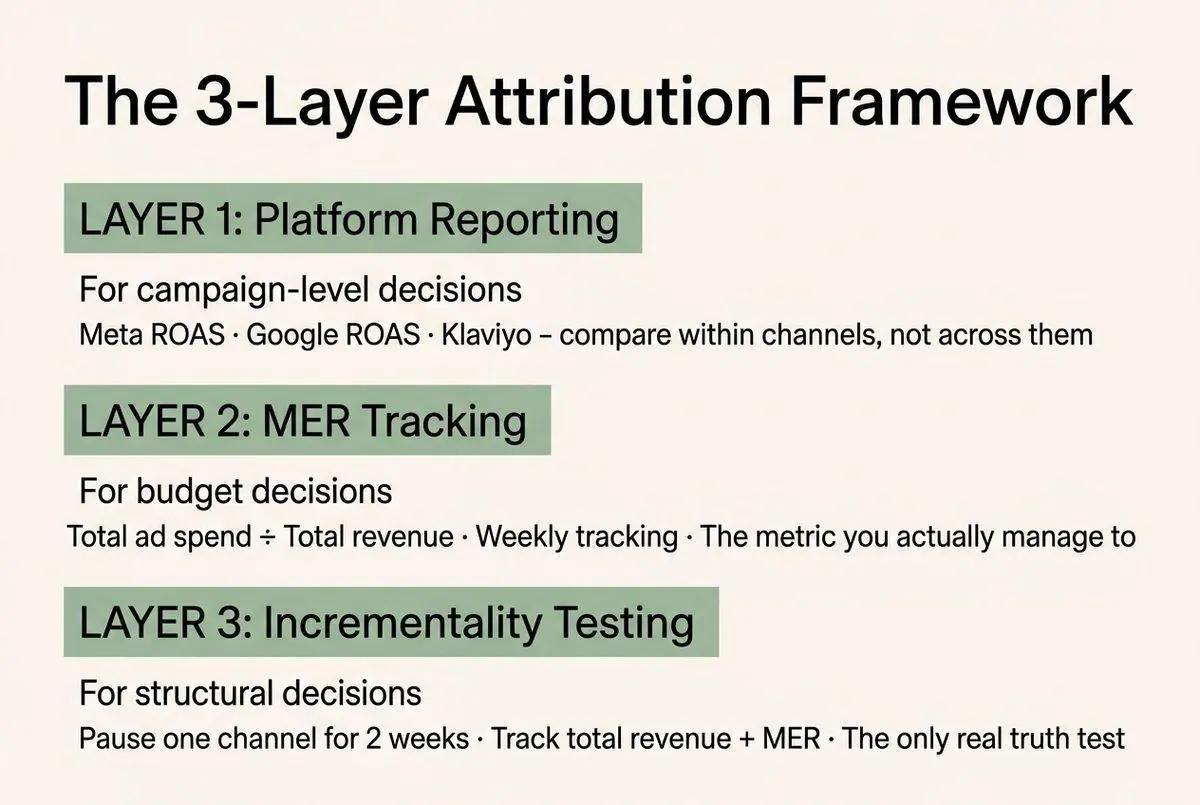
Layer 1: Platform reporting (for campaign-level decisions)
We look at Meta ROAS, Google ROAS, and Klaviyo revenue to understand which campaigns and ad sets are performing relative to each other inside each platform. Platform reporting is useful for relative comparison within a single channel - not for understanding cross-channel contribution.
A Meta ad set with 3.2x ROAS is probably better than one running at 1.4x, within the same attribution window and campaign type. That comparison is valid. Comparing Meta's reported 3.2x ROAS against Klaviyo's reported 28% revenue share is not.
Layer 2: MER tracking (for budget decisions)
Before adding a new channel, increasing total budget, or pausing a channel, we look at the weekly MER. This is the number that tells you whether your marketing as a whole is generating more revenue than it costs.
Build a simple MER tracker in a spreadsheet: week, Shopify total revenue, total ad spend across all channels, MER. Run it for 8 weeks and you will see patterns that no platform report will show you.
Layer 3: Incrementality tests (for structural decisions)
The only reliable way to know if a channel is truly driving incremental revenue is to remove it and see what happens. We do this methodically - pausing a channel for 2 weeks, watching total revenue and MER, then making a data-based decision.
Most fashion brands spending 5,000 euros or more per month on ads have never run a proper incrementality test. It feels risky to pause a channel. But without it, you are making budget decisions on assumptions. Book a free strategy call and we will walk you through how to structure one for your brand.
Klaviyo Attribution: The Inflation Problem
Klaviyo's default attribution is a 5-day click and 1-day open window. Any purchase within 5 days of an email click gets credited to Klaviyo - even if that customer was already planning to buy.
This creates a specific problem for campaigns.
When you send a promotional campaign to your full list, you are reaching customers with high existing purchase intent. Many of them were planning to buy in the next week regardless. Klaviyo then credits their purchase to your campaign. The revenue numbers look strong. But the question is: how much of that was actually incremental?
Flows are more defensible than campaigns
Klaviyo flows - welcome series, abandoned cart, post-purchase, win-back - are triggered by specific behaviours. An abandoned cart email recovers a purchase that was at risk of not happening. That is incremental. A campaign sent to your full list on Tuesday morning is capturing purchases that may have happened on Thursday anyway.
The practical implication for how you read your Klaviyo data
Do not cut your email budget based on inflated campaign attribution numbers, and do not increase send frequency because campaigns 'perform well' in the attribution window. Measure your email programme by flow-specific metrics: open rate, click rate, and revenue per recipient per flow. Those numbers are far more signal than noise.
Across our Klaviyo accounts, flow revenue typically represents 60-70% of total Klaviyo-attributed revenue. That portion is the more defensible incremental contribution. Campaign attribution - especially during peak send periods - regularly overstates incremental impact by 30-50%.
Building Your MER Dashboard
You do not need an expensive attribution tool to get a much clearer picture. Here is the setup we use with clients at every budget level.
Weekly MER tracker
In a simple spreadsheet, track each week: Shopify total revenue, total ad spend across all channels (Meta + Google + TikTok), MER (spend/revenue), and one line of notes on what changed - new campaign, product drop, paused a channel. Run it for 8 weeks and patterns will emerge that no platform report will show you.
Channel traffic composition via GA4
In Google Analytics 4, use the traffic source / medium report to understand what share of sessions comes from each channel. Do not use GA4 as an attribution source of truth - but use it to track whether paid social is growing as a share of traffic, whether direct traffic is holding, whether organic is contributing more or less than 6 months ago.
First-touch source for new customer acquisition
Use UTM parameters consistently on every ad, email, and link you share. In Shopify, you can track the first-touch source for each customer. For new customers specifically - which are the most valuable long-term - first-touch attribution is more meaningful than last-click. A customer who found you via a Meta ad and purchased through an email click three days later: Meta initiated it, email closed it. Both earned credit.
When to invest in third-party attribution tooling
Tools like Triple Whale, Northbeam, or Rockerbox add de-duplicated attribution that is cleaner than platform self-reporting. The right time to invest is when your total ad spend crosses 5,000-7,000 euros per month. Below that threshold, the tool cost and setup time outweigh the benefit.
We do not recommend third-party attribution tools under 500K euros in annual revenue. Above that, the improved data quality typically pays for itself in better budget decisions within 2-3 months.
Attribution at Different Brand Stages
Your attribution framework should match your scale. Investing in sophisticated tooling before you have the data volume to support it is a waste of time and money.
Under 500K euros revenue: MER tracking in a spreadsheet is enough
At this stage, you probably have one or two ad channels and Klaviyo. Build your MER tracker. Focus on whether the overall marketing machine is generating more than it costs. Do not invest time in multi-touch attribution models - the data volume is not there to make them statistically meaningful.
500K to 2M euros revenue: add channel isolation tests
At this stage, you likely have Meta, Google, and Klaviyo running simultaneously. Attribution confusion gets expensive here. A 20% over-attribution in Meta at this scale can mean you are spending 30,000 euros more than you should per year. Run quarterly incrementality tests on each channel.
2M euros and above: invest in proper tooling
At this scale, inaccuracy in platform reporting translates to material budget misallocation. Third-party attribution tools start paying for themselves clearly. The error margin in your current data is costing you more than the tool.
Attribution is one of the most expensive problems in fashion marketing to get wrong. Misreading your data leads to overspending on channels that are not working and underinvesting in ones that are. The good news: you do not need perfect attribution. You need a consistent framework, a reliable primary metric, and the discipline to test before committing. Every brand's setup is different. If you want to understand what your channels are actually contributing - book a free strategy call and we will review your current attribution setup together.