
Most fashion brands are sitting on a data problem they don't know they have. They can track clicks, impressions, and purchases. But they don't know why someone buys, what they're actually looking for, or when they're likely to come back.
Zero-party data is the most underused lever in fashion marketing right now. Most brands observe their customers. Very few ask them what they actually want. The ones that do are building a compounding advantage that paid acquisition alone can never create.
What Zero-Party Data Actually Means
Let's get specific. Data in fashion marketing falls into four categories:
Third-party data is data purchased from external sources - interest categories, demographic lists, behavioral segments from data brokers. Privacy regulations have made this increasingly unreliable, and Meta and Google have moved away from it as a targeting lever.
Second-party data is another company's first-party data shared through a partnership. Rare in fashion, but it exists in platform data agreements and marketplace sharing arrangements.
First-party data is data you collect through customer behavior - website visits, email opens, purchase history, ad clicks. Valuable, but observational. You're inferring intent, not being told it.
Zero-party data is data customers deliberately and proactively share with you. It's not inferred. They told you. Style preference: 'I prefer minimalist basics.' Size: 'I'm a 38.' Shopping intent: 'Looking for occasion wear, not everyday.' This is the highest-signal data available.
The key difference: first-party data tells you what someone did. Zero-party data tells you who they are and what they want.
Zero-party data carries the highest predictive value of any data type because it represents declared intent - not inferred behavior. A customer who tells you they want minimalist styles is a more reliable signal than someone who clicked a minimalist-style ad once.
Why Fashion Brands Need This Now
Three forces have made zero-party data more important than it was three years ago.
Signal loss from iOS restrictions and cookie deprecation has reduced the accuracy of behavioral tracking. When a customer doesn't accept tracking on their iPhone, Meta loses the signal. Your first-party data gaps grow. Zero-party data bypasses this entirely because it lives in your own systems - in Klaviyo, in your tech stack, in your customer profiles. No platform permission required.
Personalisation expectations have increased. The brands your clients compete with are getting better at personalisation. Generic email blasts and one-size-fits-all ads are performing worse as customers raise their standards. If you're sending the same welcome email to someone who bought a €250 jacket and someone who bought a €40 t-shirt, you're leaving performance on the table.
Ad costs are rising. When advertising costs increase, efficiency becomes the competitive edge. Better data means you spend smarter - matching the right message to the right person at the right time. Brands with strong zero-party data sets can build tighter Meta custom audiences, which improves ad relevance and lowers CPM.
Is your brand collecting the right data from your customers? Book a free strategy call and we'll look at your current setup together. Book a free call
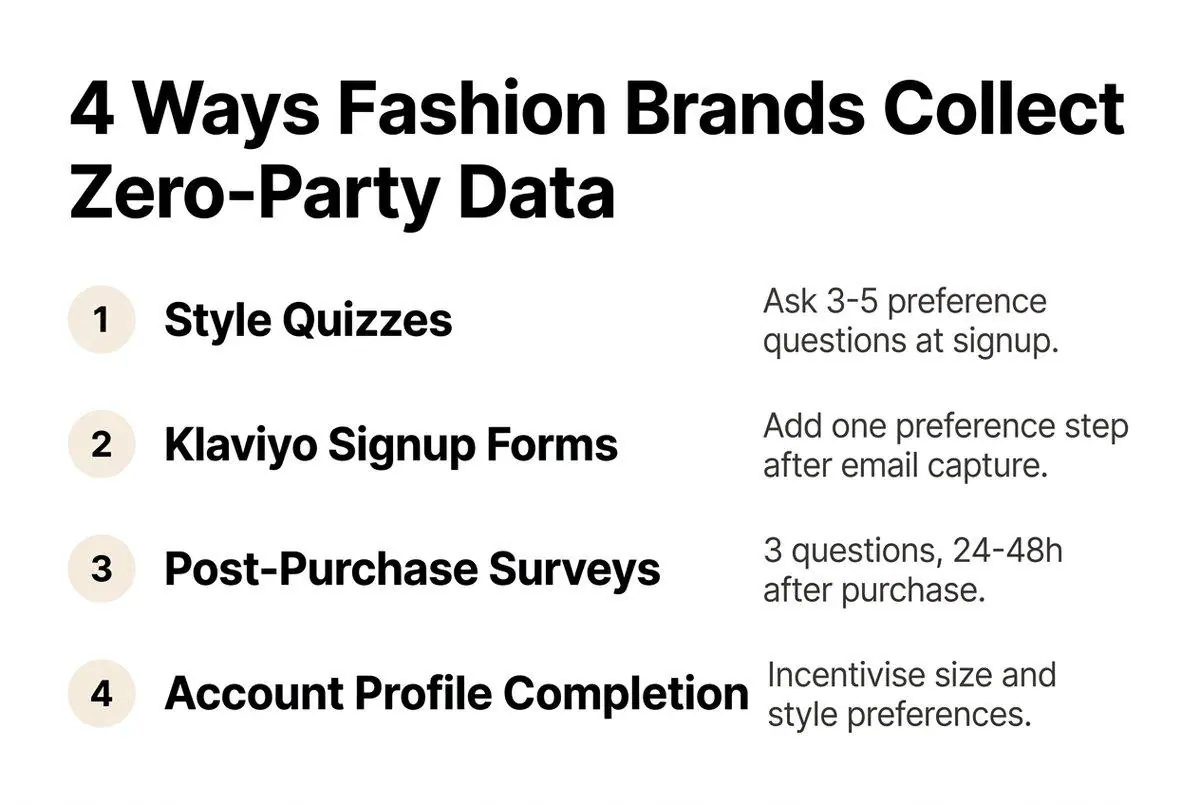
Four Ways Fashion Brands Collect Zero-Party Data
1. Style and product quizzes
A well-designed quiz is the single most effective way to collect zero-party data at scale. Beauty and supplement brands use this well - fashion brands are underusing it.
A fashion quiz might ask: What's your typical style? (minimalist / statement / streetwear / classic), What occasion do you primarily shop for? (everyday / work / going out / events), What's your typical size range?
The answers go directly into Klaviyo profile properties, which then power personalised flows and segments. The rule: keep it under five questions. Every additional question reduces completion rate significantly.
2. Klaviyo signup forms with preference capture
Your email popup doesn't have to be just 'enter your email'. With Klaviyo's multi-step signup forms, you can add one preference question after the email is captured. Something simple: 'What do you mostly shop for?' with three or four options.
This one question creates a segmentation variable you can use across all future flows - welcome series, post-purchase, win-back. We typically see higher-quality subscribers from forms that include a preference step, because the customer is making an active choice to share information - a signal of higher intent.
3. Post-purchase surveys
The purchase moment is when your relationship with a customer begins. A short post-purchase survey - three questions, delivered via email 24-48 hours after purchase - gives you context you can't get from behavioral data alone.
Useful questions: How did you hear about us? What made you decide to buy (for first-time buyers)? What were you shopping for when you found us? This data feeds attribution modeling, Klaviyo profile data, and future campaign messaging.
4. Account profile completion
For brands with customer accounts on Shopify, prompt customers to complete their profile with size preferences, style interests, and birthday. Incentivise this with a small discount on the next purchase.
Profile completion creates a persistent, updatable zero-party data record that improves over time as the customer returns and refreshes their preferences.
In our experience, fashion brands that add even a single preference question to their Klaviyo signup form see meaningful segmentation lift in their welcome series - without any additional spend.
How to Use Zero-Party Data in Your Marketing
Personalised Klaviyo flows
Klaviyo's conditional splits let you branch flows based on profile properties. A customer who said they prefer minimalist styles gets a welcome series with different product highlights than someone who said they prefer bold statement pieces.
At a basic level, this is simple to implement: one conditional split, two content branches. The impact on open rates, click rates, and flow revenue is measurable within two to three months.
At a more advanced level, you can combine zero-party and first-party variables - style preference plus purchase frequency plus last category bought - to build flows that adapt dynamically as the customer relationship deepens. For a deeper look at what a complete Klaviyo flow setup looks like, we've covered that in detail.
Meta custom audiences
Export your Klaviyo segments - built on zero-party data - to Meta as custom audiences. A segment of customers who identified as 'shopping for occasion wear' is a tighter, higher-intent audience than a broad interest targeting set.
This is how zero-party data bridges email and paid media. The same preference data that personalises your Klaviyo flows also sharpens your Meta ad targeting. When your audience is more precisely defined, relevance goes up and wasted impressions go down.
Creative matching
When you know what a customer wants, you can match your ad creative to their stated preference. A customer who said 'minimalist styles' should see your cleaner, more pared-back creative variants - not your boldest campaign imagery. This requires a systematic tagging approach to your creative library, but the result is better relevance and lower wasted spend.
Want to see how zero-party data could improve your Klaviyo performance and Meta targeting? We'll walk through your current setup and identify where personalisation would have the biggest impact. Book a free strategy session
The Practical Klaviyo Setup
Here's what a working zero-party data setup in Klaviyo looks like for a fashion brand.
Custom profile properties
Create custom properties in Klaviyo for each data point you're collecting: style_preference (minimalist / statement / streetwear / classic), shopping_for (everyday / work / occasion / gifting), size (XS/S/M/L/XL or EU sizing), survey_completed (true/false - prevents resending the ask).
These properties can be set via Klaviyo signup forms, embedded quizzes using hidden fields, post-purchase survey flows, or direct API calls from your Shopify backend.
Segment logic
Build segments based on profile properties: minimalist shoppers, occasion buyers, high-intent new subscribers who've completed preferences. These segments feed into both Klaviyo flows and Meta custom audiences.
Keep the data clean
Zero-party data degrades if you don't maintain it. Customers' preferences change. Build a re-engagement touchpoint - six to twelve months after last preference update - that asks: 'Your style has probably evolved - update your preferences.' This keeps data fresh and doubles as a re-engagement moment.
What Not to Do
Collecting data you never use
This is the most common mistake we see. You add a preference question to your signup form. Customers answer it. You look at the data in Klaviyo, think 'great' - and then send the same broadcast to everyone anyway.
If you collect it, use it. Every unused data point is a missed personalisation opportunity and a missed reason to earn the customer's trust.
Asking too many questions at once
A ten-question onboarding quiz feels like homework. Five is already pushing it. Start with one or two high-value questions, build the infrastructure to use those answers, then expand. Sequence matters more than completeness.
Using vague answer options
'What's your style?' with options like 'Trendy', 'Classic', 'Bold' sounds useful but maps to nothing in your product catalog. Design your preference options around actual product categories or collections in your store.
Treating it as a one-time collection
Zero-party data needs to be maintained. A preference captured at signup is accurate on day one. At month twelve, it may be stale. Build in preference refresh moments - seasonal, post-purchase, or triggered by a behavioral change.
The most common failure mode we see: brands collect preference data through a signup form but never use it in their flows. The data sits unused in Klaviyo profile properties while generic broadcasts go to everyone. Collection without activation is wasted infrastructure.
Every brand's situation is different. The right zero-party data strategy depends on your product range, your Klaviyo list size, and where you are in your growth journey. If you want to understand what makes sense for your specific brand - book a free call and we'll look at it together.