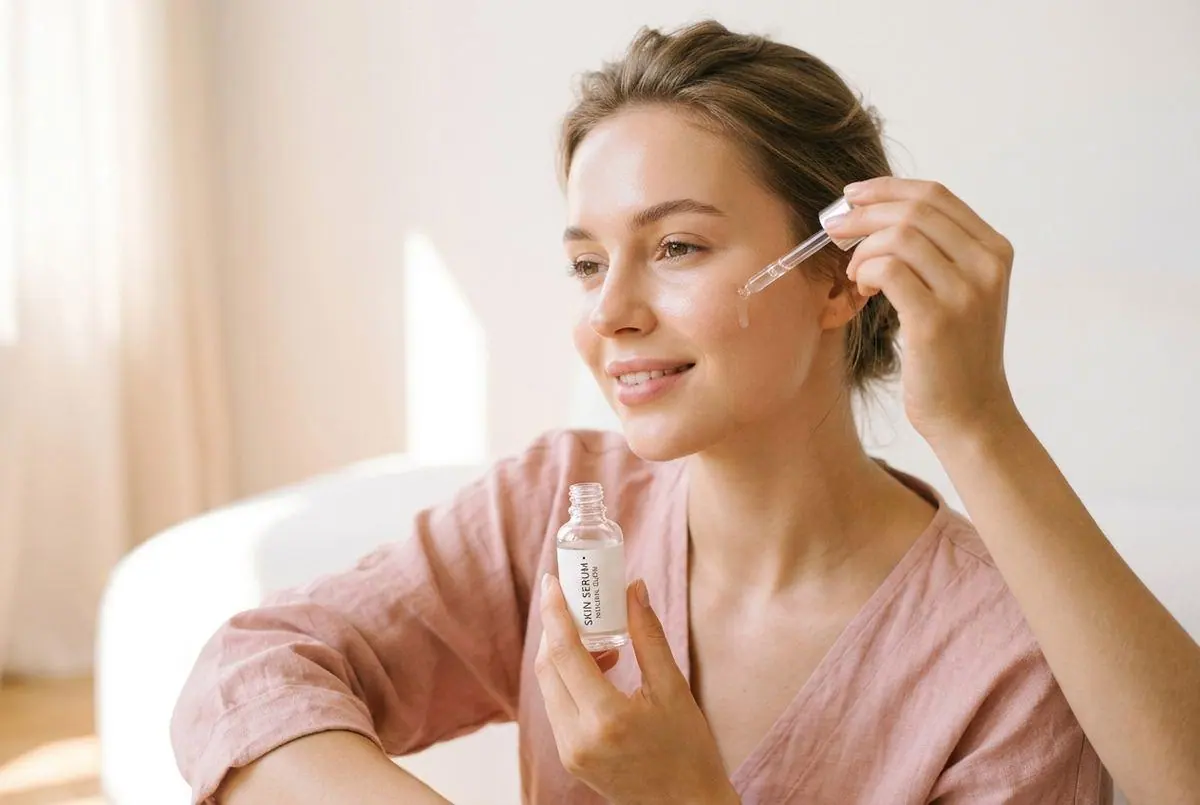
If your beauty brand sends the same welcome email to a 45-year-old focused on anti-aging and a 22-year-old dealing with breakouts, you are leaving revenue on the table. A skin quiz fixes that.
Why a Skin Quiz Is the Best Lead Capture Tool for a Beauty Brand in 2026
Most beauty brands capture email the same way: a 10% discount popup. It works - but it treats every subscriber identically. You get a list. Not an audience.
A skin quiz does something fundamentally different. It captures declared intent: what the subscriber actually wants from their skincare. That data is yours. It does not rely on pixel tracking. It does not disappear when cookies change. And it creates segmentation logic that makes every email, flow and ad more relevant.
The result is not marginal. Across beauty clients we work with, brands using concern-based Klaviyo segmentation from quiz data consistently see higher email revenue per recipient compared to brands sending to unsegmented lists.
Zero-party data - data a customer deliberately and proactively shares - is particularly valuable in beauty because the purchase decision is deeply personal. Skincare is not one-size-fits-all. A product that transforms one person's skin can be completely wrong for another. When your Klaviyo segments reflect that reality, your email program stops guessing.
This matters more in 2026 than it did two years ago. As third-party cookie deprecation progresses and Meta's signal quality fluctuates, the brands that build direct declared data from their own audience have a structural advantage - in email, in retargeting, and in Lookalike audience quality.
The 5 Quiz Questions That Create the Most Useful Klaviyo Segments
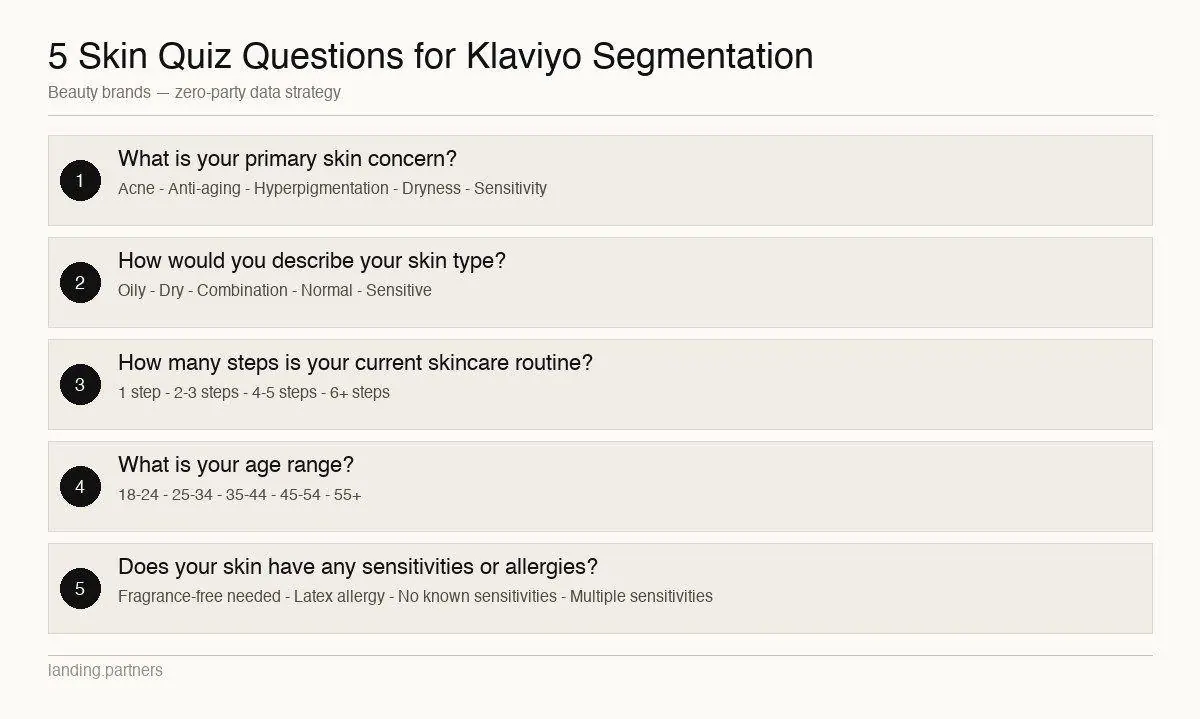
Not all quiz questions produce equal segmentation value. After implementing quizzes for beauty clients, these five questions consistently deliver the most actionable Klaviyo data.
Question 1: What is your primary skin concern?
This is the highest-value question in any skin quiz. The answer creates your most powerful segment: the concern-based flow trigger.
The options that generate the most useful distinct segments: acne and breakouts, anti-aging and fine lines, hyperpigmentation and uneven tone, dryness and dehydration, and sensitivity and redness. Each becomes a Klaviyo segment. Each triggers a different welcome and education sequence.
Question 2: How would you describe your skin type?
Oily, dry, combination, normal or sensitive. Combined with concern, this determines which specific product recommendations appear in dynamic content blocks within flows.
Question 3: How many steps is your current skincare routine?
This tells you how sophisticated the subscriber is. A person with a 1-step routine (cleanser only) needs a fundamentally different education sequence than someone already using a 5-step routine. The education level of your email content should match the routine complexity of the subscriber.
Question 4: What is your age range?
Age range serves two purposes: personalising product recommendations and informing Meta Custom Audience targeting. A brand selling both a retinol serum and a gentle hyaluronic cleanser needs to know which segment of their list is which age range to recommend the right product at the right moment.
Question 5: Does your skin have any sensitivities or allergies?
This is a trust-building question as much as a segmentation question. It signals that your brand takes individual skin health seriously - and prevents the mistake of recommending active ingredients to subscribers who have declared fragrance sensitivity or a history of reactions.
Beauty brands using concern-based Klaviyo segmentation from quiz data see higher email revenue per recipient than brands sending unsegmented welcome sequences - with no additional send volume required.
How to Connect Quiz Data to Klaviyo: Segments, Flow Triggers and Dynamic Content
The quiz is the front end. Klaviyo is where the value actually lives. Getting the integration right determines whether your quiz produces revenue or just a filled-in form.
The integration logic
When a subscriber completes a quiz, their answers need to write to Klaviyo profile properties. Not just to a tag. Profile properties allow dynamic content blocks, flow branching and audience suppression to work correctly.
If you are using Octane AI, profile properties sync natively to Klaviyo. If you are using Typeform, you need Zapier or a direct Klaviyo API connection to pass the responses as profile properties on the subscriber record.
Segment structure
Build your primary segments on the concern dimension: Skin Concern is Acne, Skin Concern is Anti-Aging, Skin Concern is Hyperpigmentation, and so on. These segments are your primary flow triggers.
Secondary segmentation layers (skin type, routine complexity) live as profile properties used for dynamic content inside flows - not as separate flows. Keeping the flow structure simple and using dynamic blocks for personalisation scales better than building one flow per concern-type combination.
Dynamic content blocks in Klaviyo
Within a flow, dynamic content blocks render different product recommendations, ingredient explanations and routine steps based on the subscriber's profile properties. A single flow can serve five different skin concern profiles without duplicating the flow structure.
This is where the revenue difference concentrates: the right product recommendation in email 3 of the welcome sequence, shown to someone who declared their concern, converts meaningfully better than a generic bestseller block.
Not sure how to structure your Klaviyo segmentation for a beauty quiz launch? Book a free call and we will map out the flow architecture for your specific brand.
Automated Flows per Skin Concern: How the Acne Subscriber Gets a Different Experience Than the Anti-Aging Subscriber
The core of quiz-driven Klaviyo is that concern-specific flows replace generic welcome sequences. Here is what that looks like in practice.
The acne and breakouts flow
Email 1 - Welcome and concern acknowledgment: You identified acne-prone skin. Here is what actually works - and what makes it worse. This email has the highest open rate in the sequence because it directly addresses the subscriber's declared problem.
Email 2 - Ingredient education: What causes breakouts (sebum, bacteria, inflammation) and what your products address about each mechanism. No medical claims. Ingredient transparency builds trust and reduces purchase hesitation.
Email 3 - Product recommendation: The specific product for acne-prone skin, with a skin type sub-variation for oily vs. dry acne-prone skin.
Email 4 - Routine builder: How to build a minimal but effective routine for breakout-prone skin. Cross-sell to a gentle cleanser if the subscriber only bought a spot treatment.
The anti-aging flow
The education sequence is longer here. Anti-aging results take time, and subscribers need to understand realistic timelines to stay engaged with the brand long enough to see results. An anti-aging Klaviyo sequence that does not set expectations is a churn machine.
Email 1 - Welcome and expectation setting: Real results take 60 to 90 days. Here is what to expect in week 1, month 1 and month 3. This email dramatically reduces early churn in the anti-aging segment.
Email 2 - Ingredient education: Retinol, peptides, vitamin C - what they do, in what order to use them, and why routine sequence matters.
Email 3 - Product recommendation with routine order included.
Email 4 - Results check-in and review request, sent at week 8. This is the most important email in the sequence for this segment - it re-engages subscribers at exactly the moment results should be appearing.
The hyperpigmentation flow
Hyperpigmentation is the most education-intensive concern. The subscriber needs to understand sun protection as much as they need to understand brightening ingredients. Email sequences for this segment consistently show higher click rates when sun protection education is a core component - not an afterthought.
Concern-specific welcome sequences in Klaviyo show meaningfully higher open rates and click-through rates compared to generic welcome flows - driven primarily by the relevance signal in the first email subject line.
Cross-Sell via Quiz Data: How to Personalise 'Complete Your Routine' Based on Concern Profile
After the welcome sequence, quiz data powers the most effective cross-sell logic in beauty email marketing: routine completion.
The idea is straightforward. If a subscriber purchased a serum for their acne concern and your quiz data shows they are on a 2-step routine, they likely do not have a dedicated cleanser matched to their skin type. That is your cross-sell.
How to build routine cross-sell in Klaviyo
Trigger: subscriber has made one purchase AND quiz profile shows routine complexity of 1 or 2 steps AND concern segment is defined.
Content: Complete your [concern] routine - with a recommended product that pairs with what they bought. Dynamic content renders the correct pairing per concern segment.
This cross-sell email, sent 14 days after first purchase, is consistently one of the highest-revenue post-purchase emails for beauty brands that have quiz data connected. It works because the recommendation is not generic - it is derived from what the subscriber told you about themselves.
Multi-concern cross-sell
Some subscribers select more than one concern. When quiz data includes a secondary concern, you can sequence cross-sell emails that address both: product 1 for primary concern, then product 2 for secondary concern in email 2, framed as the complete two-concern routine.
Want to see what a quiz-powered Klaviyo flow architecture looks like for a beauty brand at your stage? Book a free 30-minute call and we will walk you through the setup.
Quiz Data as a Meta Custom Audience: Concern-Based Targeting for More Relevant Ads
Quiz data does not stay in Klaviyo. Once you have clean, concern-based segments, you can sync them to Meta as Custom Audiences and use them for targeted advertising.
How to sync Klaviyo segments to Meta
In Klaviyo, create a segment for each concern. In the Klaviyo-Meta integration, map each segment to a Custom Audience in your Meta ad account. Klaviyo updates these audiences automatically as subscribers enter or exit segments.
What you do with these audiences
Retargeting by concern: show the acne Custom Audience an ad featuring your acne-targeted product with ingredient-led creative. Show the anti-aging audience an ad featuring your retinol with skin transformation-style creative. The creative relevance improvement from concern-based targeting reduces CPM and improves CTR compared to broad retargeting lists.
Lookalike audiences: build a Lookalike from your highest-converting concern segment. If your acne segment converts at a higher rate than your average list, a Lookalike built from that segment is likely to outperform one built from your full customer list.
Exclusion audiences: suppress existing quiz-completers from your prospecting campaigns. You already have their declared data - retarget them specifically rather than serving them a generic acquisition ad.
Brands that sync concern-based Klaviyo segments to Meta Custom Audiences report improved ad relevance and lower CPMs on retargeting, compared to running retargeting against unsegmented purchaser lists.
Tools for Beauty Quizzes: Octane AI, Typeform and Jebbit
The quiz tool you choose determines how cleanly the data flows into Klaviyo. Here is what we use and recommend at each growth stage.
Octane AI - best for serious Klaviyo integration
Octane AI was built specifically for Shopify brands and has a native, deep Klaviyo integration. Quiz responses write directly to Klaviyo profile properties. It handles conditional logic well - showing different follow-up questions based on previous answers. It also includes an on-site quiz popup that integrates with Shopify product recommendations.
Best for: beauty brands on Shopify at Phase 2+ (€250K+ revenue) that want a purpose-built quiz tool with full Klaviyo sync. The monthly cost is higher than alternatives but the integration quality justifies it at scale.
Typeform - best for fast deployment
Typeform is faster to deploy and requires no developer for the quiz itself. The integration with Klaviyo runs via Zapier: quiz responses go through Zapier to create or update Klaviyo profiles with the correct properties. It works well but requires setting up and maintaining the Zap correctly.
Best for: beauty brands at Phase 1 (under €250K revenue) or brands that want to test quiz segmentation before committing to a dedicated tool.
Jebbit - best for enterprise and advanced branching
Jebbit offers the most advanced conditional logic and interactive quiz formats. It integrates with Klaviyo via API and is significantly more flexible for complex product catalogues with dozens of SKUs across multiple categories.
Best for: larger beauty brands at Phase 3+ with complex ranges and the team to manage advanced quiz logic.
Benchmarks: What We Measure at Beauty Clients Using Quiz Segmentation
We look at two primary metrics when evaluating quiz-driven Klaviyo segmentation for beauty clients.
Email revenue per recipient
Email revenue per recipient - total email-attributed revenue divided by the number of recipients - is the clearest measure of whether segmentation improves performance. When a subscriber receives a relevant product recommendation based on their declared concern, the likelihood of clicking and purchasing is higher than with a generic bestseller list.
Across beauty clients we work with, concern-based segmented flows show meaningfully higher email revenue per recipient than unsegmented welcome sequences. The gap is largest in the first 30 days after list signup - the window when declared intent is freshest.
List growth rate and quiz completion rate
A well-placed skin quiz converts better than a standard discount popup for email capture in many beauty contexts. We see quiz completion rates of 55 to 75% when the quiz is embedded on a landing page and positioned around the value of a personalised recommendation rather than just a form fill.
The benchmark to aim for: 60%+ quiz completion rate. Below 50% suggests the quiz is too long, the value proposition is unclear, or the placement is wrong.
A note on Klaviyo attribution
Klaviyo's 5-day click window attributes purchases that may have happened anyway. We evaluate quiz-driven flows by comparing email revenue per recipient across segmented vs. unsegmented sends - not by looking at absolute attributed revenue numbers, which can be misleading. The right way to evaluate your quiz investment is a like-for-like comparison, not total revenue attribution.
Every beauty brand's situation is different. How quiz segmentation fits your Klaviyo setup depends on your product range, list size and current flow structure. If you want to know what the right approach looks like for your specific brand - book a free call.