How to Increase Customer Lifetime Value for Fashion Brands: The Klaviyo, Loyalty and Paid Media Playbook

Key Takeaways
- •Most fashion brands focus too much on acquisition and not enough on the customers they already have.
- •LTV (lifetime value) is the metric that determines whether your paid media is actually profitable long-term.
- •The three pillars of LTV for fashion: repeat purchase rate, AOV growth, and churn prevention.
- •Klaviyo flows - particularly post-purchase and winback - are the highest-ROI lever for LTV.
- •Meta retention campaigns and VIP Lookalike audiences extend the value of your best customers significantly.
- •A healthy LTV:CAC ratio for fashion is 3:1 at minimum - but what 'good' looks like depends on your price point and stage.
Why LTV Is the Most Important Number in Fashion DTC Right Now
Fashion brands spend most of their energy on acquisition. New customers, new campaigns, new creatives. The dashboard is full of ROAS and CAC. Almost nothing tracks what happens after the first purchase.
That is a problem - and in 2026, it is getting more expensive by the month.
Meta CPMs have risen across fashion categories. The cost to acquire a new customer keeps climbing. If your business model relies entirely on that first purchase to be profitable, you are building on sand.
Customer lifetime value (LTV) changes the economics entirely. A customer who buys twice is worth roughly 1.5x a one-time buyer on revenue alone. A customer who buys four times is worth between 3x and 5x - and costs you almost nothing compared to acquiring someone new.
We work with fashion brands across Benelux and Europe, from early-stage brands to established labels scaling past €2M. The brands that grow sustainably are not the ones with the lowest CAC. They are the ones with the highest LTV.
Based on our work with 40+ fashion brands: brands with a repeat purchase rate above 30% spend, on average, 40% less on paid media to hit the same revenue target as acquisition-only brands.
How to Calculate and Benchmark LTV for Your Fashion Brand
LTV is straightforward in theory: average order value multiplied by average number of purchases per customer over a defined period. Most brands use a 12-month or 24-month window.
The formula: LTV = AOV x Average Purchase Frequency x Gross Margin %
The gross margin step is critical. Revenue LTV without margin adjustment is misleading - especially in fashion, where return rates can significantly compress the real number.
LTV by fashion subsector - what we see
LTV varies significantly by type of fashion brand:
- Luxury and contemporary (AOV €150-400): Lower purchase frequency (1.8-2.5x per year), but high AOV means LTV can still be strong. Churn prevention matters most here - one lost customer is expensive to replace.
- Streetwear and casualwear (AOV €60-120): Higher purchase frequency potential (2.5-4x per year), lower AOV. The LTV ceiling is set by how well you capture repeat behaviour via email and loyalty.
- Kidswear and childrenswear: Unique pattern - seasonal buying tied to growth cycles. Back-to-school and seasonal transitions drive natural repeat triggers. LTV window often spans 2-4 years before the child ages out of the brand.
Not sure what your LTV looks like across segments? Book a free retention audit - we will pull your actual data and show you where the LTV gaps are.
The Three Pillars of LTV for Fashion
Every brand we work with that has strong LTV does the same three things well. Pull any of the three levers and you move the number. Pull all three and the compounding effect is significant.
Pillar 1: Repeat Purchase Rate
Repeat purchase rate is the engine. For most fashion brands, getting a customer to buy a second time is the hardest step. After the second purchase, the likelihood of a third increases significantly.
Target benchmarks vary by brand type, but across our client base we see healthy repeat rates ranging from 25% to 40% within 12 months. Below 20% usually means the post-purchase experience is broken - either the product did not meet expectations, the email follow-up was absent, or there was no compelling reason to return.
The primary lever here is Klaviyo post-purchase flows, which we cover in the next section.
Pillar 2: AOV Growth
Increasing what each customer spends per order compounds LTV without requiring more purchases. For fashion, the most effective AOV tactics are product bundling, 'complete the look' recommendations, and tiered free shipping thresholds.
A brand that moves average AOV from €85 to €105 increases LTV by 23% without acquiring a single new customer. **That is the math most acquisition-focused brands never run.**
Pillar 3: Churn Prevention
Churn in fashion is quieter than in subscription businesses. A customer does not cancel - they just stop buying. That makes it harder to detect and easier to ignore.
The signal to watch: days since last purchase. When a previously active customer crosses 90 days without a purchase, the probability of return drops sharply. Klaviyo winback flows exist precisely to intervene at this moment.
Across our client base, Klaviyo winback flows targeting customers at the 60-90 day mark consistently recover 8-15% of at-risk customers - at near-zero incremental cost compared to paid acquisition.
Klaviyo as Your LTV Engine
Email is the highest-ROI channel for LTV in fashion. Not because of campaign emails - but because of automated flows that run in the background, triggered by customer behaviour.
The flows that contribute most to LTV, ranked by impact:
1. Post-Purchase Flow
The window between first and second purchase is where most fashion brands lose money they do not realise they are losing. A well-built post-purchase flow does three things: confirms the purchase with warmth, sets expectations around delivery and fit, and introduces the broader brand world to prime the next purchase.
Timing matters. For fashion, the optimal re-engagement point is after the customer has received and likely worn the item - typically 14-21 days post-delivery. Too early and the email feels pushy. Too late and the moment has passed.
The post-purchase flow is the single highest-LTV lever we build for fashion brands. Brands without one leave significant repeat revenue on the table.
2. Winback Flow
Triggered when a previously active customer has not purchased within a defined window - typically 60 or 90 days depending on your brand's natural purchase cadence. The best winback sequences combine a personal tone, a compelling reason to return (new collection, exclusive access), and a clean exit for truly lapsed subscribers.
Do not lead with a discount. It conditions your customer base to expect discounts and trains customers to wait before buying. Lead with relevance instead — a new collection, a product they browsed, or a seasonal moment. Your BFCM strategy will be significantly more profitable if your customer base hasn't been trained to expect discounts year-round.
3. VIP Flow
Your top 20% of customers typically generate 50-60% of revenue. A VIP trigger - set when a customer crosses a purchase or spend threshold - activates a differentiated experience: early access, exclusive communication, personal touches. This is not just good service. It is an LTV multiplier.
Ready to build or audit your Klaviyo LTV stack? Book a free Klaviyo audit - we will review your current flows and identify the exact gaps.
Loyalty Programs for Fashion: When They Work and When They Don't
Loyalty programs are widely recommended and often poorly implemented. We have seen them increase LTV meaningfully - and we have seen them become expensive discount programs that erode margin without improving retention.
The difference is almost always in the design.
What works
Points-based systems work best when the redemption experience feels like a reward, not a discount. The key design principle: make points feel aspirational, not transactional. VIP tiers with non-discount benefits - early access to new drops, exclusive product, personalised service - drive significantly better LTV than pure cashback models.
Loyalty programs tied to Klaviyo segmentation are particularly effective. When a customer crosses a tier threshold, Klaviyo can trigger a personalised congratulations sequence, early access to an upcoming drop, or an exclusive product recommendation. That closed loop between loyalty status and email experience is what separates high-performing programs from forgettable ones.
What doesn't work
Generic points that feel like supermarket stamps. Discount-first structures that condition your customer base to wait for their reward before purchasing. Loyalty programs launched before the brand has a meaningful repeat purchase base - you need a foundation of returning customers for loyalty mechanics to amplify.
Our honest position: for most brands under €500K revenue, invest in Klaviyo flows before a loyalty program. Flows are cheaper to build, easier to optimise, and drive LTV more directly at that stage.
When we have combined a well-structured loyalty tier with Klaviyo post-purchase and winback flows, we consistently see 20-35% improvement in 12-month repeat purchase rates versus flow-only setups.
Meta as an LTV Tool: Retention Campaigns and VIP Audiences
Most brands use Meta for acquisition. The brands with the strongest LTV also use it for retention - and the economics are very different.
Retention campaigns
A retention campaign on Meta targets your existing customer base with product discovery content - new arrivals, seasonal lookbook, collection drops. The goal is not to re-acquire someone who lapsed. It is to stay present for customers who are already warm but not yet in a buying moment.
CPMs for retention audiences are typically lower than cold audiences. The conversion rate is higher. The creative requirements are different - you do not need to explain who you are or why to trust you. You need to show them something they want.
Post-purchase upsell campaigns
Custom audiences of recent purchasers (14-30 days post-purchase) with complementary product ads are one of the most efficient uses of Meta budget in fashion. The cost is low, the relevance is high, and the ROAS is typically the strongest in the entire account.
VIP Lookalike audiences
Export your highest-LTV customer segment from Klaviyo - customers with 3+ purchases or above a revenue threshold - and use them as the seed for a Lookalike audience on Meta. This is one of the cleanest signals you can give Meta's algorithm: find more people who behave like your best customers.
The acquisition cost for a new customer via a VIP Lookalike is typically higher than a broad Lookalike, but the LTV of customers acquired through this audience is measurably better. If you are not using your Klaviyo LTV segments as Meta seeds, you are leaving signal quality on the table.
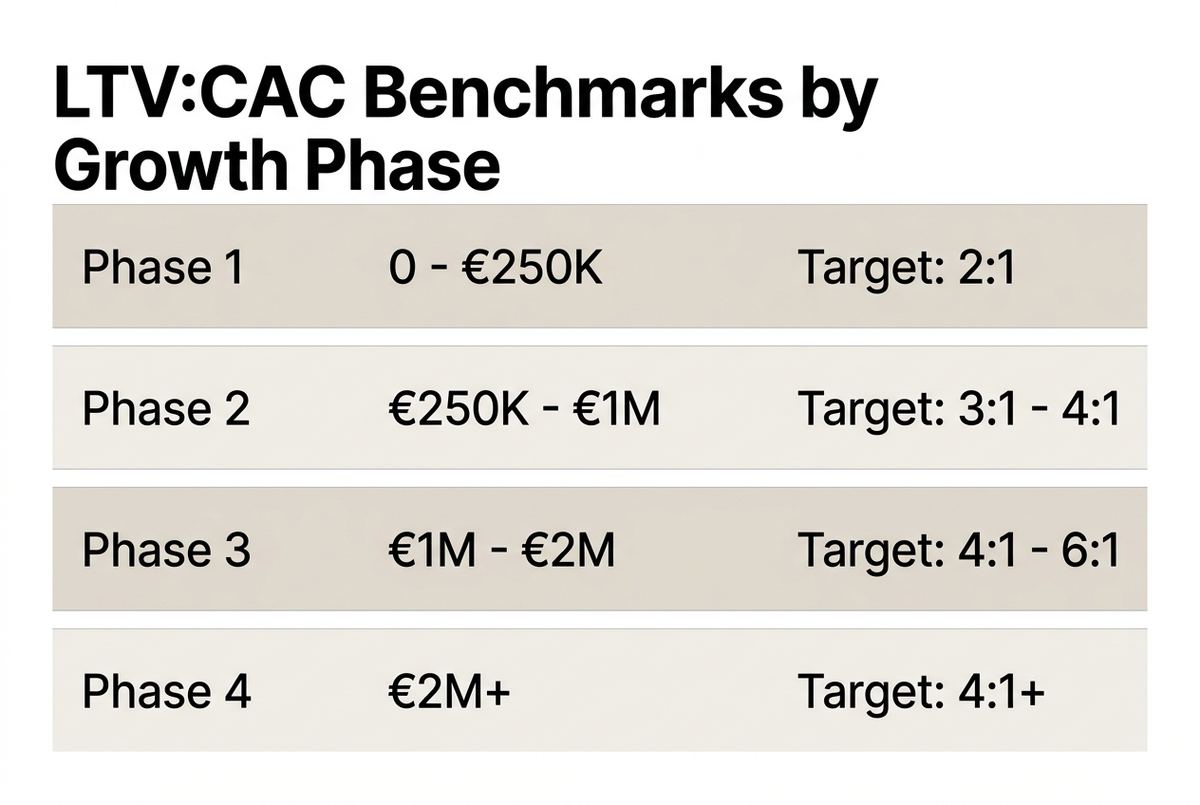
LTV:CAC Benchmarks by Growth Phase
The LTV:CAC ratio is the most useful single number for assessing whether your growth model is financially sound.
The minimum healthy ratio is 3:1. That means for every €1 you spend acquiring a customer, you recover at least €3 in lifetime value. Below 3:1, your model is under structural pressure - either CAC is too high or LTV is too low.
What 'good' looks like per growth phase:
- Phase 1 (0-€250K revenue): Many brands in this phase have negative or near-zero LTV:CAC because they are building the customer base. Focus here is on stabilising the post-purchase experience and building the email foundation. Target: reach 2:1 before scaling spend.
- Phase 2 (€250K-€1M): Flows are running, list is growing, some repeat patterns emerging. Target: 3:1 to 4:1. If you are below 3:1 here, paid media is likely subsidising a retention problem.
- Phase 3 (€1M-€2M): At this stage, LTV should be a strategic lever, not a hopeful side effect. Target: 4:1 to 6:1. Loyalty programs start making sense here.
- Phase 4 (€2M+): International expansion requires you to build LTV fast in new markets. Brands entering new markets without a tested LTV playbook burn through acquisition budgets unnecessarily. Target: maintain 4:1+ in home market while building toward 3:1 in new markets.
One important note: LTV:CAC varies significantly by acquisition channel. Email-acquired customers (from a pop-up, for example) typically have higher LTV than Meta-acquired customers. Organic/SEO customers tend to have the highest LTV of all. Building multi-channel acquisition with LTV tracking per source is the mature version of this analysis.
Frequently Asked Questions
Every fashion brand's LTV situation is different. What the right repeat rate target is, which flows to build first, whether a loyalty program makes sense for your stage - all of it depends on your price point, margin, and current customer base. If you want to know what the right approach looks like for your specific brand: book a free Klaviyo and retention audit.