BFCM for Fashion Brands: How to Prepare Your Meta Ads, Email and Website 8 Weeks Out
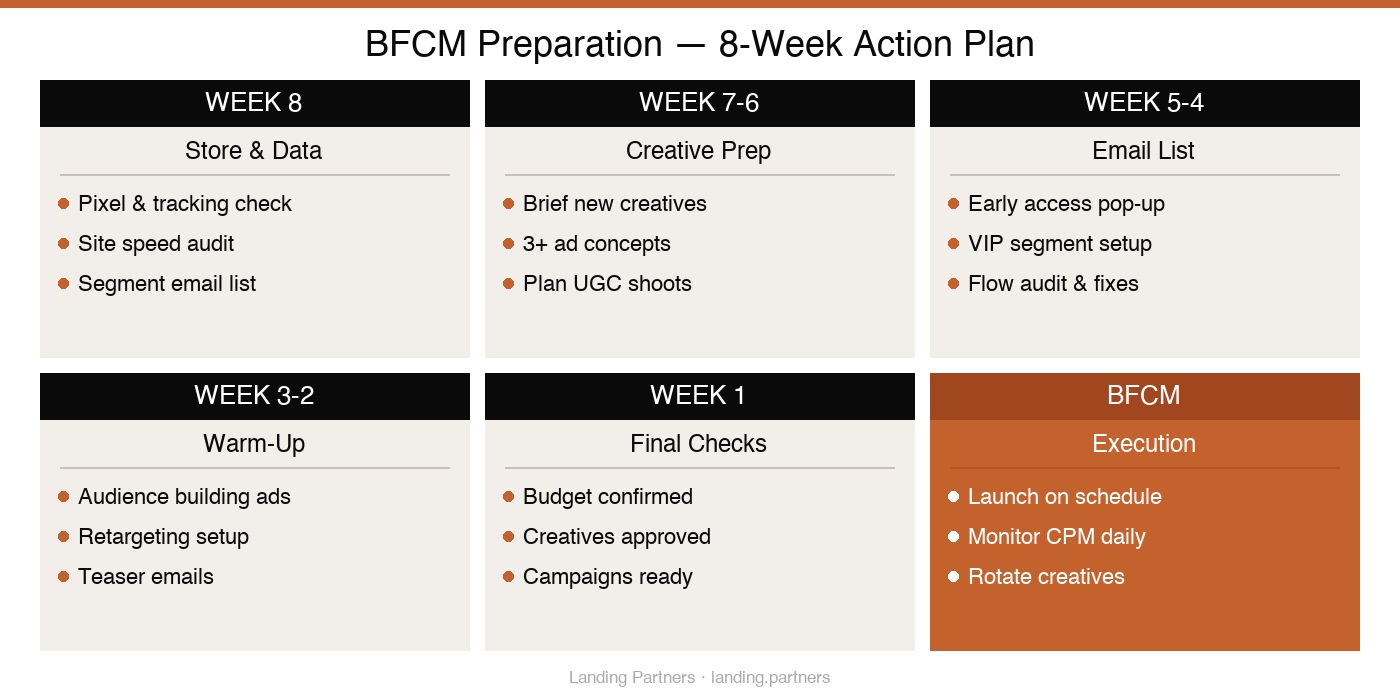
Black Friday is not a campaign. It's a season - and it starts 8 weeks before the cart icon turns orange. Your entire BFCM email calendar should be structured around it.
Every year, we see the same pattern: brands scramble in the last two weeks, launch discount campaigns without enough warm audiences, burn budget at 3x their normal CPM, and then call it a bad BFCM. The brands that win don't wait. They treat Black Friday the way fashion brands treat a collection launch - with a production timeline, a testing window, and a clear rollout plan.
This is the 8-week framework we use with our clients. It's not a checklist of obvious tips. It's the actual sequencing that separates the brands that double revenue during BFCM from the ones that break even on inflated ad spend.
Key Takeaways
- •BFCM preparation starts 8 weeks out - not 2. The brands that win have their creative, audiences, and store ready before the competition starts spending.
- •Email list size matters more than email tactics. If you don't have 1,000+ engaged subscribers, email won't save your BFCM. Focus on list building now.
- •CPMs spike 40-80% during BFCM week. The only way to compete is with warmer audiences and higher-quality creative - not higher budgets alone. Check our Meta ads benchmarks for fashion brands to understand what realistic ROAS looks like at different spend levels.
- •MER is your north star during BFCM - not ROAS. Attribution windows get noisy when every channel is running simultaneously.
- •Post-BFCM is the most underused window in fashion. The customers you acquired in November are warm in December - use them.
- •BFCM strategy differs by brand type. Kidswear brands may find September more important than November. Know your email marketing calendar before copying a generic playbook.

Week 8 Out: Store and Data Readiness
The first thing we do with clients 8 weeks before BFCM is audit the store - not the campaigns.
Your ads can't fix a broken store. If your product pages are slow, your size selector is clunky, or your checkout has unnecessary steps, every euro you spend during BFCM week is partially wasted. We've seen brands run great BFCM campaigns that converted at half their normal rate because they hadn't tested mobile checkout in 3 months.
At week 8, we check:
Page speed on mobile (under 3 seconds to interactive - non-negotiable)
Checkout flow - how many steps, what's the drop-off point
Product imagery - do the BFCM collection items have strong visuals ready
Inventory levels confirmed - nothing worse than running a campaign to a sold-out product
Pixel and Conversions API firing correctly - BFCM is not the time to discover tracking gaps
On the data side, week 8 is when we pull 90-day audience data and identify your warmest segments: recent purchasers, video viewers at 75%+, website visitors from the last 60 days, and email list upload audiences. These are the people you'll be warm-targeting in weeks 2-3. If your pixel has been firing cleanly, you'll have rich signals to work with. If not, you're essentially starting cold.
Not sure if your store is ready to scale spend? Book a free webshop analysis and we'll tell you exactly what to fix before BFCM.
Week 7-6 Out: Creative Production
Creative is the highest-leverage variable in fashion ads - and it takes time to produce, test, and iterate.
Week 7-6 is when you brief your creative team, not week 2. We typically ask clients to have 3-5 new BFCM-specific creatives in testing by week 5. That means briefs go out at week 7, production happens at week 6-5, and the first round of results comes in at week 4.
What BFCM creative looks like for fashion
The mistake most brands make is pivoting entirely to discount-led creative. '30% off everything' as the hook. This works - briefly - but it also trains your audience to wait for the next sale and attracts price-sensitive buyers who rarely become loyal customers.
The best BFCM creative we've seen does two things at once: it acknowledges the sale, but leads with product and desire. The offer is the reason to act now - not the reason to want the product.
Formats that consistently perform during BFCM for fashion:
- Product video with a clear offer callout in the first 3 seconds
- Before/after price comparison (full price vs. BFCM price) - simple, direct, converts
- UGC-style 'haul' content featuring your bestsellers
- Collection overview with a countdown element (last hours, last sizes)
We see significantly higher creative fatigue rates during BFCM week compared to the rest of the year. The same creative that worked in October will often stop performing mid-BFCM. Plan for creative refreshes mid-week, not just at launch.
Testing window: weeks 6-5
Run your BFCM creative candidates at low budget in weeks 6-5 - not as BFCM campaigns, but as normal ads targeting warm audiences. The goal is to see which hooks and formats get the strongest early signals. The winners go into your BFCM campaign stack. The losers get cut.
Week 5-4 Out: Email List Preparation
If you have fewer than 1,000 engaged subscribers by week 5, email is not going to be your BFCM weapon. The math doesn't work - a list of 800 people, even at a strong open rate, generates limited revenue. That's fine. Focus your energy on paid channels and plan for list growth as a longer-term priority.
If you have 2,000+ engaged subscribers, your email list is one of your most valuable BFCM assets - because it costs nothing to send to.
List cleaning and segmentation
Two weeks before you start warming the list, clean it. Suppress contacts who haven't opened or clicked in the last 180 days. Sending to a disengaged list during BFCM hurts your deliverability, which hurts the emails that matter. Better to reach 1,500 people who open than 3,000 who don't.
Build your BFCM segments at week 5:
- VIP segment: top 20% of purchasers by revenue - they get early access
- Engaged non-purchasers: opened 3+ emails in 90 days, never bought - BFCM is your conversion window
- Lapsed purchasers: bought 6-18 months ago, haven't returned - win-back opportunity
A note on attribution: during BFCM, Klaviyo's 5-day click window will attribute a lot of conversions to email that were already happening via other channels. Don't let inflated email revenue numbers become your planning input for next year. Look at flow-specific metrics (revenue per recipient, click rate) rather than total attributed revenue — our Klaviyo benchmark data for fashion brands gives you the reference points to evaluate what worked.
Warming the list in weeks 4-3
Don't go cold into BFCM. In weeks 4-3, send 2-3 non-promotional campaigns - new arrivals, brand story, top picks. The goal is inbox presence and open rate health before you switch to promotional mode.
Building a BFCM email strategy from scratch? Book a free call - we'll map out what's realistic for your list size and brand type.
Week 3-2 Out: Campaign Warm-Up and Audience Building
This is where the Meta side gets serious.
CPMs during BFCM week are 40-80% higher than normal. The only sustainable response to that is having warmer audiences and better creative - not simply outspending the competition. Brands that launch cold campaigns on Black Friday morning pay a premium for every impression and often can't make the economics work.
Audience building in weeks 3-2
Run top-of-funnel campaigns with your BFCM creative at controlled budget - not to sell, but to accumulate video views, clicks, and website visits. These people go into your retargeting pool for BFCM week. You're building a warm audience that costs you less to reach than cold traffic.
Simultaneously, activate your email list as a Custom Audience on Meta and build a lookalike from your top 500-1,000 purchasers. These are your highest-quality targeting pools.
The brands in our portfolio that start audience warming 3 weeks out consistently see lower CPMs during BFCM week compared to brands that launch cold. The difference is not marginal - it materially affects whether the economics work.
Campaign structure to prepare
Don't try to run one big BFCM campaign. Structure it in layers:
- Retargeting campaign: website visitors + video viewers (last 30 days) + email list
- Warm prospecting: lookalikes from purchasers + engaged email segments
- Cold prospecting: broad or interest-based, higher funnel - only if budget allows after retargeting
Set up all three campaigns in Ads Manager before BFCM week, but only activate retargeting and warm prospecting first. Cold prospecting is optional - run it only if your retargeting audience is exhausted.
Week 1 Out: Final Checks
The week before Black Friday is for verification, not creation.
All campaigns built and in review - Meta review can take 24-48h, don't schedule launches for Black Friday morning
Email campaigns scheduled and tested - send a test to yourself on every device
Discount codes generated and tested in checkout - every code, every product
Inventory double-checked against campaign coverage
Landing pages verified - do the ad links go to the right collection? Is the BFCM offer visible above the fold?
Backup creative ready - if a top-performing ad gets disapproved or fatigues, you need replacements on standby
Budget caps reviewed - know your daily spend ceiling and who has authority to increase it during the week
One thing we always do: a live test purchase on mobile the day before BFCM. Click a real ad, go through checkout, buy something. If anything is broken, you find it now - not on Black Friday at 10pm.
BFCM Week: Execution
Once you're live, the job changes from building to managing.
What to monitor daily
- MER (total sales / total ad spend) - your real-time profitability signal. ROAS is unreliable during BFCM because every channel is running simultaneously and attribution windows overlap. MER gives you the true picture.
- Creative performance by ad - which hooks are holding, which are fatiguing
- Audience saturation - if frequency on your retargeting audiences goes above 4-5 in 3 days, expand to lookalikes
- Email open rates - if open rates on your BFCM campaigns drop below your normal baseline, pause and check deliverability
Don't make major structural changes during BFCM week. Resist the urge to rebuild campaigns or change campaign objectives when something looks slow. The Meta algorithm needs time to optimize - especially under high CPM conditions. The time for experimentation was weeks 6-4. Now you execute.
The brands that perform best during BFCM are the ones with the most boring execution week. They built the plan in advance, they trust it, and they make only small tactical adjustments. The brands that panic-build in week 1 rarely recover.
Cyber Monday
Cyber Monday is not BFCM's afterthought - it's a genuine second peak, often with lower CPMs than Black Friday because some competition has already exhausted budget. We typically hold 20-25% of BFCM budget for Cyber Monday specifically. If your Black Friday went well, extend offers. If it underperformed, Cyber Monday is a chance to course-correct with a cleaner offer.
Post-BFCM: The Retention Window
This is the most underused window in fashion ecommerce.
The customers you acquired during BFCM are warm in December. They just bought from you. They know your brand. They're in a gifting mindset. A well-structured post-BFCM email flow in the first 2 weeks of December - featuring new arrivals, gift ideas, or exclusive offers for recent buyers - consistently drives strong repeat purchase rates.
On the paid side, don't stop campaigns abruptly after Cyber Monday. Transition your retargeting to focus on your BFCM purchasers with a 'recently bought, gift for someone else?' angle. This is low-cost, high-intent traffic.
Also: review your Klaviyo post-purchase flow. The email someone gets 7 days after their BFCM order is one of your highest-leverage retention touchpoints of the year. If that flow is weak or inactive, fix it before December.
BFCM by Brand Type: What Changes for Your Category
A generic BFCM playbook works for some brands. For others, it's the wrong plan entirely.
Women's fashion and streetwear
BFCM is your biggest peak. Full preparation applies. Expect high competition and CPM spikes. The brands that win have strong creative, warm audiences, and a clean offer structure. Avoid discount-only messaging - lead with product, use the offer as urgency.
Kidswear and teenswear
September back-to-school is often a bigger peak than BFCM for kidswear brands. Parents buy for necessity in September - the timing is forced. BFCM for kidswear is more gift-driven, which is still a strong moment, but if you've been treating BFCM as your major event and underinvesting in September, that's where to shift attention. BFCM still matters - but don't build your annual plan around it as the only peak.
Gifting brands
BFCM is critical. For many gifting-focused fashion brands (scarves, accessories, jewellery-adjacent), the November-December period represents the majority of annual revenue. For these brands, the 8-week framework is non-negotiable - every week matters. Email is especially important: your gifting audience is highly intent-driven, and your list is likely your best channel for converting consideration into purchase.
Jewellery brands
BFCM drives volume. But the highest AOV spikes for jewellery often come during fashion weeks and Valentine's Day, not BFCM. Treat BFCM as a volume play with accessible price points and accessories. Save your premium campaign investment for the moments where your audience is in a higher-consideration, higher-spend mindset.
What Most Brands Get Wrong
After running BFCM campaigns for dozens of fashion brands, the mistakes we see repeat every year:
Starting too late
Two weeks is not enough. Creative takes time. Audiences need warming. Stores need auditing. The brands that start at week 2 are competing against brands that started at week 8 - and they feel it in their CPMs.
Setting a ROAS target instead of a MER target
ROAS is easy to manipulate - attribution windows can be set wide or narrow, campaign objectives can be optimized to maximize reported conversions. During BFCM especially, when email, paid, and organic are all running simultaneously, ROAS numbers don't tell you whether you're making money. MER (total sales / total ad spend) does. Every brand we work with tracks MER as the primary signal during BFCM week.
Discounting everything
A blanket 30% off across your entire catalog trains price-sensitive behavior and devalues your brand positioning. The better approach: a clear, time-limited offer on a defined set of products, with full-price items still available for customers who value them. This protects margin on your premium lines and maintains brand equity.
No post-BFCM plan
The November acquisition window is only valuable if you have a December retention plan. We see brands put enormous energy into BFCM and then go quiet in December - losing customers they just paid to acquire.
Budget Guidance
BFCM budget depends on your revenue stage. There's no universal number - what works for a €5M brand will crush a €300K brand.
The principle we use: BFCM is not the time to discover your budget ceiling. Know your number before the week starts, know who can authorize changes, and have a clear trigger for when you scale up (MER above target) and when you pull back (MER below breakeven).
As a rough framework across our client base:
- Phase 1 (0-€250K revenue): BFCM should be your biggest spend week of the year, but keep daily budgets at 2-3x your normal daily spend. Don't overextend - the audience warming advantages of a Phase 4 brand don't apply here.
- Phase 2 (€250K-€1M): 3-5x normal daily spend during peak days. You should have enough pixel data and warm audiences to make this work.
- Phase 3 (€1M-€2M): This is where BFCM gets genuinely competitive and creative quality separates the winners. 5-8x normal daily spend is not uncommon for the top performers.
- Phase 4 (€2M+): BFCM is a full-team event. Multi-country, multi-channel, with dedicated budgets per market.
Want to know what the right BFCM budget looks like for your brand specifically? Book a free growth call and we'll map it out based on your numbers.
Frequently Asked Questions
Every brand's BFCM situation is different. What works for a €5M women's streetwear brand will not work for a €400K gifting brand. The discount structure, the creative approach, the email strategy, the budget level - they all depend on your margin, your audience size, and where you are in your growth journey. If you want to know what the right BFCM plan looks like for your specific brand, book a free call and we'll build it with you.