DTC vs. Wholesale: What's the Right Strategy for Your Fashion Brand?

Most fashion brands we work with face this question at some point: should we go all-in on direct-to-consumer, or does wholesale still make sense in 2025? DTC requires a bigger advertising commitment — our fashion brand advertising budget guide covers how to size your spend based on your revenue stage and channel mix.
It's not a simple answer. Both models work. Both have real trade-offs. And the right choice depends entirely on your margin structure, brand stage, and growth goals - not on what's trending.
Key Takeaways
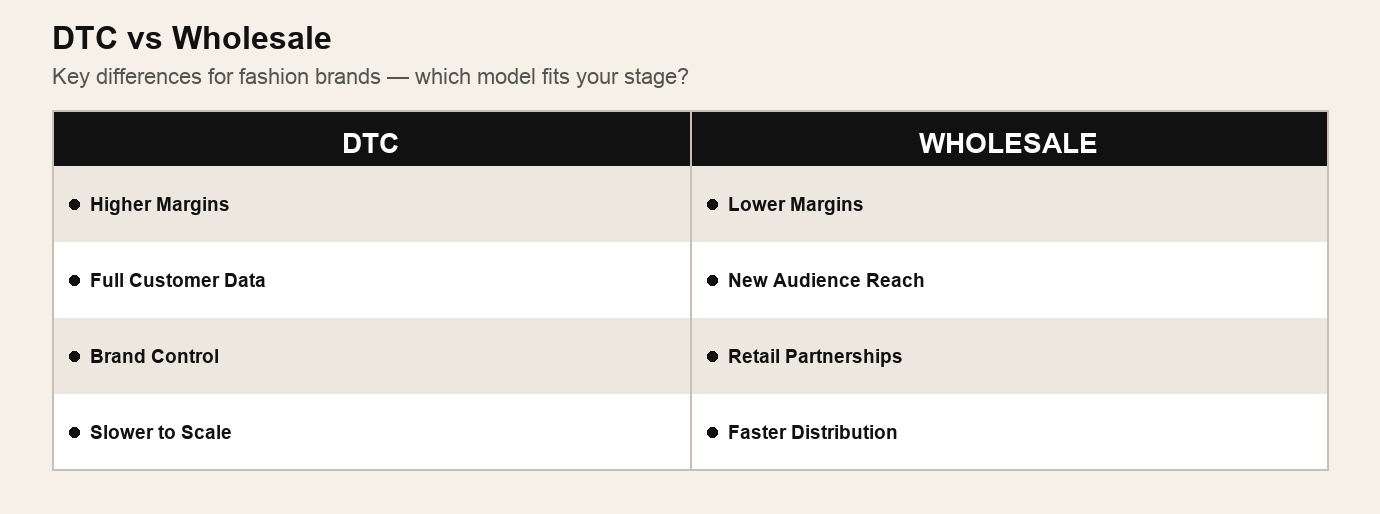
- •DTC gives you higher margins, customer data, and full brand control - but requires patient capital and consistent marketing investment. For more on this, see advertising budget allocation for fashion brands.
- •Wholesale gets your product in front of buyers fast - but at lower margins, with no customer data, and limited control over how your brand is presented
- •Most successful fashion brands we work with eventually combine both - but the sequence matters
- •If you're under €500K revenue, DTC is almost always the right primary focus
- •Wholesale as a growth hack rarely works - it works as brand validation at the right stage
What DTC Actually Means for a Fashion Brand
DTC (direct-to-consumer) means selling directly through your own channels - your webshop, your email list, your social ads. No intermediary. No retailer taking a cut.
The upside is real: **you keep 60-80% gross margins** instead of the 40-50% a retailer leaves you with. You own the customer relationship. You control pricing, presentation, and the full brand experience from ad to unboxing.
The downside is equally real. Without a retailer network distributing your product, every sale you make is a sale you had to earn through marketing. That means consistent ad spend, strong creative, a converting webshop, and an email strategy that actually works.
Across our client base, DTC brands that hit €1M+ revenue typically have a MER (blended return on total ad spend) of 4-6x at scale - meaning for every euro spent on marketing, they see €4-6 in total revenue.
DTC rewards patience. **The brands that struggle are the ones that expect profitability in month three.** Building a direct audience takes 12-18 months of consistent investment before the flywheel turns - returning customers, organic word of mouth, and a Klaviyo list that actually converts.
Not sure if your DTC setup is ready to scale? We do free webshop and funnel analyses for fashion brands. Book a free call
What Wholesale Actually Means in Practice
Wholesale means selling your collection to retailers - boutiques, department stores, multi-brand webshops - who then sell to end consumers at a markup.
The obvious appeal: volume, fast. Instead of building an audience buyer by buyer, one wholesale account can move significant stock. It also builds brand credibility - getting stocked by the right retailers signals to consumers that your brand is worth paying attention to.
But the margin hit is significant. A product that retails at €150 might wholesale at €60-70. Your production cost at €30 leaves you with €30-40 margin per unit instead of €100+. At low volume, wholesale is often not profitable at all.
**The bigger issue for early-stage brands: you lose the customer.** The retailer owns that transaction. You get no email address, no purchase history, no ability to re-market. If a consumer buys your jacket from a boutique, you have no way to follow up, build loyalty, or drive a repeat purchase.
We've seen brands invest significantly in wholesale relationships early, only to find that their DTC channel had no audience to fall back on when a key retailer dropped them or went out of business.
Wholesale also comes with complexity - payment terms (often 30-60-90 days), returns, markdown risk, and the operational burden of managing B2B orders alongside B2C.
The Margin Math: Why It Matters More Than You Think
Let's make this concrete. Assume a fashion brand selling a jacket at €200 retail.
DTC scenario:
Retail price: €200 - Production cost: €45 - Gross margin: €155 (77%) - Customer acquisition cost (CAC): €35-50 via Meta ads - Contribution margin per sale: €105-120
Wholesale scenario:
Wholesale price: €80 - Production cost: €45 - Gross margin: €35 (44%) - No marketing cost for that unit - Contribution margin per sale: €35
**The gap is not just margin percentage - it's absolute euros per unit.** At DTC, you're making €105 per jacket after acquisition costs. At wholesale, you're making €35. You need 3x the wholesale volume to match DTC contribution - before overheads.
This math changes at very high wholesale volume, where production costs drop significantly and you can negotiate better terms. But most brands we work with are not at that volume.
Trying to figure out the right margin structure for your growth stage? Book a free strategy call - we'll look at your actual numbers.
When Wholesale Makes Strategic Sense
We're not anti-wholesale. There are specific situations where it's the right move.
Brand validation at early stage: Getting stocked by a well-known boutique or concept store is a brand signal that's hard to manufacture through DTC alone. For luxury or contemporary brands where distribution credibility matters, selective wholesale partnerships can accelerate perceived brand value.
New market entry: When expanding internationally, having local wholesale partners can reduce the marketing investment required to build awareness from scratch. We've seen this work well for Benelux brands entering Germany or France - a strong local retailer introduces the brand to their existing audience.
Category-specific dynamics: Some categories are still wholesale-first by consumer behavior. High-end bridal, some luxury categories, and specialty sports are examples where consumers expect to discover and touch products in-store before buying.
Among the fashion brands we work with that have wholesale revenue, those who treat wholesale as 20-30% of total revenue (not the primary channel) typically show the strongest DTC growth - because they're not dependent on retailer relationships for survival.
The selective retail partnership: One or two marquee wholesale accounts - placed strategically - can amplify DTC without cannibalizing it. The key is selectivity. Mass wholesale distribution with 50 accounts across all price tiers destroys brand positioning and sets a floor on your DTC conversion.
The Hybrid Model: How Most Successful Brands Actually Operate
The DTC vs. wholesale framing is a bit of a false choice. Most fashion brands that scale successfully end up with both - but the sequence and proportion matter enormously.
**Our general recommendation based on what we've seen across 100+ brands:**
Phase 1 (0-€500K revenue): DTC first. Build your audience, your email list, your Klaviyo flows, your creative library. Every euro of marketing should go to understanding who buys your product and why. Wholesale at this stage is a distraction unless you get approached by a genuinely strategic partner.
Phase 2 (€500K-€2M revenue): Selective wholesale as a brand amplifier. By now you have proof of demand. 1-3 strategic wholesale accounts that reach your target consumer in markets where you have limited organic reach. Keep wholesale below 30% of revenue.
Phase 3 (€2M+ revenue): More structured wholesale strategy is viable - but only if your DTC economics are solid. International expansion often benefits from a hybrid approach where wholesale opens doors and DTC captures the repeat purchase.
Not sure which phase you're in or what the right mix looks like for your brand? Book a free call and we'll give you a clear recommendation based on your actual numbers.
The Data Argument for DTC
There's an aspect of the DTC vs. wholesale debate that doesn't get enough attention: **what you learn.**
Every DTC transaction is a data point. You know who bought, what they paid, how they found you, what they browsed before converting, whether they came back. Over time, that data becomes a serious competitive advantage - it informs your creative strategy, your product development, your Klaviyo segmentation, and your Meta campaign structure.
Wholesale gives you none of this. You know how many units you shipped. That's it.
For fashion brands building towards scale, the absence of first-party data in a wholesale-first strategy creates a ceiling. At some point you need to know your customer. **The brands that have that data grow faster, spend their marketing budget more efficiently, and retain customers at higher rates.**
Across our client base, fashion brands with strong first-party data - a healthy Klaviyo list, good purchase history segmentation, returning customer rates above 30% - consistently outperform comparable brands without it on every paid media KPI.
Common Mistakes We See
Treating wholesale as a shortcut to scale: A €50K wholesale order feels like success. But if your DTC channel has 500 newsletter subscribers and a 0.8% conversion rate, you've delayed a problem, not solved it.
Discounting for wholesale without margin analysis: Some brands offer wholesale terms without properly calculating whether the margin works at their current production volume. Run the numbers first.
Letting wholesale accounts set your DTC pricing: If your main retailer sells your product at €150 and you want to sell it at €180 DTC, you have a problem. Protect your DTC price positioning from the start.
Going wholesale too early in a new market: We've seen brands enter Germany via wholesale, build zero DTC presence there, and then struggle to reactivate when the retailer relationship ended. Wholesale market entry needs a parallel DTC investment.
Frequently Asked Questions
Every brand's situation is different. The DTC vs. wholesale question depends on your margin structure, your brand stage, your category, and your growth ambitions. If you want to know what the right approach looks like for your specific brand - book a free call and we'll give you a straight answer.