The European Fashion Ecommerce Market in 2025: Key Markets, Consumer Behavior and Opportunities

European fashion ecommerce is growing - but not evenly. The gap between brands that enter the right markets in the right order and those that try everything at once is significant.
We work with fashion brands across Belgium, the Netherlands, Germany, France, and the UK. What we see consistently: most brands underestimate how different each market is - in consumer behavior, platform preferences, logistics expectations, and competitive dynamics.
This guide breaks down the key European fashion markets, what we know about consumer behavior in each, and how to think about market entry if you're a growing fashion brand.
Key Takeaways
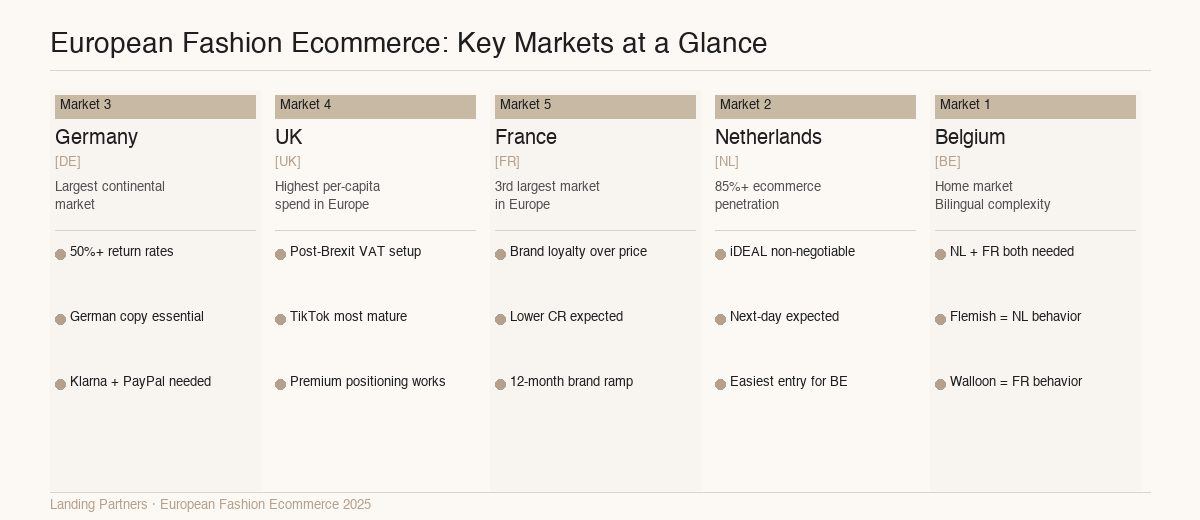
- •Europe's five core fashion ecommerce markets are Germany, UK, France, the Netherlands, and Belgium - each with distinct consumer behavior and entry requirements.
- •Germany is the largest continental market but also the most demanding - returns exceed 50%, local payment methods are non-negotiable, and trust signals matter more than anywhere else.
- •The UK offers the highest per-capita online fashion spend in Europe, but post-Brexit logistics and VAT rules add real operational complexity.
- •France is brand-loyal and fashion-conscious, but conversion rates are lower than the European average - brand building comes before performance marketing.
- •The Netherlands has the highest ecommerce penetration in Europe and the lowest friction entry point for Flemish-speaking Belgian brands.
- •Belgium is the natural starting point for domestic brands - but its bilingual market is more complex than most assume.
The Scale of European Fashion Ecommerce
Europe is home to five markets that matter most for fashion ecommerce - in terms of both volume and accessibility for growing brands.
These markets are not equal. **Germany and the UK together account for over half of European online fashion spending.** France sits at number three. The Netherlands punches above its weight relative to population size. Belgium is smaller, but for Flemish brands it's home - and it's often the first proof point before scaling outward.
What this means practically: if you're a Belgian or Dutch fashion brand, you're already sitting inside one of the most digitally mature fashion ecosystems in the world. You don't need to look far for growth - but you do need to understand what changes as you move across borders.
Europe's top 5 fashion ecommerce markets combined represent over €150B in annual online fashion revenue. Germany and the UK together account for more than half of that total.
Germany: The Biggest Market, the Most Demanding Customer
Germany is the largest fashion ecommerce market in continental Europe. It's also the most unforgiving for brands that arrive unprepared.
What makes Germany structurally different
German consumers are price-sensitive and research-heavy. They compare before buying. Return rates in German fashion ecommerce regularly exceed 50% - this isn't failure, it's structural. German shoppers routinely order multiple sizes, try them at home, and return what doesn't fit. Your unit economics need to account for this from day one.
If you're running Meta or Google ads into Germany and calculating ROAS without factoring in return rates, your margin picture is incomplete.
Payment methods are not optional
PayPal, Klarna, and 'Kauf auf Rechnung' (buy now, pay on invoice) are near-mandatory. A checkout without these options will convert significantly worse than in your home market. **Add German payment methods before you invest in German traffic** - the sequence matters.
Trust signals carry more weight
German consumers place higher value on visible trust signals: return policy prominently displayed, GDPR-compliant data language, and German-language customer service. An English-language webshop in Germany converts noticeably lower than a properly localized one. This isn't a creative problem - it's a structural one.
Expanding into Germany? Before you scale your ad spend, your checkout needs German payment methods and your webshop needs German-language content. Book a free call to review your market readiness.
United Kingdom: Highest Spend, Highest Operational Complexity
The UK has the highest per-capita online fashion spend in Europe. British consumers are comfortable buying fashion online, respond well to performance marketing, and have relatively high average order values in the premium and contemporary segments.
Post-Brexit logistics reality
Since Brexit, selling into the UK from the EU involves customs duties, VAT registration, and additional logistics overhead. The operational bar is higher than any other European market. Brands that haven't sorted their UK VAT setup often absorb unexpected costs that erode margins at scale.
That said, **the UK rewards quality fashion brands** - particularly in premium and contemporary women's wear. British consumers are fashion-forward and respond strongly to editorial creative.
TikTok is ahead of the continent
TikTok Shop has seen significant adoption among UK fashion consumers in a way not yet replicated elsewhere in Europe. If you're investing in TikTok for fashion, the UK is the most mature test market. Instagram remains strong for discovery, but the social commerce landscape is evolving faster here than anywhere else.
UK online fashion spend per capita is the highest in Europe - roughly 40% above the European average. But post-Brexit operational costs mean margin modeling requires careful attention before scaling UK ad spend.
France: Brand-Loyal, Patient, and Fashion-Conscious
France is the third-largest fashion ecommerce market in Europe - but it behaves differently from Germany or the UK.
French consumers are brand-loyal in a way that takes time to build. They respond to aesthetic quality and brand narrative. **Direct response advertising works less efficiently in France** - conversion rates are typically lower than in NL or BE, and first-purchase costs are higher.
What works in France
Brands that succeed in France typically invest in brand awareness before performance. Instagram performs well for fashion discovery. French language is non-negotiable - attempting to sell to French consumers in English will cost you conversion regardless of how good the creative is.
French fashion consumers also have strong category loyalty: women's ready-to-wear, luxury accessories, and footwear consistently outperform. If your brand operates in these categories, France is a market worth building toward - but expect a 6-12 month ramp before paid media pays off.
Soldes and French seasonality
France has legally defined sale periods - les Soldes - twice a year: January and late June/July. These are high-traffic, high-competition moments. Fashion brands entering France need to plan creative and inventory strategy around these windows, not just BFCM.
Netherlands: High Digital Penetration, Natural Starting Point
The Netherlands has one of the highest ecommerce penetration rates in Europe. Dutch consumers are comfortable buying online, expect fast delivery (next-day is the baseline expectation), and are comparatively price-transparent - they shop around.
The natural first step for Flemish brands
For Flemish-speaking Belgian brands, the Netherlands offers the lowest-friction international expansion. The language barrier is minimal, the digital infrastructure is strong, and Dutch consumers respond to similar creative styles.
We consistently see Belgian fashion brands grow Dutch revenue faster than any other international market in their first 12 months of expansion. **If you're a Flemish fashion brand not yet active in the Netherlands, it's your lowest-hanging international opportunity.**
iDEAL is non-negotiable
iDEAL remains the dominant payment method in the Netherlands. A checkout without iDEAL is a significant conversion drag. Dutch consumers also expect clear, direct communication - transparency in pricing, returns policy, and delivery timelines is valued more here than in almost any other European market.
The Netherlands has an ecommerce penetration rate of over 85% - one of the highest in Europe. For Belgian fashion brands, it's typically the fastest-growing international market in the first year of expansion.
Belgium: Home Market, Underrated Complexity
Belgium is smaller than the other four markets, but its complexity is consistently underestimated. The bilingual nature of the country means a Dutch-only or French-only approach leaves significant volume behind.
**Flemish consumers and Walloon consumers behave differently.** Flemish consumers are closer to Dutch behavior - digitally active, price-aware, respond well to performance marketing. Walloon consumers are closer to French behavior - more brand-loyal, lower online purchase frequency, longer decision cycles.
For most brands we work with, Belgium is the starting point - not because it's easy, but because it's home. Getting Belgium right across both regions creates the operational and creative foundation for expanding outward efficiently. Our dedicated guide to digital marketing for fashion brands in Belgium covers the platform mix, language strategy, and paid media benchmarks in detail.
Consumer Behavior Across Europe: What's Changed in 2025
Across all five markets, we see consistent shifts in 2025 that affect how fashion brands need to operate.
Mobile is the primary buying device everywhere
In all five markets, the majority of fashion purchases now happen on mobile. The gap between mobile traffic share and mobile conversion rate is still significant for many brands. Brands that haven't optimized for mobile checkout - not just mobile browsing - are leaving revenue on the table in every market.
Social discovery is fragmenting
Instagram remains the dominant social discovery platform for fashion across Europe. TikTok has accelerated in the UK and is growing in NL and DE. Pinterest remains relevant for higher-AOV fashion categories. **Brands relying on a single platform for discovery are increasingly exposed.**
Returns are a structural cost, not an anomaly
Return rates vary by market - Germany highest, France lower, UK moderate - but in all five markets, returns need to be factored into unit economics from the start. Brands that model without accounting for returns consistently run into margin surprises as they scale.
Price sensitivity has increased across the board
Post-2022 inflation has made consumers more price-conscious in every European market. This doesn't mean premium brands can't succeed - it means the value proposition needs to be clearer, and the first purchase needs to deliver on its promise for repeat behavior to follow.
Not sure which European market makes sense for your brand next? We help fashion brands map their expansion path based on margin structure, existing traction, and product positioning. Book a free growth call.
Where Most Brands Get Europe Wrong
We see the same mistakes repeatedly when fashion brands try to scale across European markets.
Translating instead of localizing
Running Dutch copy in France or English copy in Germany isn't localization - it's translation, and consumers notice. **A translated ad will consistently underperform a natively written one**, even if the translation is technically accurate. Native copy, native payment methods, native delivery expectations - these are the table stakes.
Assuming one market's economics apply to another
A conversion rate that works in Belgium won't be the same in Germany. A ROAS target that makes sense in the Netherlands won't be right for France. Each market has its own cost structure, return rates, and consumer patience curve. Applying one market's benchmarks to another leads to wrong conclusions about what's working - and wrong decisions about budget.
Entering too many markets at once
This is the most common mistake we see from brands at the €500K-€2M stage. The temptation to run Meta ads in five countries simultaneously is real. But the operational, creative, and financial cost of doing it poorly in five markets is higher than doing it well in two. **Nail one international market before opening a second.** The systems and creative infrastructure you build for market one make market two significantly faster.
Skipping the logistics work
Consumer expectations around delivery speed and returns differ by market. German consumers expect free returns. Dutch consumers expect next-day. UK consumers post-Brexit face additional friction. Entering a market without matching local logistics expectations will hurt conversion and retention regardless of how good your ads are.
Based on what we see across our client base: brands that fully optimize one international market before moving to a second grow significantly faster in year two than brands that spread across multiple markets simultaneously.
How to Prioritize Your European Market Entry
If you're a Flemish or Dutch fashion brand, the logical sequence based on what we see across our client base is:
1. **Belgium + Netherlands** - This is your home base. If you're not maximizing both markets, don't expand yet.
2. **Germany** - Largest continental market, but requires preparation: German copy, German payment methods, German trust signals. The investment is worth it at the right scale.
3. **United Kingdom** - High potential, but post-Brexit complexity requires proper operational setup. Best approached once you have proven international execution capability.
4. **France** - Lower direct-response efficiency, higher brand investment required. Best approached with a 12+ month horizon and established brand equity.
For brands already active in Belgium and the Netherlands, Germany is typically the right next move - not because it's easy, but because the market size justifies the preparation investment.
What This Means for Your Paid Media Strategy
Paid media across European markets isn't a translation exercise. **Each market requires its own creative, its own messaging logic, and its own budget structure.**
Meta's creative performance varies by country - what hooks work in Belgium don't necessarily resonate in Germany. CPMs differ. Click-through rates differ. Conversion rates on the landing page differ because the consumer's trust baseline is different.
What we recommend for brands scaling into new European markets:
Run separate campaigns per market - never bundle countries in one campaign. The data becomes unreadable and you can't optimize by market.
Test market-specific creative. At minimum, translate hook copy and CTA copy. Ideally, use market-native creators for UGC in that language.
Set market-specific ROAS targets. A market in month one will have different cost structures than the same market in month twelve - and different cost structures than your home market.
Use email and retargeting to support paid. **In new markets where brand awareness is low, a single ad touch rarely converts.** Klaviyo email capture and retargeting sequences are more important in cold markets than in your home market.
Frequently Asked Questions
Every brand's situation is different. European market expansion depends on your margin structure, logistics setup, creative capacity, and where your brand is in its growth stage. If you want to know what the right European expansion path looks like for your specific brand - book a free call with us.