UGC for Fashion Brands: How to Get, Brief and Deploy User-Generated Content

Key Takeaways
- •UGC converts better than branded content for fashion — but only when it's briefed correctly. Unstructured UGC is wasted spend.
- •The biggest mistake brands make: treating UGC as 'any customer photo'. The best UGC is strategic, briefed, and tested.
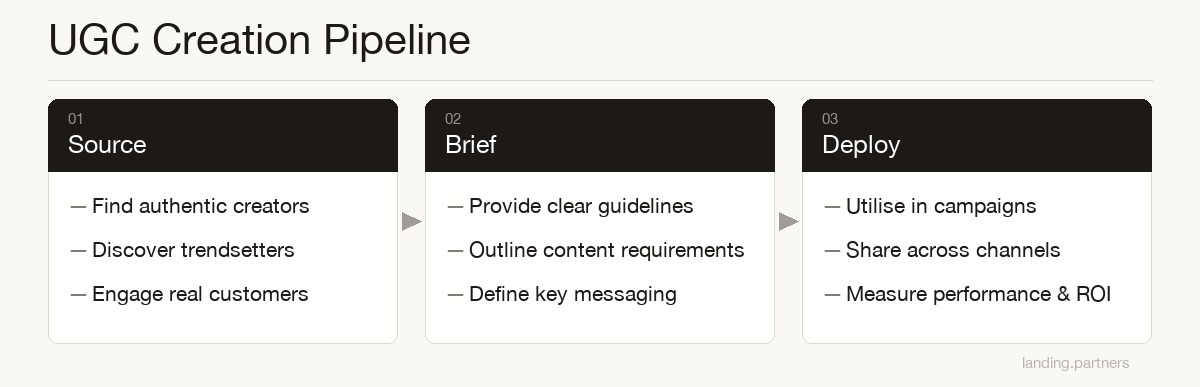
- •Getting UGC right means three things: sourcing the right creators, briefing for the right hooks, and deploying in the right placements.
- •UGC performs best at the top of the funnel — it introduces the brand in a way that feels earned, not advertised.
- •We've seen UGC reduce cost-per-purchase by 20-40% compared to studio content in the right contexts — but it's not a universal fix.
Most fashion brands treat UGC as an afterthought — a way to cut creative costs or fill gaps in the content calendar. If you need a seasonal framework for when to activate influencers around key dates, our fashion brand email marketing calendar maps out the full year including BFCM, Soldes and key campaign moments. That's the wrong frame entirely.
User-generated content is one of the highest-leverage creative formats available to fashion brands right now. When it's done right, it outperforms studio content at top of funnel, builds genuine trust with new audiences, and gives your Meta campaigns a format that doesn't look like an ad. When it's done wrong, it looks cheap, confuses the algorithm, and damages the brand you've been building.
We've deployed UGC campaigns for fashion brands across the €100K-€5M revenue range. Here's what we've learned about what actually works.
What UGC Actually Is (and What It Isn't)
UGC stands for user-generated content — but in the context of paid media for fashion, this term has evolved. It no longer just means spontaneous content from real customers. It now covers a spectrum:
Organic UGC
Real customers posting about your brand without payment. The most credible form, hardest to source at scale. Usually requires a brand with an existing community or a strong hook (packaging, product surprise, community ritual).
Creator UGC
Content creators — not influencers with large audiences, but creators who are skilled at producing authentic-looking content — are briefed to create UGC-style videos and photos for a flat fee. They retain no publishing rights to their audience; the content goes to your ad account. This is now the dominant model for scaling UGC in paid media.
Influencer content re-used as UGC
Content originally created by influencers for their own channels, licensed for use in paid ads. Can work well when the creator's audience overlaps with your target — the content already proved organic resonance before you paid to amplify it.
Understanding which category you're working with matters because the brief, the sourcing process, and the expected performance differ significantly.
Based on our Meta campaigns across 40+ fashion clients: UGC-style creative (all three categories combined) outperforms pure studio content in cold audience acquisition in roughly 60-70% of cases — when properly briefed.
Why UGC Works for Fashion Brands
Fashion is one of the most trust-dependent categories in ecommerce. When someone is spending €80 on a pair of trousers from a brand they've never bought from, the question they're answering isn't just 'do I like this product?' — it's 'can I trust this brand to deliver what I see in the photo?'
Branded studio content answers the first question beautifully. UGC answers the second.
A video of a real person (or a creator who looks like a real person) receiving the package, trying on the item, and giving an authentic reaction signals something that no campaign image can: this is a brand that real people buy from and enjoy.
On Meta, this matters for another reason: UGC-style content tends to get lower CPM because it generates higher engagement rates. The algorithm rewards content that keeps people watching — and UGC-style hooks do that better than static studio images in cold audiences.
The attention economics of fashion UGC
The first 2-3 seconds determine everything. UGC that starts with a product reveal, an unboxing moment, or a try-on hook tends to retain attention better than studio footage that opens on a brand logo or campaign shot.
We test hooks aggressively in our UGC campaigns. The patterns we see consistently: 'honest review' hooks and 'I ordered from this brand and...' openings outperform both aspirational lifestyle hooks and discount-led CTAs in cold audience acquisition.
Not sure which creative format is right for your brand's current stage? Book a free creative strategy call and we'll tell you exactly what to test first.
How to Source UGC for Your Fashion Brand
The sourcing process is where most brands get stuck. Here's how we approach it:
Option 1: Your existing customer base
If you have 1,000+ customers, you can activate them as UGC creators. The most effective approach: a post-purchase email at day 7-10 with a simple ask. 'Share a photo or video wearing your [product name] and we'll feature you on our channels.' Offer a small incentive — store credit, not cash — to keep the motivation genuine.
Expect a 2-5% conversion rate on this ask. With 1,000 customers, that's 20-50 pieces of organic content — enough to test with, not enough to run a sustained paid campaign at scale.
Option 2: Creator UGC platforms
There are platforms specifically built to connect brands with UGC creators — people skilled at creating authentic-looking content who don't have a large following. Rates typically range from €50-€200 per piece depending on complexity. For a fashion brand, you want creators who can actually wear and move in your product category. Style fit matters as much as filming skill.
The briefing quality determines the output quality. We've seen brands spend €2,000 on creator UGC and get unusable content because the brief was three sentences. More on briefing below.
Option 3: Influencer licensing
If you're already running influencer campaigns (gifting or paid), add a licensing clause to your agreements. Pay a flat €100-€300 extra to license their content for paid ads for 3-6 months. This is often the most cost-efficient UGC source because the content was already created and proved organic resonance before you paid to amplify it.
In our influencer campaigns, licensed influencer content used in Meta ads typically performs 15-30% better than pure creator UGC at cold audiences — because the credibility signal is stronger when there's a real person with a real following behind the content.
How to Brief a UGC Creator for Fashion
A UGC brief for fashion is different from a standard influencer brief. You're not asking someone to tell their story — you're asking them to create a specific hook-body-CTA structure that you can test in paid media.
What every UGC brief must include:
Brand context: what you sell, who you're for, what makes you different (2-3 sentences max)
The hook: specific opening line or visual moment. Give 2-3 options — let the creator choose what feels natural to them.
The body: what to show, what to say. For fashion: wear the product, show the fit, show the texture. For accessories: hold it, zoom in on detail.
The CTA: what you want the viewer to do. Usually 'shop [product] now' or 'link in bio'. Keep it simple.
Technical specs: video length (15s or 30s), orientation (9:16 for Stories and Reels), no licensed music that Meta will flag.
Tone: honest and direct, not sales-y. Real person, not presenter.
What you do NOT want to specify: the exact words, the exact movement, or over-scripting. The value of UGC is authenticity — over-briefed content sounds like a teleprompter.
The 3-hook framework
For every product or campaign angle, we brief creators with three hook variants:
1. Problem/solution hook: 'I've been looking for a [product type] that doesn't [common frustration]'
2. Reveal hook: Start with packaging or product flat-lay, then reveal the unboxing moment.
3. Social proof hook: 'I ordered this based on the reviews and here's what I actually think'
Test all three. Usually one dominates within the first €100-150 of spend. Double down on the winner.
If you're not testing UGC hooks systematically, you're leaving performance on the table. Talk to our team about how we structure creative testing for fashion brands.
Where to Deploy UGC in Your Meta Campaign Structure
UGC is not equally effective everywhere in the funnel. We see very different results depending on where it's deployed:
Cold audiences (top of funnel)
This is where UGC shines. A new customer discovering your brand needs social proof before they'll engage. UGC delivers that. Use video UGC here — try-on content, unboxing, honest review format. The goal is stopping the scroll and building initial trust.
Retargeting (middle and bottom of funnel)
This is where UGC is often over-used. Someone who already visited your product page doesn't need more social proof — they need to see the product clearly, understand sizing, and see the price. Studio content and catalog ads typically outperform UGC at retargeting.
A mistake we see constantly: brands running the same UGC creative at both cold audiences and warm retargeting. The funnel logic is completely different. Match the format to the audience intent.
In our campaign structures, UGC-heavy cold audiences consistently outperform pure studio creative in CAC — but at retargeting stage, catalog and product studio assets outperform UGC by 20-35% in ROAS.
Stories vs. Feed vs. Reels
UGC in native 9:16 format works best in Stories and Reels placements. In-feed, you can use either 9:16 or square (1:1) — test both. Avoid forcing landscape UGC into vertical placements — it kills the authenticity signal and signals 'repurposed ad' immediately.
When UGC Doesn't Work (And Why)
UGC is not a silver bullet. We've seen it fail in predictable patterns:
Wrong brand tier
For luxury and high-end fashion brands (€400+ AOV), UGC-style content often conflicts with the brand positioning. A customer who spends €500 on a coat expects premium imagery. If your brand equity is built on editorial and campaign photography, UGC can actually decrease conversion by creating a trust gap. The format needs to match the expectation.
Poor briefing
Under-briefed UGC produces content that's unusable for ads — too long, wrong framing, off-brand tone. Good UGC requires good briefs. Non-negotiable.
No hook testing
Treating UGC as a creative format rather than a testing input. A single piece of UGC without variants to test against tells you nothing. You need at least 3-5 variations to learn anything meaningful.
Ignoring creative fatigue
UGC content fatigues faster than studio content because it's designed to feel 'in the moment'. After 2-3 weeks of high spend, even strong UGC creative starts to drop off in performance. Build a pipeline — you need fresh UGC regularly, not a one-time batch.
A UGC program that works is a system, not a single shoot.
Building a Sustainable UGC Pipeline
The brands we see doing UGC well share one thing: they've built it into a repeatable system. Here's the framework we recommend:
Monthly cadence
Brief 4-8 new UGC assets per month. Not all at once — stagger them so you're feeding fresh creative into the ad account consistently. For brands spending €5K-€20K/month on Meta, this is roughly the right volume to keep creative fresh without overwhelming the testing process.
Creator roster
Build a stable of 3-5 UGC creators who know your brand, have already delivered quality content, and can be re-briefed quickly. Finding new creators for every brief wastes time and quality. Develop a roster and treat it like a creative asset.
Performance logging
Track every UGC asset by hook type, creator, and format. Within 2-3 months you'll start to see patterns — which hooks work for your specific audience, which creator style resonates, which product categories get the most engagement. This data makes your briefing sharper over time.
Seasonal refresh
UGC should align with your product drops and collection launches. Brief new UGC 3-4 weeks before a major launch so it's ready when the campaign starts. Briefing UGC after launch means you're spending the first weeks with stale creative at the worst possible time.
Building a UGC system takes time and the right structure. If you want a clear plan for your brand's creative pipeline — including UGC volume, briefing templates, and deployment strategy — book a free call with our team.
Frequently Asked Questions
Every brand's situation is different. UGC strategy depends on your price point, your existing creative assets, your audience size, and your current funnel performance. If you want to know what the right approach looks like for your specific brand - book a free call and we'll build the plan together.