Most email marketing calendars are built for general ecommerce. Fashion does not work that way.
Fashion has a distinct seasonal rhythm driven by collection drops, sale windows, fashion weeks, and brand-specific peaks that shift depending on what you sell. A women's ready-to-wear brand and a kidswear label have almost nothing in common in their fashion email marketing calendar - even though both are in fashion.
After working with 40+ fashion brands, we have built this framework around what we actually see working - not generic advice, but the specific triggers, timing, and frequency decisions that drive results in fashion specifically.
Why Fashion Email Is Different From General Ecommerce
General ecommerce email advice treats the calendar as a series of promotions. Email your list when you have something to sell, hit hard on BFCM, suppress the disengaged. Simple.
Fashion is more complex - for three reasons.
First, fashion has a cultural calendar. Collection drops, fashion weeks, seasonal transitions - these create natural storytelling moments that most other product categories do not have. You can build anticipation in a way that is genuinely engaging, not just promotional.
Second, fashion buying is emotionally driven. The right email at the right moment - a first look at a new collection, a behind-the-scenes piece, a styling guide for the season ahead - can drive purchases that no discount could trigger. Email is not just a promotional channel in fashion. It is a brand channel.
Third, the sale windows are different. For most ecommerce, the year peaks at BFCM. For fashion, the peaks are multiple and brand-type dependent. Missing any of them - or over-communicating during the wrong periods - costs more than most brands realise.
Based on our work with 40+ fashion brands: brands that plan their email calendar 6-8 weeks ahead of key sale moments consistently outperform those planning 1-2 weeks out - not just in email revenue, but in overall conversion rate during those periods.
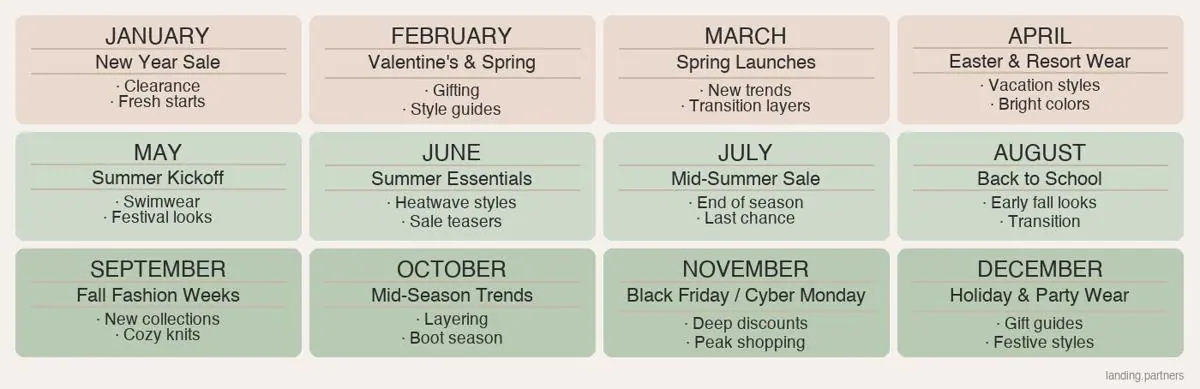
The Fashion Email Calendar: Month by Month
This breakdown covers the core seasonal moments. The weight of each moment depends on your brand type - key differences are flagged throughout.
January - Sales and Recovery
For women's fashion, streetwear, and most contemporary labels: January is a major sales month. The communication rhythm here is:
• Pre-sale announcement (late December): tease to engaged subscribers only
• Sale launch: full list, urgency-led
• Mid-sale: extension or 'last chance' send - only if the sale is genuinely ending
• Post-sale: recovery email - new arrivals, editorial, move people off the discount mindset
For kidswear brands: January is transitional. The big moment was Christmas. Focus shifts to spring/summer preview and brand storytelling - not discounts.
For jewellery brands: January is quiet post-Christmas. Discounting in January can damage brand positioning built through the gifting season. New arrivals and SS preview are the right focus.
February - Valentine's Day (Only for the Right Brands)
Valentine's Day matters for: jewellery, gifting brands, fragrance, accessories. For most women's fashion and streetwear brands, it is a minor moment at best.
Do not force Valentine's Day content if your product is not naturally gift-driven. Generic 'gift ideas' emails from a brand that is not a gifting brand feel off and erode trust. Use February for SS collection seeding instead - early looks, editorial, building anticipation.
Not sure which seasonal moments are worth activating for your brand specifically? Book a free email strategy call and we will map the calendar to your customer data and brand type.
March and April - Spring/Summer Launch
This is a critical stretch for most fashion labels. The SS collection is live or close to it. This is where editorial email earns its place - styling content, collection narratives, lookbook reveals.
The temptation to discount early in the season is one of the most common mistakes we see. March-April is the window where full-price selling is easiest. The customer is excited about new arrivals. You have not yet trained them to wait for a sale.
Communication rhythm for March-April:
• Collection launch email (hero email, editorial quality)
• Style edit follow-up 3-5 days later: picks for specific customer segments
• New drops or restocks as they go live
Flows carrying the weight for cart recovery and browse abandonment in the background
May - Mother's Day
For gifting brands and jewellery: Mother's Day (second Sunday of May in most of Europe) is one of the top 3 peaks of the year. If you're advertising in the Belgian market, the mix of French and Dutch audiences requires a bilingual campaign approach. Plan the campaign sequence 4 weeks out minimum: teaser, gift guide, last shipping dates, post-purchase.
For apparel brands: Mother's Day is relevant only if your product has a clear gift angle. If not, skip it - forcing relevance rarely works and can feel tone-deaf.
June and July - Summer Sale Season
For women's fashion and streetwear: the summer sales window (typically late June through July) is the second major sale period after January. The same rhythm applies - warm the list before the sale, not just during it.
We consistently see that brands who send a 'pre-sale access' email to their most engaged subscribers (3-5 days before the full list sale launch) get significantly higher open rates on the main sale email. The exclusivity priming works - your best customers respond to being treated as insiders.
For kidswear: June is relatively quiet. Focus shifts toward back-to-school preparation from August onward.
August - Back to School (Kidswear Priority)
For kidswear and teenage fashion labels: late August is frequently the biggest single month of the year - bigger than BFCM. Plan accordingly, 6 weeks out minimum.
For adult fashion: August is typically lower engagement outside of summer sale clearance. Use August to build the list and seed AW arrivals.
September and October - Autumn/Winter Launch and BFCM Preparation
The AW season launch mirrors the SS pattern from March-April. New collection, editorial quality, full-price focus. Do not rush to discounting.
October is also where early BFCM preparation begins — our Klaviyo benchmarks for fashion show what open rates and placed order rates to target before you start your sequence. If you plan to participate in BFCM, start warming your list in October - not in November. Use October emails to introduce AW hero pieces, segment your list by engagement level, and seed VIP early-access messaging for your most loyal buyers.
November - BFCM
Your BFCM strategy matters for most fashion labels - but the right approach depends heavily on brand type and price point.
For luxury or positioning-focused brands: participating in BFCM with a full site discount risks the brand equity built all year. Consider instead: exclusive new arrivals, limited edition pieces, or loyalty-only offers. The goal is to reward loyal customers - not train new ones to wait for discounts.
For contemporary and streetwear brands: BFCM is a major revenue window. The email sequence is: early access to engaged subscribers (Wednesday before Black Friday), full list launch on Black Friday, Cyber Monday extension only if inventory warrants it, then post-BFCM recovery back to full price.
BFCM strategy varies significantly by brand type and margin structure. If you are unsure how to approach it for your brand, book a free strategy call before October. That is when the planning needs to start.
December - Christmas and Gifting Season
For jewellery and gifting brands: December is the biggest month of the year. Gift guides, last order dates, 'still time to order' sequences - this is the peak.
For apparel brands: December is strong but more variable. Gift-wrapping services, styling for holiday events, and year-end editorial all perform well.
The period between Christmas and New Year is often under-used. Customers who received gift vouchers or made purchases and are in a discovery mindset respond well to 'what to spend your voucher on' content. It is a low-competition window where a well-timed email can punch above its weight.
Campaigns vs. Flows: When to Use Each
One of the most common structural mistakes we see: brands over-relying on campaigns during seasons where flows should carry the weight - and vice versa.
Campaigns are one-time sends to your list. They are best for collection launches, sale announcements, seasonal events, editorial content, and moments where the whole list needs the same message at the same time.
Flows (automated sequences triggered by behaviour) carry the ongoing relationship load. Welcome series, abandoned cart, browse abandonment, post-purchase, winback - these run in the background and should never be paused for seasonal campaigns.

The distinction matters for planning: flows need to be set up before the busy season, not during it. If your abandoned cart flow is not live before BFCM, you are leaving the most reliable revenue in email on the table at the exact moment when site traffic is highest.
Across our client base, automated flows consistently contribute to email-attributed revenue in the background throughout the year - because they fire at the exact moment a customer shows intent, not when it is convenient to send. During peak campaign windows, campaign revenue spikes above flows. But outside of those windows, flows are the backbone. Brands without well-built flows are disproportionately dependent on campaigns - which means their email revenue is only as strong as their next send.
A practical planning rule: during low-engagement months (April-June for most fashion brands), let flows do the work. During high-engagement months (BFCM, sale seasons, collection drops), layer campaigns on top - but do not pause the flows.
How Often Should a Fashion Brand Email?
Frequency depends on three things: your brand type, your list quality, and the time of year. There is no universal number.
A luxury label sending 4 emails a week will see unsubscribe rates spike and damage the list quality built over years. A streetwear drop brand with highly engaged subscribers can send daily around a drop without any issue - because the audience expects and wants it.
Rough frequency guidelines by brand type:
• Luxury / contemporary fashion: 2-4x per month outside of key sale windows; up to 6-8x per month during sales or collection launches
• Streetwear / drop-model brands: low (1-2x per month) between drops, high (daily or every other day) during drop week
• Kidswear: 4-6x per month during key selling periods (back-to-school, Christmas); lower in transitional months
• Jewellery / gifting: 3-4x per month as a baseline, with significant increase during gifting seasons (Valentine's, Mother's Day, December)
The signal that your frequency is too high is not usually your unsubscribe rate. It is your open rate trend. If open rates are declining consistently over 4-6 weeks, you are either sending too frequently or your content quality has dropped. Both are fixable - but you need to identify which one is the actual problem first.
The signal that your frequency is too low: warm leads are going unworked. If someone signed up 3 months ago and has received fewer than 5 emails, they have largely forgotten who you are. Re-engagement becomes harder, not easier, with time.
The Most Common Fashion Email Calendar Mistakes We See
Sending more volume during sales, not before them. The goal of email before a sale is to warm the audience so that when the sale lands, they already want to buy. Brands sending 3x more volume during a sale than in the weeks leading up to it are fighting harder for less.
Treating all subscribers identically. A customer who has bought 4 times in the last year should receive different emails - in content, timing, and offer - than someone who signed up last week and has never purchased. Segmentation is not optional for fashion brands serious about email performance.
Discounting too early in the season. Every time you train a new-season subscriber to expect a discount within 6 weeks of a collection launch, you are shortening your full-price selling window for the next season too.
Pausing flows during campaigns. Flows should never be paused because 'we are already sending a campaign this week.' The customer who abandoned their cart during your BFCM campaign is among the most valuable leads in your list. The flow should fire regardless of what else you are sending.
No warming strategy for list growth ahead of peaks. If you are running list-building ads in October specifically for BFCM, those new subscribers need a welcome sequence that moves them toward purchase before the BFCM window opens. A subscriber who joined the day before Black Friday and received no emails is unlikely to convert on a cold BFCM blast.
Every brand's email calendar looks different. The right frequency, the right seasonal moments, the right balance of campaigns and flows - it depends on your price point, your brand type, your list quality, and your growth stage.
If you want to map this framework to your specific situation - and build an email calendar that is actually matched to your brand's seasonal rhythm - book a free email strategy call with our team. We will look at your current setup and tell you exactly what to build next.