Price Drop and Low Stock Klaviyo Flows for Fashion Brands: How to Convert High-Intent Browsers Who Didn't Buy the First Time

Your abandoned cart flow is doing its job. But what about the browser who viewed a dress three times, never added it to cart, and disappeared? Standard abandoned cart flows won't catch her. Price drop and low stock Klaviyo flows will.
These two flows are the most underused sequences in fashion Klaviyo setups. They target a very specific buyer: someone who has shown repeated, high-intent interest in a product but hasn't converted yet. The gap between interest and action is exactly where scarcity and price movement can do the work.
We build these flows for fashion clients at Landing Partners, and what we see consistently is that they generate incremental revenue that no other flow touches. Not because they're aggressive - but because they're timed to moments when a browser is most likely to act.
Key Takeaways
- •Price drop and low stock flows target high-intent browsers who didn't convert the first time
- •Low stock flows work best for fashion because collectie-logic creates natural scarcity
- •Price drop flows should only fire for genuine markdowns - never as a default discount mechanism
- •The optimal architecture: browse abandonment -> low stock branch -> price drop branch
- •Benchmarks: 12-18% incremental revenue per month for fashion brands with active flows
- •Flow type determines messaging tone: luxury brands handle scarcity very differently than streetwear
Why Fashion Is the Perfect Category for Scarcity-Based Flows
Fashion has something most other e-commerce categories don't: genuine, built-in scarcity. A dress in size 36, a specific colourway of a jacket, a piece from a limited-run collection - these products run out. That's not manufactured urgency. It's the nature of how fashion works.
This makes low stock alerts fundamentally more trustworthy in fashion than in, say, electronics or home goods. When you tell a browser that only 3 units of her favourite jacket remain in her size, it's almost always true. And she knows it.
**The browser who is most likely to convert** is the one who has viewed the product multiple times, hasn't added to cart yet, and is in that consideration limbo where she wants it but hasn't committed. A low stock alert or a price reduction is the external push she was waiting for.
Across our fashion clients, browsers who trigger a low stock flow after viewing a product 2+ times convert at 3-4x the rate of a standard abandoned browse email.
There's a reason these flows work better than an extra abandoned cart nudge: they offer new information. The buyer already knows she wants the product. She doesn't need to be reminded it exists. She needs a reason to act now.
The Browse Abandonment Trigger: Setting the Right Entry Conditions
The foundation of both flows is the browse abandonment trigger - but the entry condition matters more than most brands realise.
Don't trigger on a single product view
A single view is noise. Someone clicked through from an Instagram ad and bounced. That's not a signal. The correct entry condition for a browse abandonment flow that feeds into price drop and low stock branches is at minimum two views of the same product within a 7-day window, with no subsequent purchase or cart add.
In Klaviyo, this is built as a metric trigger: 'Viewed Product' where the person has viewed the same product URL twice in 7 days, and has not placed an order since.
The timing of the first email
Send the first browse abandonment email 24 hours after the second view. Not 1 hour - that's cart abandonment timing, and it's too aggressive for someone who never added to cart. At 24 hours, the product is still fresh in her mind but enough time has passed that the email doesn't feel stalker-ish.
The content of this first email is simple: show the product, no urgency messaging yet. Just a beautiful image, the product name, and a clean link back to the product page. You're reminding, not pressuring.
Not sure if your Klaviyo flows are set up correctly? Book a free Klaviyo audit and we'll map out exactly which flows are missing or underperforming.
Low Stock Flows: When to Fire and How to Frame It
The low stock branch of your flow fires when inventory for the specific product the browser viewed drops below a defined threshold. In Klaviyo, this requires a product inventory webhook or a Shopify integration that passes inventory levels as event properties.
The threshold question: how many units triggers the alert?
This isn't universal. It depends on your fashion subsector and your typical sell-through velocity:
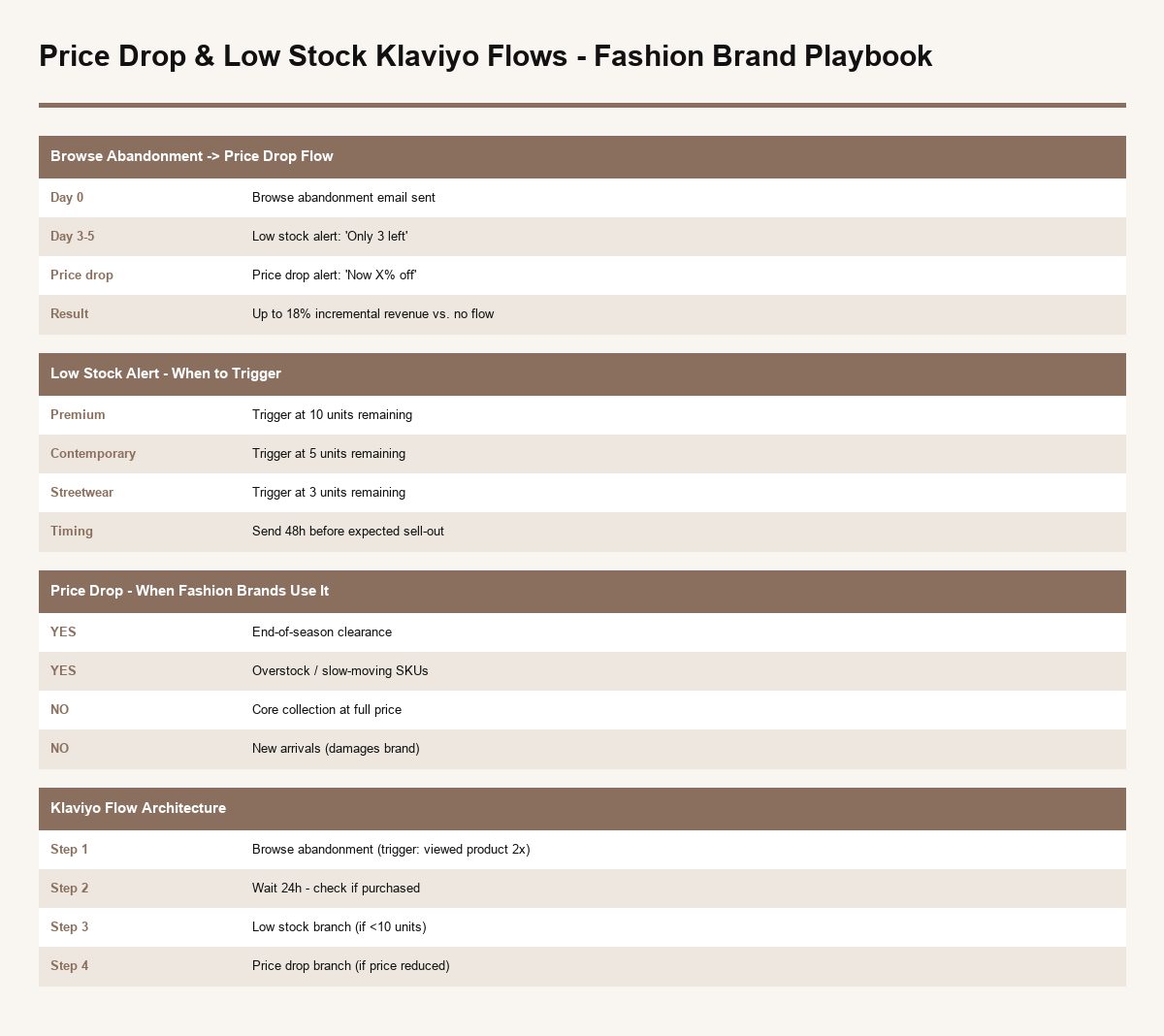
For **premium and luxury fashion brands**: trigger at 10 units remaining. At this price point, the scarcity signal needs to feel exclusive, not desperate. '10 pieces left' communicates rarity, which matches the brand positioning.
For **contemporary fashion brands**: trigger at 5 units. This is the sweet spot where the urgency feels real without feeling like a fire sale.
For **streetwear and high-volume fashion brands**: trigger at 3 units. The audience expects more aggressive scarcity signals, and the sell-through velocity is typically faster.
When we A/B tested threshold messaging for a contemporary fashion client, 'Only 5 left in your size' outperformed 'Selling fast' by 34% in click rate. Specific numbers convert better than vague urgency.
How to write the low stock email
The low stock email has one job: communicate genuine scarcity without sounding panicked. Three elements matter:
First, **lead with the product image**, not with 'HURRY'. The product she wants is the hero. The scarcity is context, not the headline.
Second, **be size-specific if you can**. 'Only 3 left in size 38' is dramatically more effective than 'Only 3 left'. If your Shopify integration passes variant-level inventory to Klaviyo, use it. If not, size-agnostic low stock messaging still works - it just converts at a lower rate.
Third, **no discount in this email**. The whole point of a low stock flow is that scarcity is the reason to act. Adding a discount undermines the message and trains your audience to wait for both scarcity and a price cut before buying.
Price Drop Flows: The Rules Fashion Brands Must Follow
Price drop flows are powerful but dangerous to use wrong. The distinction between a healthy price drop strategy and one that slowly erodes your brand is how and when you activate them.
When a price drop flow is appropriate
End-of-season clearance is the clearest valid use case. When you're moving winter stock to make room for spring arrivals, a price reduction is expected and brand-safe. Browsers who viewed a coat in November and see a 25% price drop in February will find it completely natural.
Overstock situations - when a product hasn't performed as expected and you need to move units - are also valid. The key is that the price drop should feel like a logical business decision, not a sign that the product has been rejected by the market.
When a price drop flow is not appropriate
Core collection products at full price should never be in a price drop flow. If a best-selling blouse gets a price drop email, you've just told every future browser to wait for the discount.
New arrivals should never trigger a price drop flow. Ever. If a product is in its first 60 days on the site, protect its price integrity. A price drop within the launch window signals weakness and damages both the product and your brand.
We've seen fashion brands inadvertently put core collection items into price drop flows. The result in one case: a 22% decline in full-price purchase rate for that product category over 3 months as browsers learned to wait.
Tone by fashion subsector
**Luxury and premium brands** should frame price drops as 'exclusive access' rather than discounting. The language is: 'The piece you've been watching is now available at a reduced price for a limited time' - not 'SALE: 30% off'. The email should look like your regular brand communication, not a promotional blast.
**Contemporary and mid-market brands** can be more direct: 'Good news - the price dropped on your saved item'. Clean, honest, no drama.
**Streetwear brands** can lean into the deal energy: 'Your wishlist just got cheaper. Don't sleep on it.' The audience expects this and it resonates.
Building the Full Flow Architecture in Klaviyo
The optimal architecture combines browse abandonment, low stock, and price drop into one coordinated sequence. Here's how we build it:
Entry trigger
Viewed Product (same product, 2+ times in 7 days). Filter: has not placed order in last 7 days. Filter: has not added to cart in last 24 hours (let the cart abandonment flow handle those).
Step 1: Browse abandonment email (Day 0, +24h after trigger)
Product imagery, no urgency copy, clean CTA back to product page. Subject line: '[Product name] - still thinking about it?'
Step 2: Wait 48 hours, check if purchased
If yes: exit flow. If no: continue to conditional splits.
Step 3: Conditional split - inventory check
Is inventory for this product below the threshold for this brand tier? If yes: send low stock email. If no: move to price drop check.
Step 4: Conditional split - price drop check
Has the price for this product decreased since the browse event? If yes: send price drop email. If no: exit flow (or optionally, send one final soft reminder on Day 10).
What to avoid
Don't send low stock AND price drop emails to the same person within 48 hours. If they've received a low stock alert, give that time to work before firing a price drop message. Stacking urgency triggers creates the perception that the brand is desperate.
Want us to build this flow architecture in your Klaviyo account? Book a free call and we'll map out the exact setup for your fashion brand.
Integrating These Flows with Meta Retargeting
The browse abandonment that triggers your Klaviyo flows is also a signal you can use in Meta. Browsers who viewed a product twice and didn't purchase are among your warmest audiences on the platform.
There are two ways to connect these flows to your Meta strategy:
**Klaviyo -> Meta Custom Audience sync**: Use Klaviyo's Meta integration to create a dynamic audience of people currently in your browse abandonment flow. Run a retargeting campaign showing them the exact product they viewed. This creates a multi-channel pressure that significantly improves overall conversion from this high-intent segment.
**Price drop as dynamic ad trigger**: When you reduce a price, you can trigger a dynamic product ad update in Meta that shows the product with the new price to anyone who viewed it on your site. Combined with the Klaviyo price drop email, this multi-channel approach typically outperforms either channel alone by 40-60% in terms of incremental revenue from this audience.
The key is not to duplicate the exact same message across both channels simultaneously. Email can carry more context and a longer narrative. Meta ads should be visual and immediate - the product, the new price, and a clear CTA.
For a contemporary women's fashion brand we manage, combining Klaviyo price drop emails with Meta dynamic retargeting for the same browse audience increased total incremental revenue from this segment by 58% versus Klaviyo alone.
Subscriber-Burn Risk: How to Avoid Over-Messaging
The biggest risk with price drop and low stock flows is sending too many urgency-based emails to the same subscriber too frequently. If someone browses your site regularly, checks multiple products, and never buys - she should not be receiving 3 urgency emails per week.
Three safeguards to build in:
**Global frequency cap**: In Klaviyo's smart sending settings, limit any individual profile to no more than 2 flow emails per 5-day period across all urgency-based flows. This prevents stacking from browse abandonment, low stock, and price drop flows firing simultaneously for a heavy browser.
**Exclude active cart abandonment**: Any profile who has added to cart in the last 48 hours should be excluded from browse abandonment flows. The cart abandonment flow handles them. Having both fire on the same person for the same product is a fast track to unsubscribes.
**Monitor engagement signals**: After 3 urgency-based emails in a 30-day window with no purchase and no click, suppress the profile from urgency flows for 60 days. They're telling you the timing isn't right. Don't keep pushing.
Measuring What Matters: The Right Benchmarks
How do you know if these flows are working? The metrics that matter are incremental, not total.
Fashion KPIs for these flows should be measured separately from your regular email metrics. Look at:
**Revenue attributed to the flow per month**: This is your baseline. For a fashion brand doing €500K+ in annual revenue, a well-built browse-to-price-drop flow architecture should generate €3K-8K per month in incremental revenue. For brands at €1M+, we typically see €8K-20K per month.
**Conversion rate of flow emails vs. regular campaigns**: Flow emails should outperform campaign emails significantly. If your campaign email click-to-conversion rate is 2-3%, your browse abandonment flow emails should be hitting 6-10%. Low stock emails should be at 8-15%.
**Unsubscribe rate from flow emails**: If your unsubscribe rate from these flows is higher than your campaign average, the frequency or the messaging is off. Normal is 0.1-0.2% per send. Above 0.4% means something is wrong.
What you should not use as a success metric: open rate alone. These flows have artificially high open rates because the audience is highly engaged. What converts them is the quality of the content and timing, not the subject line.
Frequently Asked Questions
Every fashion brand's inventory and customer behaviour is different. The right threshold for your low stock trigger, the right tone for your price drop messaging, and the right flow architecture depends on your price point, your audience, and your sell-through patterns. If you want to know what this looks like built specifically for your brand - book a free Klaviyo strategy call and we'll walk through the setup together.