
International expansion is the ambition of almost every fashion brand we work with. It is also the most common cause of stalled growth we see.
Most brands go international too early, spread their budget across too many markets, and end up underperforming everywhere. A few do it right - and when they do, the results compound fast.
Based on our work with 40+ fashion brands across Belgium, the Netherlands, Germany, France and the UK, here is what actually determines success when crossing borders.
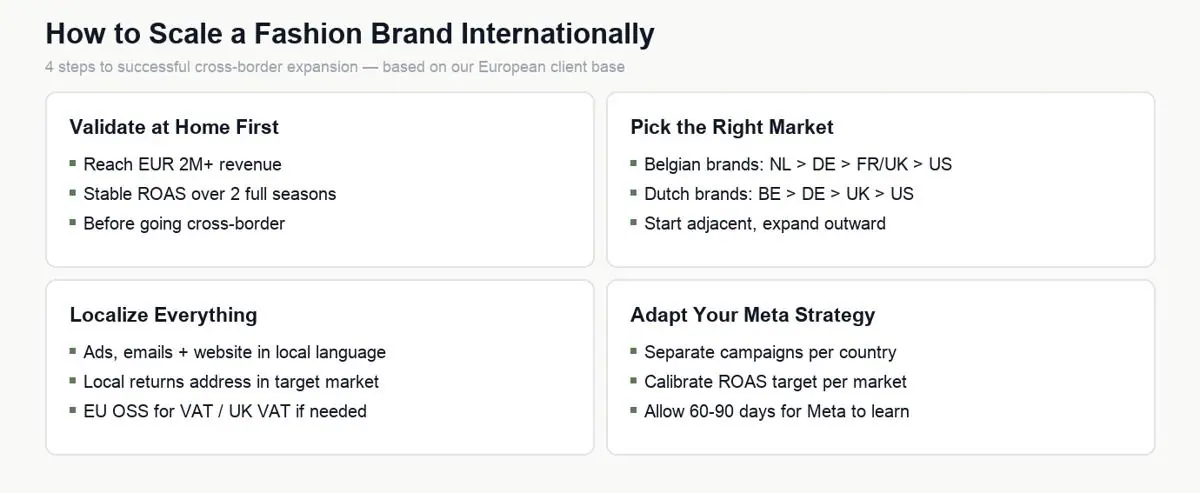
When Are You Actually Ready to Go International?
The most honest answer: later than you think.
In our experience, most brands attempt international expansion somewhere between €500K and €1M in home market revenue. Almost none of them are ready at that stage.
The minimum threshold we recommend: €2M+ in your home market, with a stable ROAS over at least two full seasons.
Why does this threshold matter? Because international expansion is expensive in ways that are not obvious upfront. You will pay higher CPMs in unfamiliar markets. Your CR will drop initially because you have no social proof in the new country. Logistics cost more. Customer acquisition cost goes up before it comes down.
If your home market is not yet profitable at scale, going international will not fix that - it will make it worse.
Based on our work with 100+ fashion brands: premature international expansion is the most common growth killer we see after the €500K mark.
The brands that expand successfully are the ones that have already solved the core loop at home: traffic comes in, the store converts, email captures and retains. When that system runs on autopilot, you can start stress-testing it in a new market.
Not sure if your home market is ready? Book a free growth call - we will tell you what needs to be in place before you expand.
Which Markets Should You Enter First?
For Belgian and Dutch fashion brands, the expansion sequence we almost always recommend is: start with the adjacent market, then the next closest, then the harder ones.
For Belgian brands: Netherlands first (same language for NL-speaking brands, high purchasing power, culturally close), then Germany, then France or UK.
For Dutch brands: Belgium first, then Germany, then UK.
Germany is the largest e-commerce market in Continental Europe and often the highest-revenue opportunity for fashion brands. But it also requires the most localization - more on that below.
France is culturally close to Belgium but has a strong preference for French-language experiences. A non-localized French campaign will underperform.
The UK is the hardest first expansion market - Brexit has added VAT and customs complexity, shipping costs are higher, and British consumers are loyal to domestic brands. We usually recommend UK as step 3 or 4, not step 1.
The US is frequently mentioned by founders as the dream market. It is also the most expensive to enter. CPMs on Meta are among the highest in the world. You need significant creative volume to compete. We recommend the US only for brands that are already scaling profitably across multiple European markets.
Across our client base, the brands that entered Germany as their first international market achieved profitability fastest - typically within two to three seasons.
What You Need to Adapt: Language, Tax, Logistics, Creative
International expansion is not just running the same ads in a different country. The brands that treat it that way lose money.
Language
For UK and US: English-language content from your home market often works fine as a starting point. But localize your copy for tone - British and American audiences read very differently.
For Germany: localize from the start. German consumers strongly prefer German-language experiences at every touchpoint - ads, landing pages, emails, and product descriptions. Running German campaigns in English is a mistake we have seen brands make repeatedly.
For France: same rule. French consumers expect French. Non-localized ads perform significantly worse.
Tax and compliance
Within the EU, the OSS (One-Stop-Shop) VAT system simplifies things considerably. If your annual cross-border B2C sales exceed the €10,000 threshold, you need to register and file via OSS. Get this in order before you scale - retroactive VAT compliance in multiple countries is painful.
For the UK: post-Brexit, UK VAT registration is required if you sell goods to UK consumers above the £85,000 threshold. Customs declarations apply to goods shipped from the EU.
For the US: sales tax varies by state. If you are starting small, you can often operate below nexus thresholds, but get proper advice as you scale.
Logistics
Return rates in fashion are high - often 20-40% depending on the category. A local returns address in your target market has a direct impact on your CR. Consumers who see a local returns address convert better. Services like Returnless, Sendcloud or a local 3PL partner in your target market make this achievable without a warehouse.
Creative
Good news: strong creative often travels well. A well-shot editorial image or a high-performing video hook does not need to be re-shot for each market. What you do need to localize: the copy overlay, the call-to-action text, and sometimes the offer framing. German consumers respond well to explicit price guarantees; French consumers respond to aspirational framing.
Need help structuring your international expansion across channels? Talk to our team - we run cross-border campaigns for fashion brands across 6+ markets.
How to Adapt Meta Ads for International Markets
The biggest mistake in international Meta strategy: running a single multi-country campaign and hoping the algorithm figures it out.
Always run separate campaigns per country. This gives you clean ROAS data per market, allows you to set country-specific budgets, and prevents Meta from routing spend to the cheapest CPM market rather than the most profitable one.
CPMs vary dramatically by market. Germany typically has higher CPMs than Belgium. France is in between. The UK has some of the highest CPMs in Europe. This means your ROAS target per country needs to be calibrated separately - you cannot expect the same return on ad spend in every market.
Creative language in ads: Use the local language in ad copy and overlays. Meta will often auto-translate, but the quality is not good enough for brand-building work. Invest in localized copy from the start.
For prospecting: broad targeting with strong creative works well in new markets, just as it does at home. Do not over-complicate the targeting.
For retargeting: you need meaningful traffic volumes in the new market before retargeting makes sense. At minimum, 5,000+ monthly sessions from that country before setting up a dedicated retargeting layer.
In our international Meta campaigns, we consistently see the first 60-90 days in a new market produce below-target ROAS as Meta builds audience signals. Brands that stop too early miss the point where efficiency kicks in.
Email Marketing in Other Languages: When to Localize?
Email is often the last thing brands localize - and that is a mistake.
For the UK and US: English is fine from the start. Adjust the tone (more conversational for UK, more direct for US), but you do not need separate templates.
For Germany: localize early. German-language email campaigns in our client base consistently outperform English versions for German audiences. The improvement is significant enough to justify the translation cost from your first few hundred German subscribers onwards.
For France: same principle. Brands that localize French email flows see noticeably higher engagement than those running French campaigns into English-language flows.
Practical approach for early-stage international email:
Start with localized welcome flow and abandoned cart only - these are the highest-revenue automations. Translate those first, then expand to post-purchase and browse abandonment as the list grows.
Do not launch international email campaigns (promotional sends) until you have at least 1,000 subscribers from that market. The cost of translating a campaign to send to 200 people is not worth it.
Segment your list by country from the start. This prevents accidental sends in the wrong language and gives you clean data on engagement per market.
Case Study: A Belgian Fashion Brand Expanding Into Germany
One of the Belgian women's fashion brands we worked with - a contemporary label in the €150-250 AOV range - decided to expand into Germany in their third year, having reached stable profitability in Belgium and the Netherlands.
What they did right: They localized everything before launch. German website copy, German ad creative overlays, German email flows, and a German returns address via a local 3PL partner. They set a 90-day patience window before evaluating ROAS.
What the first 90 days looked like: Meta ROAS in Germany started at roughly 60% of their Belgian benchmark. CPMs were higher. The algorithm was building signals. They stayed the course.
What happened by month 6: German ROAS had reached parity with Belgium. Email engagement from the German list was above the Belgian benchmark - the localized flows performed better than expected.
Within 12 months, Germany represented 30% of total brand revenue, with a CAC lower than Belgium - the market was less saturated in their segment.
For this brand, Germany went from 0% to 30% of revenue within 12 months - made possible by full localization from day one and patience to let Meta build audience signals.
The key lesson: international expansion is not a quick win. The brands that treat it as a 30-day test fail. The brands that plan for a 6-month ramp, localize properly, and maintain consistency - they are the ones that see Germany, France or the UK become meaningful revenue drivers.
Ready to plan your international expansion? Book a free call with our team - we will map out the right markets, timeline and budget for your brand.
International Expansion Checklist
Home market is consistently profitable at €2M+ revenue
Target market selected based on cultural proximity and logistic feasibility
Website localized in target market language
Ad creative copy and overlays localized
Welcome flow and abandoned cart email translated
Klaviyo subscriber list segmented by country
VAT/tax compliance in order (OSS for EU, UK VAT if applicable)
Local returns address or 3PL partner in target market
Separate Meta campaign(s) per country
Country-specific ROAS target set (not copied from home market)
90-day patience window set before evaluating campaign performance
Every brand's international journey is different. The right markets, the right timeline, and the right budget depend on your margin, price point, product and stage. If you want to know what international expansion looks like for your specific brand - book a free call with our team.