Digital Marketing for Fashion Brands in Belgium: What's Different About the Belgian Market

Belgium has 11 million people, three official languages, and two fashion audiences that behave nothing like each other. If you have been applying your Dutch or French marketing playbook here and wondering why it is not clicking - this is why. Getting your ad budget allocation right for Belgium is often step one.
Key Takeaways
- •Belgium has two primary consumer audiences - Dutch-speaking Flanders and French-speaking Wallonia - that require different creative, messaging, and often different channel approaches
- •Flemish consumers behave closer to Dutch shoppers; Walloon consumers share more traits with French shoppers - but neither is a direct copy
- •CPMs on Meta in Belgium typically run 15-25% lower than in the Netherlands, making it a cost-efficient testing ground for European expansion
- •English-first works for younger urban fashion audiences but misses significant demand in the 35+ segment
- •The biggest mistake Belgian fashion brands make: treating Belgium as one market instead of two — for examples of how Belgian fashion brands are winning online, see our case study roundup
We are based in Ghent - a city in Flanders, the Dutch-speaking part of Belgium. We work with Belgian fashion brands every week. And we can tell you that Belgium is one of the most misunderstood markets in European fashion - precisely because it looks simple from the outside.
It is small enough that international brands often lump it into a broader European campaign. It is complex enough that brands who do that consistently underperform. The brands that treat Belgium with the same strategic rigour they apply to Germany or the UK are the ones growing here.
Belgium Is Two Markets in One
The most important thing to understand about Belgium is the north-south split. Flanders (Dutch-speaking, roughly 60% of the population) and Wallonia (French-speaking, roughly 30%) are not just different languages. They are different media ecosystems, different consumer cultures, and different trust frameworks.
Flemish consumers discover fashion more like Dutch shoppers - Instagram-heavy, strong affinity for local brands, and high sensitivity to social proof from within their community. Walloon consumers discover fashion more like French shoppers - brand heritage matters, visual aesthetics carry more weight, and trust is built slower but is more durable once established.
Flanders accounts for roughly 70% of Belgian ecommerce sales. For fashion brands prioritising where to invest first, this is where Belgian online demand is concentrated - but Wallonia's lower media costs and less competitive landscape make it a strong second market once Flanders is working.
Running one campaign that ignores this split is the most common - and most expensive - mistake we see Belgian brands make. You are not reaching one audience. You are reaching two audiences with one message, and that rarely works.
Not sure how your current campaigns are performing across Belgium's two markets? Book a free audit and we will show you exactly where you are leaving budget on the table.
The Belgian Consumer: How They Discover and Buy Fashion
Across both regions, Belgian fashion consumers share one key trait: they are brand-loyal once you earn their trust, but they are slow to trust. The time from first touch to first purchase tends to be longer in Belgium than in the Netherlands or the UK.
On Meta, Flemish consumers respond well to content that feels local — use our creative strategy brief framework to structure this properly - Belgian faces, Belgian streets, recognisable references to the domestic market. International creative that performs well in the UK often runs below average in Flanders because it lacks that grounding. Walloon consumers respond more to aspirational content with strong visual direction, closer to the French premium aesthetic.
Email and retargeting play a larger role in Belgium than in markets where organic social is stronger — which is why a solid Klaviyo flow setup is especially important for Belgian brands. Belgian consumers browse and compare before they buy. A well-timed email flow - not a hard sell, but a relevant follow-up - consistently closes purchases that Meta alone does not. Across our Belgian client accounts, abandoned cart recovery rates are among the strongest we see anywhere in Europe.
Across our Belgian client base, mobile accounts for around 70% of sessions and a growing share of completed purchases. Mobile optimisation is not a nice-to-have - it is where the majority of your Belgian audience is experiencing your brand.
Mobile commerce in Belgium is the dominant channel. Despite this, we still see mobile CR running 10-15% below desktop on most Belgian fashion stores we manage. That gap represents recoverable revenue. Checkout flow, product page speed, and mobile-first UX are direct growth levers - especially given that 70% of your sessions are arriving on a phone.
Language Strategy: NL, FR, or EN?
This is the question every Belgian fashion brand eventually faces. The honest answer is that it depends on your audience - but there is a practical framework.
For fashion brands targeting 18-34 urban consumers: English-first works. Young Belgian fashion consumers, especially in Antwerp, Brussels and Ghent, are highly proficient in English and often prefer it for fashion content. It also lets you sidestep the NL/FR operational split while your brand is still finding its feet.
For fashion brands with broad age targeting or lifestyle positioning: you need NL and FR. The 35+ audience in both regions is significantly less likely to engage with English-only content. If your brand targets families, working professionals, or gifting occasions, single-language English is leaving a material part of your addressable market untouched.
For Belgian brands expanding toward the Netherlands or northern France: start with your strongest language first. A Flemish brand expanding to the Netherlands has a natural head start - the language transfers directly and the Dutch online fashion market is roughly 1.8x the size of Flanders. Build density there before stretching to Wallonia or France.
A note on Brussels: the capital is genuinely bilingual and skews young and internationally oriented. For fashion brands, Brussels often rewards English-first or dual NL/FR creative more than any other Belgian city. If your brand has a strong urban identity, Brussels should be a deliberate focus - not just an incidental part of a nationwide campaign.
Channel Mix: Where Belgian Fashion Consumers Spend Their Time
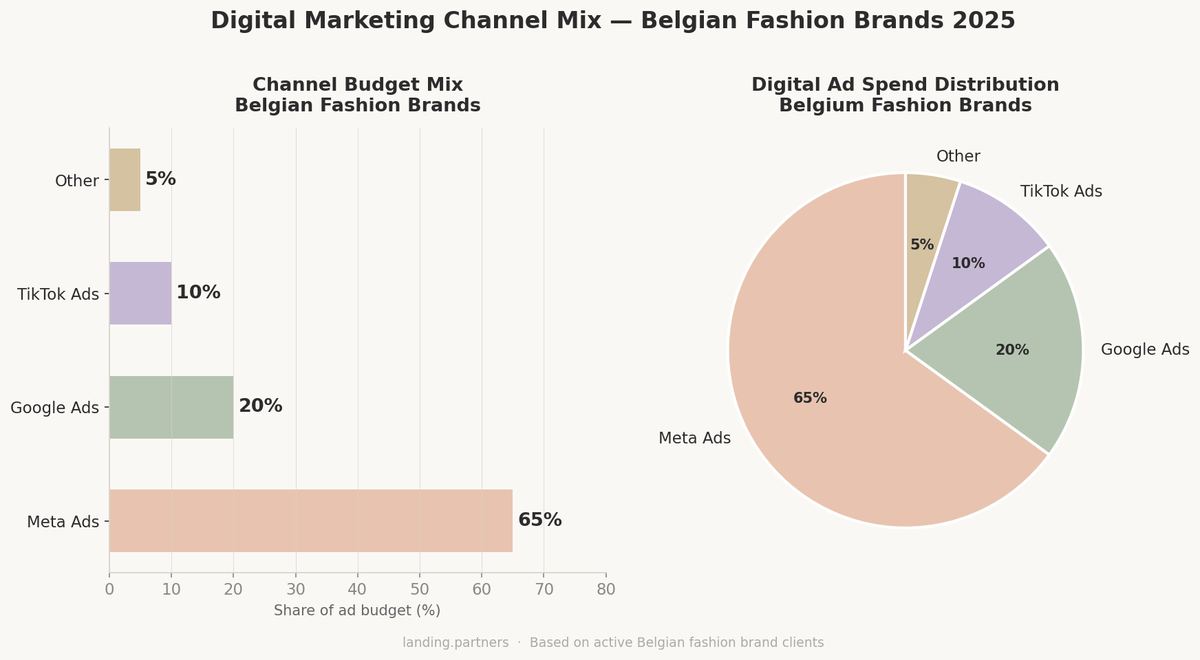
Based on what we see across our Belgian client accounts, here is how the channel picture looks for fashion (see also our Meta ads benchmarks for fashion brands):
Meta (Instagram and Facebook): the dominant paid channel for Belgian fashion at every price point. Instagram drives discovery and brand awareness; Facebook drives retargeting and reaches older demographics more efficiently. CPMs in Belgium typically run 15-25% lower than in the Netherlands - which makes Belgium a cost-efficient environment for testing creative before scaling to higher-CPM markets.
Email: consistently delivers the strongest returns once list size reaches 1,000+ subscribers. Belgian consumers who opt into email are high-intent. The welcome series and abandoned cart flow perform particularly well - we see Belgian email flows driving a disproportionate share of first-purchase conversions compared to other European markets we manage. Do not underinvest in email for Belgium.
Google: Shopping and brand search perform well, particularly in Flanders. Organic search in Belgium is slightly less competitive than in the Netherlands, meaning well-structured content can rank faster with less domain authority. French-language SEO in Wallonia is notably underdeveloped overall - an opportunity for brands willing to invest in FR content.
TikTok: growing fast in Flanders, slower in Wallonia. Flemish Gen Z fashion consumption on TikTok is now comparable to the Netherlands. For brands targeting under-25, TikTok is no longer an optional channel - it is where discovery is happening.
Pinterest: punches well above its weight for Belgian women's fashion and home-adjacent lifestyle brands. We see Belgian fashion brands getting meaningful organic Pinterest traffic with minimal ongoing investment. Worth maintaining even without paid spend, particularly for brands with strong visual product catalogues.
Want to know which channels are actually driving growth for Belgian fashion brands right now? Book a free strategy call - we will walk you through what we are seeing across our client base.
What We See Holding Belgian Fashion Brands Back
After working with Belgian fashion brands at every revenue stage, the bottlenecks are consistent. Here is what comes up again and again:
1. Treating Belgium as one market. Separate Flanders and Wallonia in your Meta campaigns. Segment your email lists by language. Use different creative briefs where budget allows.
We see 20-35% better email engagement when language matches the audience region. Basic NL/FR segmentation in Klaviyo is one of the lowest-effort, highest-return changes a Belgian fashion brand can make.
2. Underinvesting in the store before scaling ads. Belgian consumers are patient browsers but impatient converters. If the checkout is not smooth, they leave - and they do not come back easily. We see CR issues on Belgian fashion sites far more often than we see budget issues. Fix the store first. Scaling spend into a leaking funnel just scales the leak.
3. Ignoring Wallonia entirely. Many Flemish brands run Dutch-only marketing and wonder why Wallonia underperforms. French-language email flows, FR ad creative, and French-language landing pages are not just a courtesy - they are a commercial opportunity. Wallonia has 3.7 million people, lower media costs than Flanders, and less competition for fashion advertising attention.
4. Skipping local credibility signals. Belgian consumers trust Belgian references. Press coverage in local publications carries weight that international press cannot replicate in this market. Local influencer partnerships — even at modest follower counts — consistently outperform international influencers for Belgian audiences. Local credibility is infrastructure, not vanity.
5. Expanding internationally before Belgium is optimised. This is the most common strategic mistake we see. A Belgian brand launches Netherlands campaigns while Belgian store CR is still below 1%. Build your home market first. It is your cheapest media market, your reference point for creative performance, and your most forgiving testing ground.
Belgium as a European Testing Ground
One underused advantage of Belgium: it is one of the most cost-efficient markets in Western Europe for testing paid media creative.
Belgian Meta CPMs typically run 15-25% below the Netherlands. Combined with Flanders' 70% share of Belgian ecommerce and a multilingual audience, Belgium offers one of the most cost-efficient testing environments in Western Europe for fashion brands.
Lower CPMs, a multilingual audience, and proximity to larger adjacent markets make Belgium a logical starting point for fashion brands building a broader European strategy. What works in Flanders with NL creative tends to translate to the Netherlands. What works in Wallonia with FR creative tends to translate to northern France.
We regularly use Belgian Meta campaigns as the primary testing layer before scaling spend into higher-CPM markets. A creative that cannot demonstrate a positive signal in Belgium rarely justifies increased spend elsewhere - and the cost of finding that out in Belgium is significantly lower than finding it out in Germany or the UK.
For international brands entering the Benelux market: Belgium is a lower-risk entry point than the Netherlands. Smaller audience, lower media costs, but genuine signal on whether your brand positioning translates to a European context. Get Belgium working, then scale outward.
How Landing Partners Works With Belgian Fashion Brands
We are a Ghent-based agency. Our team speaks Dutch and French. We have worked with Belgian fashion brands from their first ad account through to eight-figure revenue - and we have learned most of the lessons worth learning, so our clients do not have to.
What that means in practice: we know the Belgian consumer from working with them every week. We know which channels are driving conversions this season. We know that Walloon consumers need a different creative brief than Flemish ones. We know that local press coverage converts to email subscribers at rates that international press rarely matches in this market.
Belgium is not a difficult market. It is a nuanced one. And nuance is what we do.
Frequently Asked Questions
Every brand's situation is different. The right strategy for a Flemish streetwear brand at €80 AOV looks completely different from a bilingual jewellery brand targeting gifting occasions across Belgium. If you want to know what the right approach looks like for your specific brand - book a free call with our team.