Most fashion brands we talk to are still thinking about TikTok the way they think about Instagram. That's the first mistake.
Why TikTok Ads Are Different From Meta for Fashion Brands
Meta is an intent-capture machine. A user sees your ad, recognizes the product, clicks, buys. The signal from Meta is behavior-based - past purchases, lookalike audiences, website activity.
TikTok is entertainment-first. Users are not there to shop. They're there to watch videos. That means fashion brands need to earn attention before they can drive purchase intent. The mindset shift is significant.
The feed algorithm on TikTok prioritizes content engagement, not audience matching. Even a brand with zero followers can reach millions if the video resonates. That's both the opportunity and the risk - your creative has to work, or nothing else will.
We see this play out consistently across our fashion client accounts: on Meta, a mediocre creative with good targeting can still convert. On TikTok, a mediocre creative dies within 24 hours regardless of budget.
Based on our client accounts: TikTok creatives need a hook that captures attention within the first 2 seconds. Videos that fail this threshold see 80-90% drop-off before any message lands.
The TikTok Fashion Consumer: Discovery, Desire, Decision
The TikTok fashion consumer doesn't start with a search. They start with a scroll. They discover a product because a creator wore it, a trend pushed it into their feed, or an ad was indistinguishable from organic content.
This has a direct implication for how you build campaigns. The job of a TikTok ad is to stop the scroll and create desire - not to explain features or offer a discount code. That's a fundamentally different brief than Meta.
We've observed that fashion consumers who discover a brand through TikTok often take longer to convert than those who come through Meta. The average time from first TikTok exposure to first purchase in our fashion accounts is often 7-14 days. This isn't a problem - it's how the platform works. Plan for it.
What happens in those 7-14 days? The user follows the brand, visits the website organically, sees retargeting ads on Meta, and eventually converts. TikTok initiates. Meta closes. That's the pattern we see again and again.
Not sure whether TikTok is the right next step for your brand, or whether to scale Meta first? Book a free channel strategy call - we'll give you an honest answer based on your current numbers.
Which TikTok Ad Formats Actually Work for Fashion
There are several ad formats available on TikTok. Not all of them are equally useful for fashion brands at different stages. Here's what we actually use and why.
Spark Ads are our default starting point for almost every fashion client. Spark Ads allow you to boost existing organic posts - either from your own account or from creators who have given permission. Because the content looks and feels organic, it performs significantly better than ads that are clearly branded productions.
In-Feed Ads (standard video ads created specifically for advertising) work, but they require higher creative quality to compete with organic content. We use them for direct-response campaigns and retargeting, where intent is already established.
TikTok Shopping Ads are increasingly relevant for fashion brands with a Shopify store. They allow product catalog integration and can surface specific products within the TikTok app. We've seen solid performance for brands with a clear hero product or a tight, focused catalog.
TopView and Branded Hashtag Challenges are reserved for larger budgets and brand-building objectives. Most fashion brands we work with don't need these in the first 6-12 months of TikTok advertising.
Across our fashion accounts, Spark Ads consistently achieve 30-50% lower cost-per-click compared to standard In-Feed Ads when running equivalent creative. The format advantage is real and repeatable.
Budget and Bidding Strategy for Fashion Brands on TikTok
One of the most common questions we get: how much do I need to spend on TikTok to see results?
Our honest answer: budgets can start from as little as €1,000 per month, but we recommend €3,000-5,000 per month to run a proper test. Below the lower threshold, you won't generate enough data to understand what's working. TikTok's learning phase requires meaningful volume.
The CPM on TikTok for fashion brands in Europe varies significantly by creative quality, seasonality, and targeting. We've seen CPMs range from €6 to €22 for the same brand on the same day, depending purely on the creative. This makes it impossible to give a reliable universal benchmark - your CPM will depend on your video quality, your niche, and the competition for that audience at that moment.
For bidding, we typically start with a Cost Cap or Lowest Cost strategy depending on the campaign objective. For awareness and top-of-funnel, Lowest Cost gets the most reach efficiently. For conversion objectives, Cost Cap gives more predictability once the algorithm has enough data.
Budget split recommendation for new TikTok accounts: 70% to top-of-funnel awareness (Spark Ads, creator-driven content), 30% to retargeting (In-Feed, product-specific creative). Adjust as you gather data.
Already running TikTok Ads but not sure if your budget and bidding setup is optimal? Request a free TikTok Ads audit - we'll review your account structure and give specific recommendations.
Creative Brief for Fashion TikTok: Different Rules Than Meta
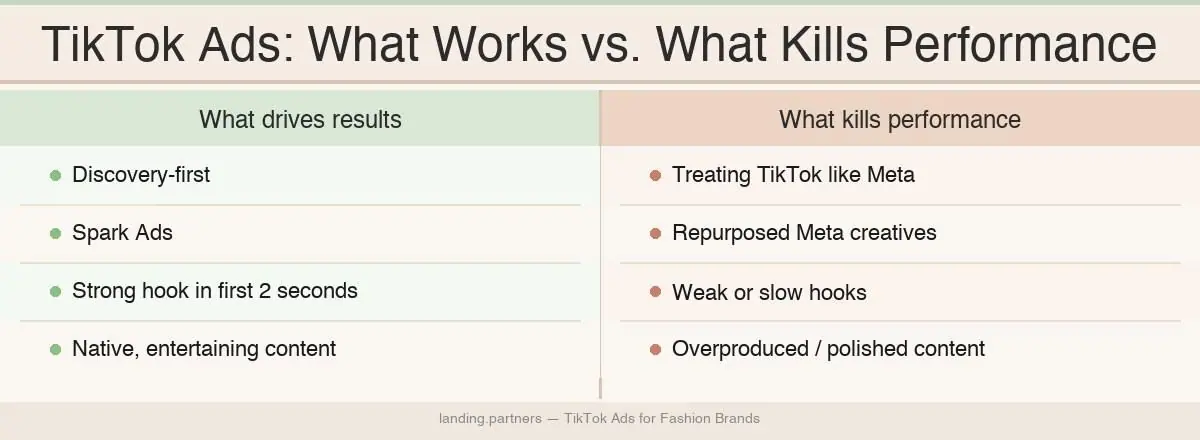
The single biggest mistake fashion brands make when launching TikTok Ads: repurposing Meta creative. It almost never works.
TikTok creative needs to be vertical, native, and fast. It needs a hook in the first 2 seconds. It needs to feel like something a real person would watch and share - not like a polished brand campaign.
What works for fashion on TikTok:
• Movement. Clothing that moves - try-on videos, outfit transitions, styling sequences. Static shots underperform.
• Real voices. Creator content with direct address to camera outperforms voiceover production in most cases.
• Trend anchoring. Content that hooks into a current TikTok trend or audio performs better than brand-originated formats.
• Problem-solution structure. "I used to struggle with X until I found Y" is a format that consistently drives engagement and click-through.
What doesn't work for fashion on TikTok:
• Polished studio shots without movement or human element.
• Long brand story intros - the first 2 seconds are everything.
• Text-heavy graphics that work on Meta Stories but feel out of place on TikTok.
• Generic discount-first messaging. TikTok audiences respond to desire and aspiration, not discount codes.
The brief we give to creators for fashion TikTok is fundamentally different from what we brief for Meta. On TikTok: start with the hook, make it feel real, show the product in use, and let the CTA be soft (curiosity, not pressure).
Fashion clients who use creator-generated content (Spark Ads) from at least 3 different creator voices per month see significantly more stable performance than those relying on a single creator or brand-only content. Creator diversity is one of the most practical ways to reduce creative fatigue on TikTok.
KPIs That Actually Matter for TikTok Fashion Advertising
Measuring TikTok performance requires a different lens than Meta. The standard ROAS figure from TikTok's dashboard is unreliable as a primary metric. The attribution model is not consistent across platforms, and TikTok's pixel is still less precise than Meta's.
The KPIs we track for TikTok fashion accounts:
• Video completion rate (VCR): are people watching through? Below 20% completion on a 30-second video signals the hook or content isn't landing.
CTR (click-through rate): a strong TikTok ad for fashion typically sees 1.5-3% CTR on top-of-funnel creative. Below 1% consistently signals creative problems.
• Cost per landing page view: more reliable than cost per click for measuring qualified traffic.
• Blended MER (Marketing Efficiency Ratio): total revenue divided by total ad spend across all channels. When TikTok is running, does the overall MER improve? That's the real signal.
• New customer rate: TikTok should primarily be bringing in new customers. If you're seeing a high proportion of returning buyers in your TikTok-attributed conversions, something is off with the attribution setup.
What we don't use as primary TikTok success metrics: last-click ROAS, TikTok-reported conversions in isolation, or any single-channel attribution figure without cross-referencing blended MER.
How TikTok and Meta Work Together in the Fashion Funnel
The most effective setup we've built for fashion brands isn't a choice between TikTok and Meta - it's a deliberate combination.
TikTok sits at the top: discovery, awareness, desire-building. Meta sits at the middle and bottom: retargeting, conversion, retention. The two channels reinforce each other when the creative is aligned.
The cross-channel pattern we see work consistently:
1. User discovers the brand via a TikTok Spark Ad (creator content).
2. User visits the website but doesn't buy.
3. Meta retargeting shows product-specific ads in the following days.
4. User converts via Meta (attributed to Meta in last-click models).
5. Post-purchase email flow activates for repeat purchase.
This means TikTok generates conversions that get attributed to Meta or organic. If you look only at TikTok's reported ROAS, you'll undervalue TikTok's role. This is why we look at blended MER before and after introducing TikTok spend.
Timing matters. We recommend launching TikTok only after Meta is profitable and stable. A brand that isn't converting on Meta usually has a store or offer problem - not a channel problem. Adding TikTok before fixing those fundamentals wastes budget.
Every brand's TikTok-Meta setup should be built around your specific funnel stage, margin, and AOV. If you want to know what the right setup looks like for your brand - book a free growth call.
Based on our work across 40+ fashion, beauty and lifestyle brands, TikTok Ads are no longer optional for brands that want to reach the next generation of fashion consumers. But the strategy, creative brief, and measurement framework are fundamentally different from Meta. Getting those right from the start saves significant budget and time.
Every brand's TikTok strategy depends on your margin, price point, current funnel maturity, and creative capacity. If you want to know what the right approach looks like for your specific brand - book a free call and we'll walk you through it.