
A fashion startup with a Shopify store, decent traffic from Meta ads, and zero email automation. That's the situation we walked into at the start of this engagement.
This case study covers a women's contemporary fashion brand based in Belgium, AOV around €120, running Meta ads as primary acquisition. When we started, their Klaviyo account was connected to Shopify but empty - no flows, no segments, and a list of fewer than 400 subscribers.
Here's exactly what we built, in what order, and what happened after 90 days.
Phase 1: List Building Before Anything Else
This is the conversation we have with almost every new fashion client. Flows are only as good as the list they run on. A welcome series to 300 contacts does almost nothing in real revenue terms.
At under 1,000 subscribers, setting up 7 flows and expecting meaningful email revenue is wishful thinking. What you need first is a list-building engine that compounds. We gave this brand a clear target: reach 1,000 subscribers before activating the full flow suite.
Here's what we put in place:
• A full-screen welcome pop-up with a 10% discount offer, triggered after 5 seconds on desktop / 8 seconds on mobile
• A sticky footer bar for returning visitors who had already seen the pop-up
• Checkout capture: every visitor who starts checkout without subscribing gets captured into a list segment
• A post-purchase invite: buyers who aren't subscribed receive a prompt to opt in to editorial content, not just promotions
Within 6 weeks, the list grew from 380 to 1,650 subscribers. The welcome pop-up drove 78% of new sign-ups. The sticky footer bar accounted for another 14%.
The key decision: we didn't activate the full flow suite until the list crossed 1,000 contacts. Before that, only the welcome series ran - so every new subscriber immediately experienced the brand's strongest automation.
Not sure what to prioritize in your Klaviyo setup? We offer a free email audit for fashion brands - we'll tell you exactly what to build first. Book a free call.
Phase 2: The Technical Setup (The Work Most Brands Skip)
Before writing a single email, we spent a week on foundations. This is what most brands rush past - and it's why their Klaviyo data becomes unreliable six months later.
The Shopify integration was live but misconfigured. The brand had connected Klaviyo to Shopify, but the product catalog sync wasn't working properly - dynamic product blocks in emails were showing broken images. We fixed the integration, re-synced the catalog, and tested across 12 product types.
Segments we built from day one:
• All subscribers (base segment)
• Engaged contacts (opened at least one email in the last 30 days)
• Purchased customers (separated from prospects)
• High-value buyers (AOV above €180)
• Lapsed buyers (purchased 90+ days ago, no new order)
• New subscribers (last 14 days - excluded from campaigns initially, in welcome series only)
Proper segmentation from day one is what separates precision email from deliverability-destroying blast campaigns. Without these segments in place before you send anything, you spend months cleaning up a messy list later.
We also set the Klaviyo attribution window to 5-day click / 1-day open. Important context: Klaviyo's 5-day click window means if someone opens an email, then visits the site 4 days later and buys, that purchase is attributed to email. That's not always a direct causal relationship - especially for campaign emails. We track flow performance by revenue per recipient, not total attributed revenue.
Phase 3: Flows in Order of Impact
We built flows in order of expected impact, not complexity. Here's the full sequence:
Welcome Series (3 emails) - Weeks 1-2
The welcome series is the highest-open-rate automation you'll ever run. Every new subscriber goes through it - so it has to be right.
Email 1, sent immediately: brand story + discount code delivery. Not a hard sell. The welcome email is not a promotional blast - it's the brand's first real introduction after someone raises their hand. We led with who the brand is, what makes them different, and delivered the 10% code naturally at the end.
Email 2, sent on day 3: social proof + product discovery. Fashion brands who convert well in the welcome series consistently include real customer reviews in email 2 - not star ratings, but actual quotes about fit, quality, and the experience of wearing the product.
Email 3, sent on day 7: urgency + second look. For subscribers who hadn't opened or clicked the first two emails, a shorter message - the code is expiring, here are three best sellers.
Abandoned Cart (3 emails) - Weeks 3-4
Fashion cart abandonment has different dynamics than other sectors. The consideration window is longer - someone might add a dress to their cart and come back 3 days later after thinking about it. Generic abandoned cart advice leaves significant revenue untouched.
The first abandoned cart email should never include a discount. Most people who are going to buy will buy without one. And sending a discount in email 1 trains customers to always abandon cart and wait for an offer.
Email 1 at 1 hour: product image, simple copy, no incentive. Email 2 at 24 hours: social proof for the specific product - reviews, a size guide link, and a low-inventory nudge if the SKU has fewer than 5 units left. Email 3 at 72 hours: sent only if no purchase - a small incentive (free shipping or 5% off) as a last recovery attempt.
Is your abandoned cart sequence leaving revenue behind? We audit Klaviyo flows for fashion brands and show you exactly where improvements are possible. Request your free Klaviyo audit.
Browse Abandonment (1 email) - Weeks 5-6
Browse abandonment is more nuanced than cart abandonment. Not every product view signals intent. We set a specific trigger: viewed 2 or more products in a single session, no add-to-cart, no purchase in the last 7 days.
One email, sent 4 hours after the session. Short, visual, no discount. 'Still thinking about these?' with the 2-3 products viewed. Simple, effective, non-aggressive.
Post-Purchase (3 emails) - Weeks 7-8
The post-purchase flow is where most fashion brands miss the biggest retention opportunity. A customer just trusted you with their money. What you do in the next 14 days determines whether they become a repeat buyer.
Email 1 at 2 hours after purchase: brand story reinforcement + a style guide for the purchased item. Its job is to reduce buyer's remorse and introduce complementary pieces before the package arrives.
Email 2 at day 5 (before delivery): anticipation-building. 'Your order is nearly there.' This email consistently reduces return requests across our client base - customers who receive it feel connected to the brand before the package arrives.
Email 3 at day 14: review request + cross-sell. The review request only goes to customers who opened at least one earlier email - a simple filter that dramatically improves review quality and response rate.
After 90 days, the post-purchase flow generated €8.40 revenue per recipient - second-highest of all flows after the welcome series (€14.20 per recipient). For reference: a well-executed campaign email in fashion typically generates €0.80-€2.50 per recipient.
Results After 90 Days
Here's what each flow was delivering at the 90-day mark, measured on a per-recipient basis:

Welcome series: email 1 open rate 54.2% / email 2: 38.6% / email 3: 22.1%. Revenue per recipient: €14.20. Discount code redemption: 31%.
Abandoned cart: recovery rate 8.4% of cart abandoners (purchased within 72h of first email). Revenue per recipient: €22.80 - the highest of all flows, as expected for high-intent contacts. Email 1 drove 61% of recoveries. Email 3 drove 24%.
Browse abandonment: open rate 44.1%. Click rate 9.8%. Revenue per recipient: €4.10.
Post-purchase: review email open rate 61.2% (filtered to engaged subscribers). Cross-sell click rate 12.4%. Revenue per recipient: €8.40. 23% of customers who received the full sequence placed a second order within 60 days.
An important note on attribution: all numbers above use Klaviyo's standard 5-day click / 1-day open window. For welcome series and cart abandonment flows, this is a reasonable approximation - these are high-intent sequences where the email genuinely drives behavior. For campaign emails sent to the full list, we apply more skepticism - Klaviyo credits purchases that would have happened regardless of whether the email was sent.
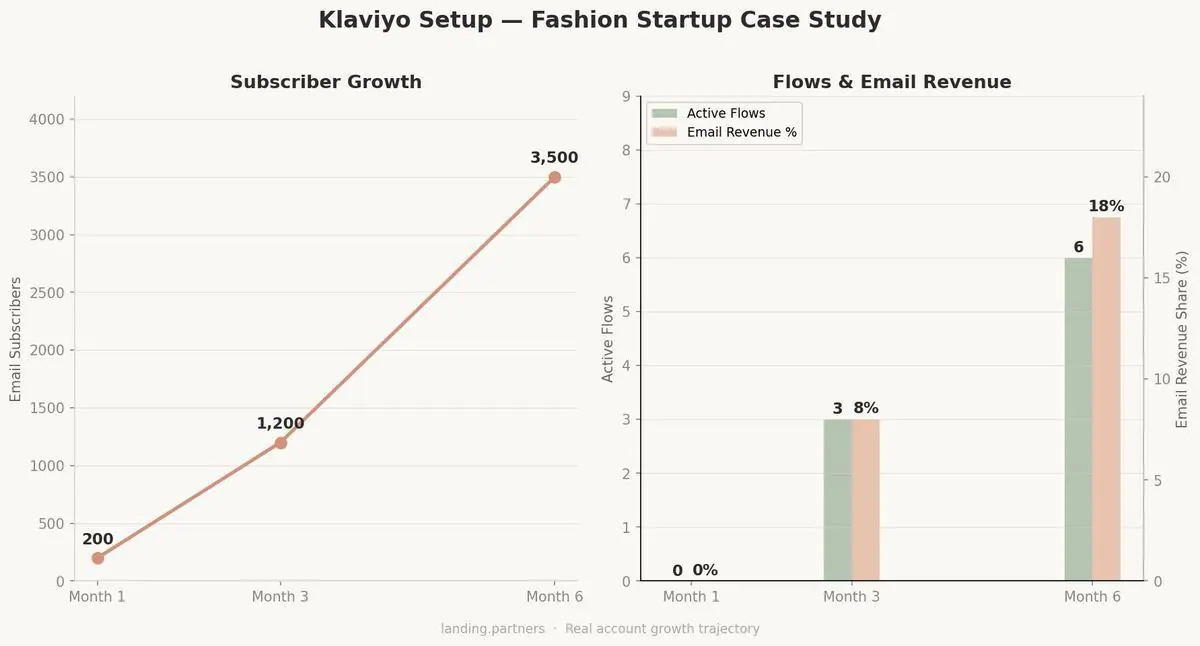
After 90 days: 1,650 subscribers (from 380), 4 flows live and generating passive revenue, welcome series open rate above 50%, abandoned cart recovery at 8.4%. The compounding engine was in place.
Three Decisions That Made the Difference
Starting with list building. Every week we delayed growing the list was a week the flows ran on a smaller audience. The pop-up strategy alone added ~1,200 subscribers in 6 weeks - directly multiplying everything downstream.
Not discounting too early. The first abandoned cart email had no incentive. The welcome email led with brand story before promotion. This protected margin and established the relationship before asking for the sale.
Segment discipline from day one. Because we built proper segments before sending anything, every flow was targeted from the start. New subscribers were excluded from campaigns during the welcome series window. Purchased customers never received cart abandonment emails. These seem like obvious basics - but most accounts we audit don't have them in place.
Every brand's situation is different. The right Klaviyo setup depends on your price point, your traffic volume, and what phase you're in. If you want to know exactly what your email infrastructure should look like - and what to build first - book a free call with our team. We'll review your current setup and give you a clear action plan.