How to Set Up Klaviyo for a Fashion Brand: A Step-by-Step Guide
Most fashion brands set up Klaviyo backwards. They build flows before they have a list. They send campaigns before they understand their audience. They measure the wrong things. Then they conclude email doesn't work - when the real issue is the setup.
We've onboarded 40+ fashion brands onto Klaviyo. The setup mistakes are almost always the same. This guide walks through the exact sequence we follow, in the order that actually matters.
Key Takeaways
- •Connect Shopify via the native integration first - everything else depends on clean purchase data
- •Build your list before you build flows - flows only become meaningful at 1,000+ active subscribers
- •Fashion needs its own segmentation logic: category preference, AOV tier, seasonal behaviour
- •Set up flows in priority order - welcome series and abandoned cart before everything else. Use our Klaviyo benchmarks for fashion brands to track whether they're performing
- •Suppression is as important as sending - deliverability depends on it
- •Measure flows by flow-specific metrics, not inflated campaign attribution windows — our Klaviyo benchmarks guide breaks down what good looks like
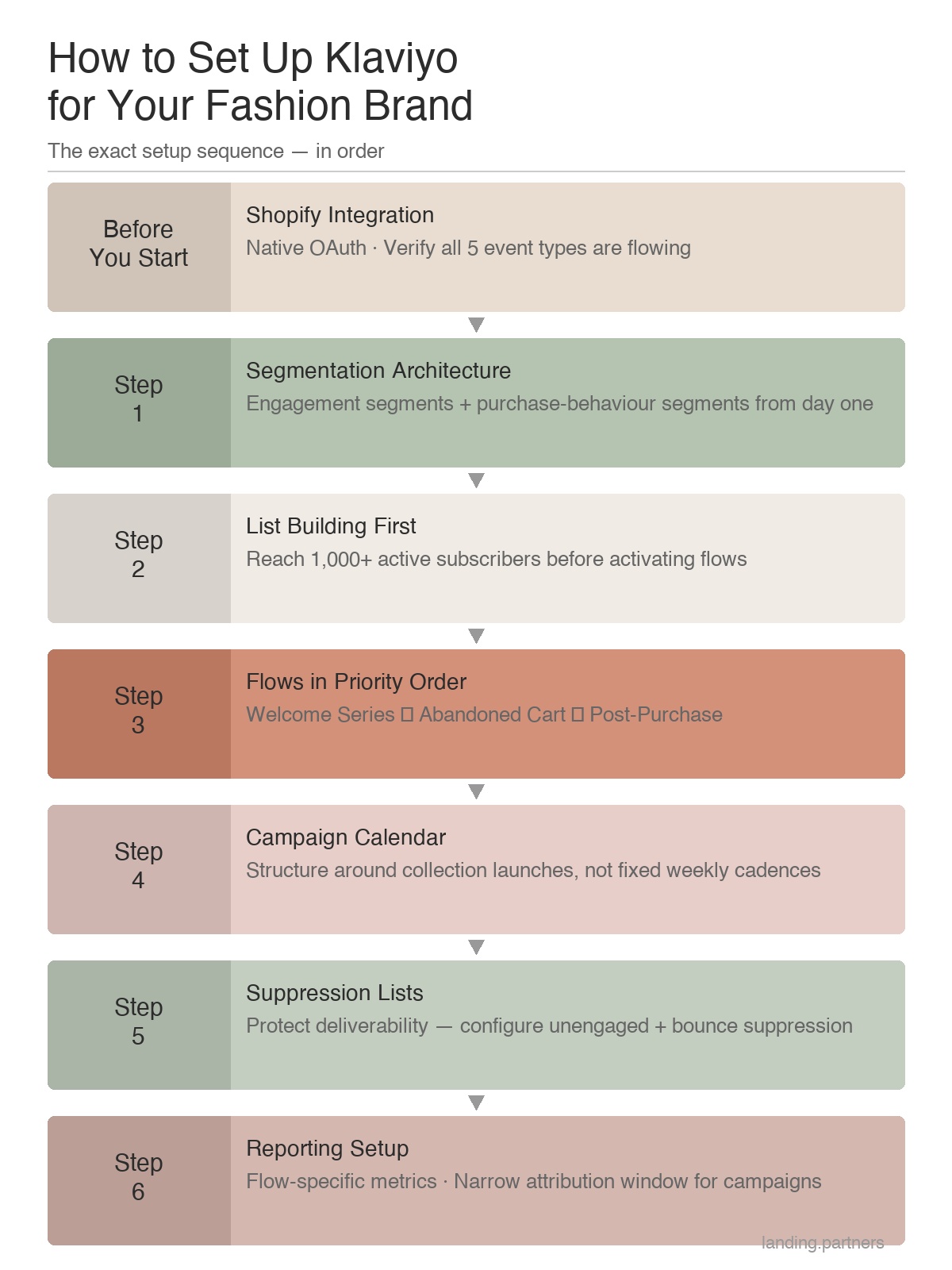
Before You Start: Get the Shopify Integration Right
Everything in Klaviyo depends on the quality of your Shopify data. If the integration is wrong, your segments will be wrong, your flows will trigger incorrectly, and your reporting will mislead you.
Connect Shopify via the native Klaviyo integration - not a third-party connector. Go to Klaviyo > Integrations > Shopify and follow the direct OAuth flow. This gives you full event tracking: Placed Order, Ordered Product, Fulfilled Order, Cancelled Order, and Refunded Order.
Check that these events are flowing in within 24 hours. Go to Klaviyo > Analytics > Metrics. You should see active event streams for each event type. If Ordered Product isn't showing separately from Placed Order, the integration is incomplete.
One thing we see constantly: brands have Klaviyo installed but the historical Shopify data was never synced properly. This breaks segmentation for any filter based on purchase history. When you first connect, Klaviyo syncs up to 3 years of historical data - verify this happened in your account settings before building anything.
Not sure if your Shopify - Klaviyo integration is correctly configured? We run free email audits for fashion brands. Book a free audit and we'll check the technical foundation before you build on top of it.
Step 1: Build Your Fashion Segmentation Architecture
Generic Klaviyo guides tell you to create an "engaged" segment and call it done. Fashion is more nuanced. Your segmentation needs to reflect how fashion customers actually behave - by category preference, price sensitivity, and seasonal patterns.
The segments every fashion brand needs from day one:
First, foundational engagement segments. These power your deliverability:
• Engaged 90 days: opened or clicked any email in the last 90 days
• Engaged 30 days: your most active subscribers - use these for testing new creative
• Unengaged 180 days: anyone who hasn't opened in 6 months - suppression candidates
Then, purchase-behaviour segments. These power your personalisation:
• One-time buyers: purchased once, never returned - target with second-purchase flows
• Repeat buyers (2+ orders): your core customer base - treat them differently
• High AOV customers: top 20% by order value - different messaging, different product focus
• Category shoppers: customers who buy primarily from one category (dresses, outerwear, accessories)
The category segment is the most underused one we see. It appears in fewer than 30% of the fashion accounts we audit. But it's one of the highest-leverage segments you can build - it lets you send collection drops only to customers who've shown interest in that category, rather than blasting your entire list.
In the fashion brands we work with, emails sent to category-specific segments achieve 20-35% higher click rates than broadcast sends to the full list. The audience is smaller - the relevance is higher.
Step 2: List Building Before Flows
This is the step most brands skip - and it's the most important one in the entire setup.
Flows are only meaningful when you have a list. Specifically: flows become a reliable revenue driver at 1,000+ active subscribers. Below that, the volume is too low to generate consistent results, and you're spending time optimising something that doesn't have enough signal to optimise from.
Before you invest time in complex flow-building, build your list.

For a fashion brand, the highest-converting list-building tools are:
• Popup with a discount (10-15% off first order) - standard, but it works. Use Klaviyo's built-in popup builder or a Shopify app like Privy.
• Embedded form on high-traffic pages (homepage, product pages) - lower conversion rate but zero friction for the visitor
• Checkout opt-in - Shopify's built-in email opt-in at checkout. Lower volume but highest quality subscribers - they're already buying from you.
• Back-in-stock notifications - these are also list-building moments for high-intent visitors who want a specific product
Don't spend three weeks building seven flows before you have 500 subscribers. Set up your welcome series (covered in Step 3) and put the rest of your energy into getting subscribers through the door.
We help fashion brands build email lists from zero. If you're under 1,000 subscribers and not sure where to focus, book a free call and we'll give you a concrete list-growth plan for your brand.
Step 3: Set Up Flows in Priority Order
Once your integration is clean and your list is growing, you build flows. Not all flows are equal - and the order in which you build them matters.
Priority 1: Welcome Series (build in your first week)
The welcome series is your highest-ROI flow, without exception. New subscribers are at peak interest. Welcome email open rates in fashion run 50-60% - significantly higher than anything else you'll send.
Build a 3-email welcome series:
• Email 1 (immediate): deliver the discount if you offered one, introduce the brand, show one clear product category to explore
• Email 2 (2 days later): brand story, what makes you different, social proof (press coverage, customer photos)
• Email 3 (5 days later): bestsellers or new arrivals, soft product-focused CTA
For fashion specifically: email 1 should feature your hero product or collection - not a generic "thanks for signing up" message. Show the product immediately. That's why they signed up.
Welcome series emails in our fashion client base generate 3-5x higher revenue per recipient compared to standard campaign emails. It's the most important flow to get right before anything else.
Priority 2: Abandoned Cart (build in your first week)
High intent. Left without buying. In fashion, the timing of abandoned cart emails matters more than most guides acknowledge. We've tested this across dozens of accounts. The pattern that works:
• Email 1: 1 hour after abandonment
• Email 2: 24 hours after abandonment
• Email 3 (optional): 3 days after - only send this if you have a specific hook, such as limited sizes remaining
Don't extend beyond 3 days. In fashion, the purchase moment passes quickly. A reminder email 7 days after cart abandonment rarely converts and mostly irritates.
Priority 3: Post-Purchase (build in your first two weeks)
The post-purchase sequence is what separates one-time buyers from repeat customers. Fashion brands are particularly bad at this - they treat the first sale as the end point, not the beginning of the relationship.
Build a 2-email post-purchase flow:
• Email 1 (day 3 after delivery): "How are you finding [product]?" - request for photos or reviews, styling content, care instructions
• Email 2 (day 14 after purchase): related products or complementary categories based on what they bought
Priority 4: Browse Abandonment, Winback, Back-in-Stock
These come after the first three are running well. Browse abandonment is particularly valuable for fashion because discovery is often aspirational - a customer who viewed a specific dress three times in a week is a warm lead, not just a casual browser.
Back-in-stock flows are frequently overlooked. For fashion brands with limited-run pieces or seasonal collections, these are high-converting moments. The customer already wanted the product - you're just closing the loop.
Step 4: Build Your Campaign Calendar Around Collections
Most email marketing calendars treat fashion like any other ecommerce vertical. That's the wrong frame. Fashion campaigns should be structured around your collection calendar, not generic seasonal dates.
The fashion campaign calendar framework:
Collection launches are your primary campaign moments. Every new drop gets an email campaign sequence - typically: teaser 3 days before launch, launch-day email, and a follow-up 5-7 days later featuring most popular items or remaining sizes.
Secondary campaign moments depend entirely on your brand type:
• Women's fashion and streetwear: January sales, July sales, BFCM, October Q4 ramp-up. Low-volume period: April through June.
• Kidswear and teenswear: September back-to-school is often a larger commercial moment than BFCM. Plan for it explicitly.
• Gifting brands (jewellery, accessories): Valentine's Day, Mother's Day, and December are the three peaks. Fashion weeks create secondary AOV spikes as customers follow editorial trends.
Don't send campaigns just to fill a calendar. The biggest mistake we see: fashion brands that set up a fixed weekly newsletter because they read that consistency matters. Consistency matters when you have something to say. A blank campaign sent on Tuesday because it's Tuesday is a fast path to unsubscribes and declining deliverability.
Among the fashion brands we work with, brands that batch campaigns around collection launches and key commercial moments - rather than fixed weekly cadences - consistently show lower unsubscribe rates and higher revenue per recipient across comparable list sizes.
Step 5: Configure Your Suppression Lists
Suppression is the most overlooked part of Klaviyo setup and one of the most consequential. It directly affects deliverability - which determines whether your emails reach the inbox at all.
Suppressions to configure from day one:
• Anyone who unsubscribed (automatic in Klaviyo - verify it's active)
• Anyone who hard bounced (automatic in Klaviyo)
• Soft bounce suppression: anyone who soft bounced 3 or more times
• Unengaged suppression: anyone who hasn't opened in 180+ days and has received at least 10 emails from you
The fashion-specific suppression consideration: if your brand doesn't discount, suppress your list around major sale periods. Sending a standard flow email to a customer who just received an unrelated promotion from a partner channel creates confusion. Klaviyo's Smart Sending feature helps manage this - enable it.
Review your suppression list quarterly. A re-engagement campaign before suppression can recover some dormant subscribers - worth running before you remove them permanently.
Step 6: Set Up Reporting That Actually Tells You Something
Klaviyo's default reporting is misleading if you don't understand the attribution model behind it.
Klaviyo uses a 5-day click, 1-day open attribution window by default. This means: if someone clicks your email on Monday and buys on Friday, Klaviyo attributes that sale to email. For flows, this relationship is often defensible - a welcome email or abandoned cart email has a clear causal connection to the purchase.
For campaigns sent to your full list, it's a much weaker causal claim. We recommend narrowing the attribution window in your Klaviyo settings to 1-day click for campaigns - it gives you a more honest view of what your campaigns are actually driving.
Measure flows by flow-specific metrics:
• Open rate (strong welcome series: 40%+, strong abandoned cart: 30%+)
• Click rate (well-targeted fashion emails: 5-8%)
• Revenue per recipient (more useful than total revenue - it normalises for list size and accounts for send frequency differences between flows)
Don't benchmark against "30-40% of revenue from email" figures you'll find elsewhere. That number is heavily influenced by attribution window settings and is not a metric we use or recommend. The more useful questions: are your flows improving month over month? Is revenue per recipient trending up? Our Klaviyo benchmarks guide covers what good open rates, click rates and revenue per recipient look like per flow type for fashion brands. Is your list growing faster than it's churning?
The Most Common Klaviyo Setup Mistakes Fashion Brands Make
Mistake 1: Building all seven flows before the list exists. We've seen brands spend weeks building complex flows, then wonder why email generates nothing. You need 1,000+ active subscribers before flows deliver consistent, meaningful revenue.
Mistake 2: Using Klaviyo's default attribution as gospel. The 5-day click window overstates email's contribution for campaigns. Build a habit of checking your MER (blended marketing efficiency ratio) alongside Klaviyo revenue numbers to get a real picture.
Mistake 3: Sending to the full list by default. Every campaign should start with the question: who is this actually for? Fashion segmentation is one of Klaviyo's strongest features - use it rather than defaulting to "all subscribers."
Mistake 4: Treating Klaviyo as a campaign-only tool. The sustained value of Klaviyo for fashion comes from flows. Brands that use it only for weekly campaigns are leaving the majority of its value unused.
Mistake 5: Ignoring deliverability. A warmed sending domain and a maintained suppression list are not optional steps. They determine whether your emails reach the inbox. Skipping them compounds over time - it's far harder to fix a deliverability problem than to prevent one.
Every brand's email setup is different. The right Klaviyo configuration depends on your list size, product type, and commercial calendar. If you want to know what the right approach looks like for your specific brand - book a free call with our team.