
Every fashion brand we onboard asks the same question before committing to Klaviyo: "We already have Mailchimp set up. Can't we just keep using that?"
It's a fair question. Mailchimp has been around since 2001. It's familiar, affordable, and works fine for sending newsletters. But fashion ecommerce isn't a newsletter business - and the gap between what Mailchimp can do and what Klaviyo can do, in the context of a fashion brand running paid media and seasonal drops, is significant.
The Question Every New Client Asks
When a brand comes to us with Mailchimp already in place, it's usually one of three situations: they're sending irregular newsletters and calling it email marketing, they've tried to set up automation but it's not working, or they're satisfied and see no reason to change.
The honest answer isn't "Klaviyo is always better." The honest answer is: it depends on where you are. But for the majority of fashion brands we work with - especially those on Shopify with an active paid media programme - Mailchimp is a ceiling, not a foundation.
Not sure which email platform fits where your brand is right now? Book a free strategy call and we'll tell you exactly what we'd recommend.
Why This Comparison Matters More for Fashion
Fashion ecommerce has a specific set of shopper behaviours that make platform choice more consequential than in most other sectors.
Shoppers browse extensively before buying. They add to cart across multiple sessions. They respond to collection drops. They have seasonal purchase patterns. They're heavily influenced by the last ad they saw. All of that is behaviour data. And behaviour data is what separates Klaviyo from Mailchimp.
Mailchimp's Shopify integration syncs order data. It knows when someone bought, what they bought, and how much they spent. Useful - but it doesn't know that someone visited your product page four times in the last 72 hours, added an item to their cart, and left without buying. Klaviyo does.
For fashion brands, that browse-and-abandon data is the difference between a generic "you might like this" email and a targeted recovery message sent at exactly the right moment.
Across the fashion brands we've migrated from Mailchimp to Klaviyo, the most consistent finding is this: brands weren't sending bad emails on Mailchimp - they were working with incomplete data. Klaviyo's Shopify integration captures real-time browsing behaviour and product-level events that Mailchimp's sync simply doesn't reach.
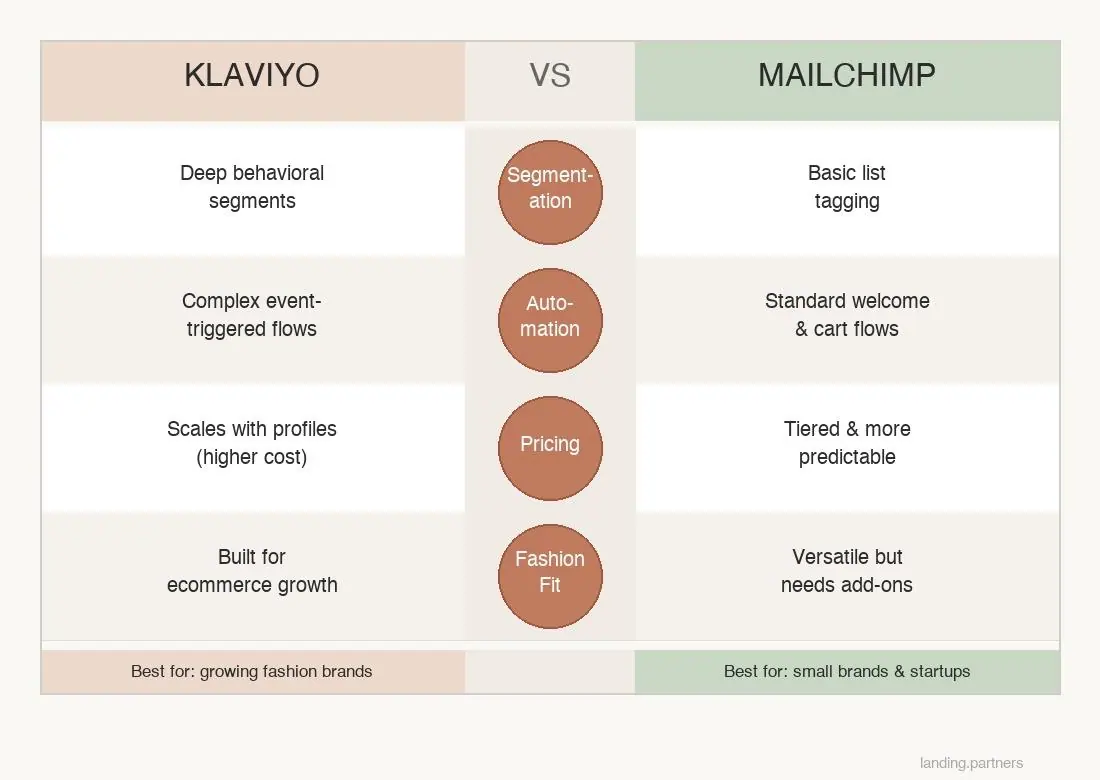
Feature-by-Feature: Where the Gap Shows Up
Shopify integration depth
Klaviyo's native Shopify integration syncs in real time: purchases, refunds, product views, collection views, search queries, cart activity, and checkout behaviour. It also pulls your full product catalogue, enabling dynamic product blocks in emails - items are auto-populated based on what each subscriber viewed or purchased.
Mailchimp reconnected to Shopify via a third-party app after the official integration was removed in 2019. The sync is less granular and has more latency. Dynamic product recommendations exist but require more manual configuration and are less tightly tied to real-time behaviour.

Segmentation
Klaviyo's segmentation lets you build audiences from any combination of profile data, purchase behaviour, and predictive properties. You can filter by product category purchased, AOV, days since last purchase, predicted next order date, number of site visits in the last 30 days, and acquisition source - and combine any of these.
Mailchimp segments on tags, purchase history, and signup data. For basic campaigns, that's workable. For the kind of behavioural segmentation fashion ecommerce requires - segmenting by what someone browsed but didn't buy, or by product category affinity - it's a significant constraint.
Automation triggers
Klaviyo triggers flows from any event: site visit, product view, collection view, cart add, checkout start, purchase, refund. You can branch mid-flow based on profile properties or real-time behaviour - a subscriber who bought once gets a different path than a subscriber who bought three times in the past 90 days.
Mailchimp's automation triggers are primarily form signups, tags, and purchases. A welcome series or a simple abandoned cart email works fine. A browse abandonment flow that responds differently based on which product category someone was in - that's where Mailchimp hits its limits.
Reporting and attribution
Klaviyo shows revenue attribution at the message level: which emails in a flow drove conversions, and when. Mailchimp's revenue reporting is mainly campaign-level and less granular on individual flow message performance.
Important caveat: email attribution in both platforms should be read with scepticism. Klaviyo's default 5-day click window means a purchase that happens four days after an email click gets attributed to that email - even if the customer would have bought regardless. Attribution is always somewhat inflated, particularly for campaigns. The metric that gives you real signal is revenue per recipient within a specific flow, tracked consistently over time.
Want to know what your current email performance actually looks like when you account for attribution inflation? Book a free Klaviyo audit - we'll show you what the numbers actually mean for your brand.
What Actually Changed When Our Clients Made the Switch
We've run migrations for fashion brands across Belgium, the Netherlands, and the UK - brands at different stages, price points, and list sizes. The pattern we see consistently after migration: campaign performance is roughly the same. Flow performance increases.
Not because Klaviyo flows are inherently better written, but because the flows can finally be triggered by the behaviour they're supposed to respond to.
Browse abandonment flows didn't exist in most of the Mailchimp setups we inherited - not because the brands hadn't thought to build them, but because the data to trigger them wasn't there. Post-purchase flows existed but were based on purchase date alone, not product category or AOV. Welcome series were static sequences, not responsive to what the subscriber had browsed before signing up.
In one migration we ran for a women's fashion brand at a €150 average order value with approximately 8,000 subscribers: flows went from near-zero tracked contribution to a measurable share of email-attributed revenue within 60 days of the switch. The content of the emails barely changed - we kept the original copy initially. What changed were the triggers. Browse abandonment, collection abandonment, and category-based segmentation in the post-purchase sequence became possible for the first time. Note: treat attribution figures with appropriate scepticism - the directional signal was clear and consistent across multiple migrations, but absolute email revenue percentages are always inflated by attribution windows.
When Mailchimp Is Still a Reasonable Choice
We recommend Klaviyo to the vast majority of the fashion brands we work with. But there are situations where Mailchimp is the more sensible starting point.
If your brand is pre-€250K revenue and not on Shopify: the complexity and cost of Klaviyo isn't justified yet. At that stage, email is secondary to product-market fit, first sales, and list growth. Mailchimp - or even a free tool - is appropriate.
If your list is under 500 subscribers: no email platform, Klaviyo included, will generate meaningful revenue at that volume. Build the list first. Klaviyo flows only become genuinely useful at 1,000+ subscribers - before that, you're automating at a scale that doesn't justify the investment.
If you're not on Shopify: Klaviyo integrates with WooCommerce, Magento, and custom platforms, but the integration depth is highest on Shopify. If your platform has limited Klaviyo connectivity, the price premium over Mailchimp is harder to justify.
The fashion brands that get the most out of Klaviyo share three characteristics: they're on Shopify, they have a paid media programme driving consistent traffic, and their email list is above 1,000 subscribers. Below those thresholds, the platform switch is premature - build the foundation first.
The Migration Process We Use
If you're moving from Mailchimp to Klaviyo, here's the process we follow:
Step 1: Connect Klaviyo to Shopify before importing any contacts. The integration pulls in historical order data immediately - you want that running before your subscribers arrive.
Step 2: Export your Mailchimp contacts with all custom fields and tags as a CSV. Map Mailchimp tags to Klaviyo list membership or profile properties during import.
Step 3: Rebuild your flows - don't copy them. Use the migration as an opportunity to add triggers Mailchimp didn't support: browse abandonment, collection views, predictive segmentation based on purchase history.
Step 4: Suppress unengaged contacts before importing. Anyone who hasn't opened an email in 6 months shouldn't come in as active. Klaviyo charges by contact count, and smaller clean lists outperform large stale ones.
Step 5: Wait 10-14 days before sending any campaigns. Let Klaviyo sync the full purchase history and build its predictive models. Your segmentation quality will be noticeably better.
Step 6: Dual-run for one send cycle. Send one campaign from both platforms to a small matched segment. This catches domain reputation issues from the switch before you're fully committed to the new platform.
The technical migration itself takes a day or less. The flow rebuild, done properly, takes 1-2 weeks. Rushing the flow rebuild is the most common migration mistake - brands move their contacts but keep the same triggers from Mailchimp. That defeats much of the point.
Running this migration yourself and hitting issues with domain warmup or flow triggers? Book a call - we'll walk through your specific setup and flag anything that needs attention before you send.
The Cost Question
Klaviyo is more expensive than Mailchimp at comparable contact counts. At 5,000 contacts, Klaviyo's paid plan runs approximately €100-150/month depending on your plan tier. Mailchimp Essentials at the same size is roughly €50-70/month.
That's a real difference. Whether it's justified depends on one thing: are you running paid media?
If you're driving traffic with Meta or TikTok, every visitor who doesn't convert is someone you paid to acquire. A browse abandonment flow that recovers even a small percentage of those visitors pays for the Klaviyo subscription many times over. The CVR lift from behavioural automation - not from better email copy, but from better triggers - is what justifies the price premium.
If you're not running paid ads yet, or if you're in Phase 1 on primarily organic traffic, the cost difference is harder to justify. Revisit the platform decision when paid media is running consistently.
Every brand's situation is different. The right email platform depends on your list size, your ecommerce platform, your revenue stage, and whether you're running paid media. If you want to know what the right approach looks like for your specific brand - book a free call.