How to Choose a Digital Marketing Agency for Your Fashion Brand: 10 Questions to Ask

Choosing the wrong agency is one of the most expensive mistakes a fashion brand can make. We've seen brands waste six months and tens of thousands of euros on agencies that looked great on the pitch deck but had never run a profitable campaign for a fashion ecommerce brand in their lives.
The problem is that most fashion founders don't know what to look for. The agency world is full of polished proposals, vague case studies, and promises that don't survive contact with reality. So we built this guide from the other side of the table - we're an agency ourselves, and we know exactly what separates the right fit from the wrong one.
Key Takeaways
- •Ask for fashion-specific results, not generic case studies from unrelated industries
- •An agency that talks only about ROAS without mentioning profitability or MER is a red flag
- •The day-to-day relationship matters as much as the strategy - know who your actual contact will be
- •Creative strategy is not optional for fashion: it's the most important performance variable
- •The right agency will ask hard questions about your margins before promising any number
Why Choosing an Agency for a Fashion Brand Is Different
Fashion is not like other ecommerce. The product is seasonal. The brand identity is a central part of the performance equation. The customer journey often starts on Instagram and ends on a mobile checkout. The conversion rates vary enormously depending on your price point.
An agency that runs great campaigns for a software company or a home goods brand will not necessarily understand the mechanics of fashion ecommerce. They won't know how to handle creative fatigue during a collection drop. They won't understand that July is a sale period, not a dead quarter. They won't think about the relationship between email flows and paid retargeting the way a fashion specialist does.
What you need is not just a good digital marketing agency - you need one that has been in the trenches with fashion brands at a similar scale to yours.
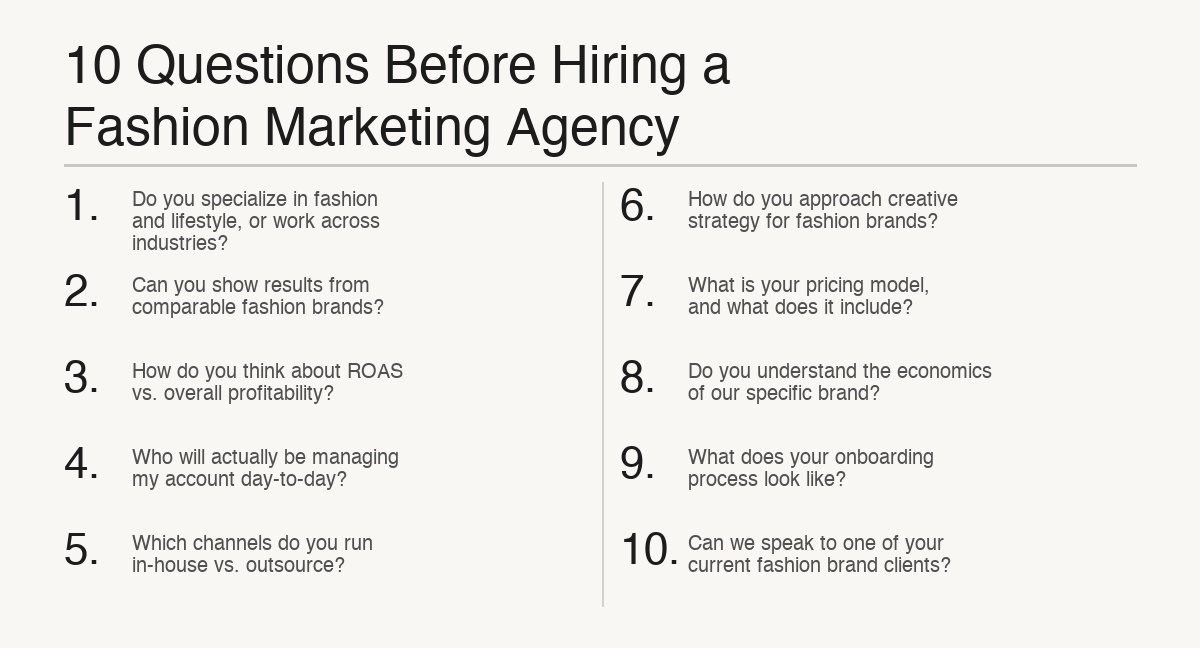
Here are the 10 questions we'd recommend asking any agency before signing a contract.
Question 1: Do You Specialize in Fashion and Lifestyle, or Work Across Industries?
This is the first question because it immediately filters out most agencies. A generalist agency will say something like "we work with all kinds of brands" or "ecommerce is ecommerce." It isn't.
Fashion has specific seasonality, specific creative requirements, specific customer psychology, and specific performance benchmarks. An agency that splits its attention across hospitality, B2B SaaS, and fashion simultaneously is not building the deep pattern-recognition that a fashion specialist builds.
Based on our work with 40+ fashion brands, the most common issue when brands switch to us from a generalist agency: the previous agency used the wrong KPIs, focused on the wrong channels, and had no fashion-specific creative framework. It's not a question of skill - it's pattern recognition that only comes from volume in one vertical.
What a good answer looks like: the agency names specific fashion clients (even anonymously), explains concretely how fashion ecommerce differs from other categories, and can speak to seasonal dynamics and category-specific benchmarks without prompting.
Question 2: Can You Show Us Results from Comparable Fashion Brands?
"Comparable" is the key word. A case study from a luxury watches brand is not comparable to an €80 AOV streetwear label. Volume, margin structure, and customer psychology are completely different categories.
Ask specifically: have they worked with brands at a similar revenue stage? Similar price point? Similar channel mix?
Push for concrete before-and-after numbers: revenue growth, ROAS, email contribution, conversion rate change. An agency with real results will be happy to share them in anonymised form. An agency that deflects with "we protect client confidentiality" on every single metric is hiding weak results.
We walk through anonymised results from our fashion client base on every discovery call. Book a free call here and see what comparable brands have achieved.
Question 3: How Do You Think About ROAS vs. Overall Profitability?
Any agency that leads with "we'll get your ROAS to 4x" without first asking about your margins, fulfillment costs, and return rate is flying blind - or optimizing for reported numbers rather than actual business results.
ROAS is an easy metric to manipulate. Change the attribution window, adjust campaign objectives, shift budget toward bottom-funnel audiences - reported ROAS goes up. But if your margin is 35% and you're shipping internationally, a 3x ROAS might actually be losing you money after all costs are counted.
What matters more: MER - total revenue divided by total ad spend across all channels. It's harder to game. It forces a real conversation about what's working across the full funnel, not just one campaign in isolation.
We've taken over accounts where the previous agency was reporting a 6x ROAS on Meta. After a proper MER analysis, the brand was barely breaking even on new customer acquisition. ROAS can look excellent while the business loses money. Always ask about the full picture.
Ask the agency: how do you define success beyond ROAS? What other metrics do you track? If they struggle to answer, that tells you everything.
Question 4: Who Will Actually Be Managing My Account Day-to-Day?
This is the question most fashion founders forget to ask. You get the pitch from the senior partner. You sign. And then you spend the next 12 months emailing a junior account manager who's running 15 other accounts simultaneously.
Ask directly: who is my main point of contact? What is their experience level? How many accounts are they managing? Will the person who pitched me still be involved after onboarding?
Some agencies have strong pitching teams and weak execution teams. The pitch experience and the day-to-day experience can be completely different products.
If you want to understand what our day-to-day client relationships look like before committing to anything, book a free discovery call and ask us directly. We'll introduce you to the person who'd actually run your account.
Question 5: Which Channels Do You Run In-House, and Which Do You Outsource?
Many agencies sell Meta + TikTok + Google + Klaviyo + CRO as a complete package - and then outsource three of those five to freelancers or sub-agencies. You may not know this until something goes wrong and accountability becomes unclear.
Ask clearly: do you have in-house specialists for every channel you're proposing? If they use partners for certain services, who are they, and how does quality control work?
There's nothing wrong with a focused agency that runs two or three channels exceptionally well. A specialist is often better than a generalist who does everything passably. But you need to know exactly what you're buying before you sign.
At Landing Partners, we run Meta, TikTok, Google, and Klaviyo entirely in-house. CRO analysis is built into our standard process. No outsourcing, no opaque sub-agency relationships - every decision goes through your Brand Manager.
Question 6: How Do You Approach Creative Strategy for Fashion Brands?
In fashion, creative is the main performance variable. The targeting matters less than it used to. The algorithm distributes to the right audiences - but only if the creative is strong enough to work as a signal and tell the platform who it's for.
Ask: does the agency have a structured approach to creative testing? Can they identify when a creative is fatiguing before it starts dragging performance metrics? Do they know how to brief a creative team on fashion-specific formats?
For fashion specifically: do they understand the difference between awareness creatives, conversion creatives, and retargeting creatives? Do they know when UGC works and when it doesn't for a particular brand tier?
An agency that outsources all creative decisions back to you is leaving your most important lever unmanaged.
Question 7: What Is Your Pricing Model, and What Does It Actually Include?
Agency pricing is notoriously opaque. Three common models, each with real tradeoffs:
Percentage of ad spend: Common at scale. Incentives can align well when the agency is genuinely growing your budget and results. The risk: they have a financial interest in spending more, even when spending less and optimizing harder would be smarter.
Flat monthly retainer: Predictable and budget-friendly. Good for brands with stable budgets. The risk: less urgency to push for exceptional results versus maintaining the status quo month-to-month.
Hybrid (base + performance kicker): Best alignment in theory - base covers execution, kicker rewards real results. Make sure the performance metric tied to the kicker is MER or revenue growth, not reported ROAS.
In every model, clarify exactly what's included. Strategy, execution, creative briefing, reporting, Klaviyo management, CRO recommendations - or just Meta campaign management? Know before you sign.
Question 8: Do You Understand the Economics of Our Specific Brand?
Before promising any number, a serious agency should ask about your margin structure, your AOV, your return rate, your fulfillment cost, and your customer lifetime value.
These numbers determine what a profitable ROAS actually looks like for your business. A brand with 60% gross margin and 5% returns can profitably acquire customers at a much higher CAC than a brand with 35% margin and 20% returns.
If an agency starts promising specific results before they understand your unit economics, that's not confidence - it's recklessness disguised as a sales pitch.
The right conversation starts with: tell us about your margins, your AOV, your best-selling categories, and your retention pattern. Then we can tell you what's realistic.
Question 9: What Does Your Onboarding Process Look Like?
Onboarding quality predicts everything that follows. A structured onboarding means the agency understands your brand, your audience, your historical data, and your actual objectives before they touch your ad account.
Ask specifically: how long does onboarding take? What do you need from us? When should we realistically expect to see results?
Realistic timelines for fashion brands:
• Month 1: Data gathering, account audit, creative testing, structural changes where needed
• Month 2-3: Learning phase - performance is inconsistent but trends should become visible
• Month 3-6: Optimization phase - if the strategy is right, consistent improvement shows
Any agency promising dramatic results within 30 days is either working with a brand that was severely underoptimised before, or they're overselling.
In our experience, the fastest meaningful improvements come from fixing structural account problems - wrong campaign architecture, poor creative-to-audience matching. These show results within 2-4 weeks. Sustainable, compounding growth takes 3-6 months of consistent work.
Question 10: Can We Speak to One of Your Current Fashion Brand Clients?
This is the final filter. An agency with satisfied fashion brand clients will be happy to arrange a reference call without hesitation. An agency that deflects, delays, or can only offer written testimonials on their own website is telling you something important.
On the reference call, ask the client three things: what's day-to-day communication like? Have there been problems, and how were they handled? Would you renew your contract?
The quality of how an agency handles problems is more revealing than the quality of their pitch deck.
Red Flags: What Should Make You Walk Away
They guarantee a specific ROAS before understanding your margins. This is either naivety or a sales tactic. Real results depend on your economics, not a number chosen to win the deal.
They can't name a single fashion-specific insight. If they treat fashion the same as every other ecommerce category, they haven't actually learned anything from the fashion clients they claim to have worked with.
The pitch team and the execution team are completely different people. You'll spend 12 months with the execution team. Meet them before you sign.
They talk more about targeting than creative strategy. In 2025, targeting is mostly automated. Creative is the real differentiator. An agency still selling audience segmentation as its primary value proposition is working with last decade's playbook.
They present inflated success metrics without context. A 10x ROAS on a retargeting-only campaign is meaningless. Full-funnel MER is the number that reflects reality.
Frequently Asked Questions
Every brand's situation is different. Choosing the right agency depends on your stage, your channels, your creative capacity, and your growth objectives. If you want an honest conversation about whether Landing Partners is the right fit for your brand - or just want to know what to look for in any agency - book a free call here. We'll give you a straight answer, even if that means pointing you elsewhere.