Meta Ads for Supplement and Vitamin Brands: How to Advertise Health Products Without Getting Restricted

Most supplement brands on Meta make one of two mistakes: they write ads that get rejected immediately, or they play it so safe that nobody clicks. We have helped supplement and vitamin brands navigate both extremes - and there is a clear path between them.
Key Takeaways
- •Meta's health and wellness policies are strict but navigable - the brands that understand the rules build lasting, scalable ad accounts
- •Benefit-first creative works; medical claim creative doesn't - the line matters more than most brands realise
- •ROAS for supplements sits lower in months 1-3 than most categories, then compounds strongly once retention kicks in
- •The first line of defence against account suspension is your account structure, not just your ad copy
- •The supplement funnel is longer than most DTC categories - education before conversion is not optional
Why Supplement Advertising on Meta Is Harder - And Why That's an Opportunity
Meta processes millions of ads daily and flags health-related content automatically before a human reviewer ever sees it. For supplement brands, this means ad rejections and account warnings can feel random. They are not.
Meta's ad review system scans for specific triggers: claims tied to disease treatment, before/after imagery that implies medical outcomes, and language that positions a product as a cure, treatment, or preventive medicine. Supplements that make energy or beauty claims sit in a different risk tier than supplements that reference blood sugar, cardiovascular function, or hormonal health.
Here is the opportunity: most supplement brands handle this badly. Their ad accounts get restricted, they rebuild carelessly, and they never reach sustainable scale. If you understand the system, your legitimate competition drops significantly.
We see supplement brands with clear, compliant creative frameworks achieve 35-40% lower CPMs over 90 days compared to brands constantly rebuilding after account restrictions - because Meta rewards account history and ad quality scores.
The brands that figure this out early build a durable advantage. The ones that don't spend their budget firefighting.
What Meta's Policy Actually Says About Health Products
Meta's Personal Health and Fitness policy draws a hard line between lifestyle claims and medical claims. The distinction is more nuanced than most supplement brands realise.
What is allowed
Supplements can advertise energy support, general wellness, beauty from within, sports performance, and lifestyle benefits. 'Supports energy levels during your training' is allowed. 'Boosts testosterone' enters grey territory. 'Treats low testosterone' is a direct rejection.
What gets flagged
Any language that implies disease treatment or prevention - including subtle framing. 'Supports heart health' is safer than 'reduces risk of heart disease'. 'For clearer skin' is safer than 'treats acne'. Before/after imagery with dramatic transformation claims triggers manual review every time.
The grey zone
Cognitive support, hormonal balance, and immune function claims sit in a policy grey zone that varies by region. In the EU, EFSA-approved health claims give you a clearer compliance foundation than US supplement standards. We use EFSA claim language as a template for European supplement clients - it is designed to pass scientific scrutiny, which means it also performs better in Meta's review system.
Not sure if your current ads are at risk? Book a free Meta audit - we will review your creative, account structure, and claim language before you scale.
Creative Strategy That Works: Benefit-First Without Medical Claims
The creative framework that works for supplement brands is not complicated: lead with the outcome the person wants, not the mechanism of the product.
A person buying a magnesium supplement wants to sleep better. They don't want a biochemistry lecture. 'Wake up actually rested' lands harder than 'magnesium glycinate supports GABA receptor function.' Both may be true. Only one passes Meta review and converts cold traffic.
Five creative formats that work consistently
First: lifestyle footage with a clear benefit hook. Someone active, energetic, or glowing - with a caption that names the benefit without overclaiming. This is the workhorse format for cold traffic.
Second: UGC testimonials framed as routine content. 'What I take every morning' and 'my supplement stack for X' perform well because they are authentic, benefit-focused, and don't read as medical advice.
Third: ingredient hero creative. Close-up of the product with clean benefit copy. Works particularly well for premium brands where quality signals matter to the buyer.
Fourth: educational content framed as value, not a sales pitch. A 15-second video explaining what adaptogens do builds enough trust for a retargeting click. It rarely converts cold traffic on its own.
Fifth: comparison creative. 'Tired of supplements that don't actually work?' - addressing scepticism directly converts better than ignoring it.
Across our supplement clients, UGC testimonial formats achieve 2.1x the CTR of product-only creative for cold audiences - but product imagery outperforms UGC in retargeting, where purchase intent is already high. Managing creative refresh is critical - see our guide on creative fatigue and rotation cycles.
The hook formula
The first three seconds must name the viewer's problem or desired outcome. Not the product. Not the brand. The thing they actually care about. 'Still tired after eight hours of sleep?' or 'Skin that changes with your routine, not despite it.' The product explains itself after you have their attention. For a complete breakdown of hook types and format testing, see our Meta Ads creative playbook.
UGC for Supplement Ads: Testimonials, Routines and Lifestyle Without Claims
UGC is the most effective creative format for supplement advertising - and also the easiest to get wrong from a compliance perspective.
The key rule: UGC creators cannot make medical claims any more than your brand can. A creator saying 'this fixed my anxiety' is a medical claim regardless of whether it comes from a paid creator or an organic customer review.
What to brief UGC creators on
Routine-based content works well. 'My morning routine with X' doesn't make a claim - it shows a behaviour. Lifestyle content showing the creator active, energetic, or healthy reads as aspiration, not medical endorsement. Review-style content where the creator talks about their experience with the taste, texture, or habit-building process is both authentic and compliant.
What to avoid in UGC briefs
Do not ask creators to describe how a supplement made them feel using language that implies medical effect. 'I noticed I had more energy throughout the day' is fine. 'It cured my chronic fatigue' is not. Brief creators explicitly on the line - most UGC creators have no familiarity with supplement advertising rules.
We always include a compliance section in supplement UGC briefs listing exact phrases to avoid alongside approved alternatives. It adds ten minutes to the briefing process and saves weeks of account recovery.
Building Audiences for Supplements in a Post-Cookie World
Supplement brands still relying on interest-based targeting are building on a weakening foundation. Meta's audience quality for health interests has declined since iOS 14 changes. The brands scaling profitably in 2026 are building first-party audience foundations. Once you have a solid first-party base, Meta Advantage+ Shopping campaigns become significantly more efficient for scaling DTC supplement brands.
Three audience layers that work
First: your email and customer list as the core seed. If you have 2,000+ customers, this creates a Lookalike that outperforms any interest stack we have tested for supplements. The people who already bought are the best signal for who will buy next.
Second: engagement audiences from your organic content. People who watch 50% or more of your video content on Instagram or Facebook have self-selected into your category. This is the most underused audience layer in supplement advertising.
Third: website traffic with purchase intent signals. Visitors to your product pages, add-to-carts who didn't purchase, and checkout abandoners form a retargeting layer that converts at 3-5x the rate of cold audiences.
CAC, ROAS, and MER all look healthier once you build proper audience architecture - because you spend more efficiently on people most likely to convert.
Building first-party audiences takes time. If you are starting from scratch, book a free growth call - we will show you how we structure the first 90 days of audience building for supplement brands.
ROAS Benchmarks for Supplement Brands on Meta
One thing we tell every supplement brand before they start: months 1-3 ROAS will look lower than you want it to. That is expected, and here is why.
Supplements have a longer purchase decision cycle than most DTC products. A potential customer sees your ad, researches the ingredient, reads reviews, compares it with what they already take, and then decides. That process often takes 7-14 days. Early-funnel ROAS benchmarks penalise this category unfairly.
Supplement brands we work with typically see month 1 Meta ROAS of 1.4-2.1x, rising to 2.8-3.6x by month 6 as retention and repeat purchase data compounds. The brands that cut budget in month 2 because of low ROAS never see the compounding effect.
The metric we push for supplement brands is MER - Marketing Efficiency Ratio - at the account level, not ROAS at the campaign level. A supplement brand with a strong repeat purchase model can sustain a month 1 MER of 1.6x if the replenishment cycle is in place.
By supplement category
Sports and protein supplements see faster initial ROAS because the audience has higher purchase intent and a shorter decision cycle. Beauty supplements and adaptogens take longer because the educational component is higher. General wellness - vitamins, minerals, omega-3 - sits in the middle.
We don't publish universal ROAS targets because they depend too heavily on your price point, margin structure, and repeat purchase rate. A €29 supplement brand and an €89 supplement brand cannot use the same ROAS target and expect accurate decisions. For cross-category context, see how Meta ROAS benchmarks vary across fashion and lifestyle brands.
What to Do When Your Ad Account Gets Suspended
Account suspensions in supplement advertising almost always come from one of three sources: a rejected ad that triggered a review cascade, a landing page that doesn't match the approved ad copy, or a payment flag that Meta treats as suspicious activity.
Prevention through account structure
Run supplements through a Business Manager with a clean history. If you have existing accounts with health-related rejections, a clean Business Manager setup gives you a better starting trust signal.
Get your Business Manager verified. Meta gives verified accounts higher thresholds before triggering review cascades. The verification process takes 2-5 days and is worth every hour of the wait.
Build a creative review process before publishing. Every ad that touches health claims should pass an internal compliance check before upload. Most supplement brands skip this when moving fast - and then spend weeks recovering.
If you get suspended
Request a human review immediately. Automated rejections fail on nuance. A human reviewer who understands EFSA claims and lifestyle framing will clear many supplement ads that the algorithm flagged incorrectly. Document your EFSA claim basis in the appeal.
Do not create new ad accounts to circumvent a suspension. Meta links accounts at the payment method and pixel level. Circumvention leads to permanent bans that cannot be appealed.
The Complete Supplement Funnel: From Cold Traffic to Repeat Purchase
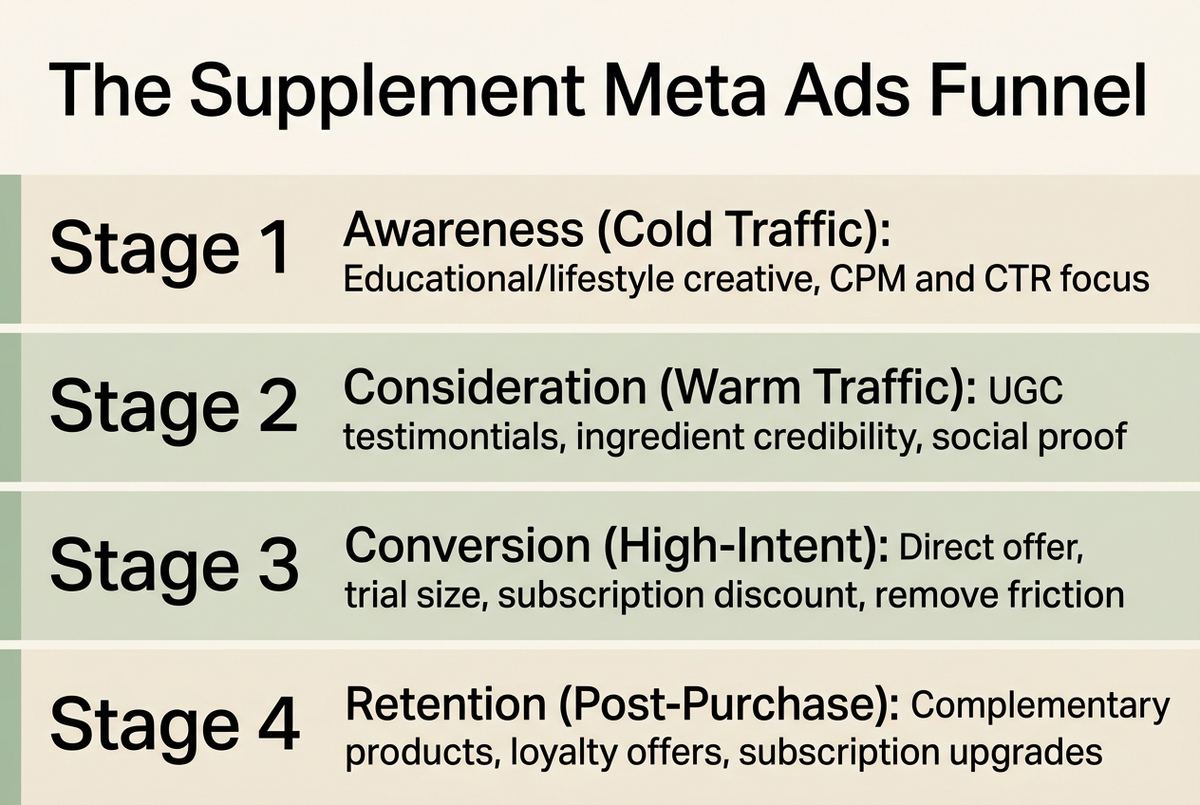
The supplement customer journey has four stages that require different creative and different messages. Running one campaign type across all of them is the single most common mistake we see.
Stage 1 - Awareness (cold traffic)
Educational or lifestyle creative. Benefit-first hook. No direct selling pressure. The goal is to get them to your site, not to close the sale in the ad. CPM and CTR are the primary metrics at this stage.
Stage 2 - Consideration (warm traffic)
Product-specific creative. Ingredient credibility. Social proof and reviews. This is where UGC testimonial content performs best. They have seen you before - now they need a reason to trust.
Stage 3 - Conversion (high-intent retargeting)
Direct offer. Starter pack. Trial size. Subscription with a first-order discount. This audience knows the product - remove friction and make the decision easy.
Stage 4 - Retention (post-purchase)
This is where supplement brands leave the most money. Meta campaigns to existing customers promoting complementary products, loyalty offers, or subscription upgrades drive compounding AOV growth. Combined with a Klaviyo replenishment flow, this stage often matches the revenue of cold acquisition at a fraction of the cost.
Every brand's situation is different. The right Meta strategy for your supplement brand depends on your margin, price point, product category, and growth stage. If you want to know what the right approach looks like for your specific brand - book a free call with our team.