How to Market a Fashion Brand Online: A Complete Guide for 2026

Most fashion brands waste their first budget on paid media before they have the funnel to support it. We've seen this pattern repeat across more than 100 brands we've worked with since 2019 - and it's almost always avoidable. When you are ready for Google, our Google Ads guide for online clothing stores covers Shopping campaigns and Performance Max from scratch.
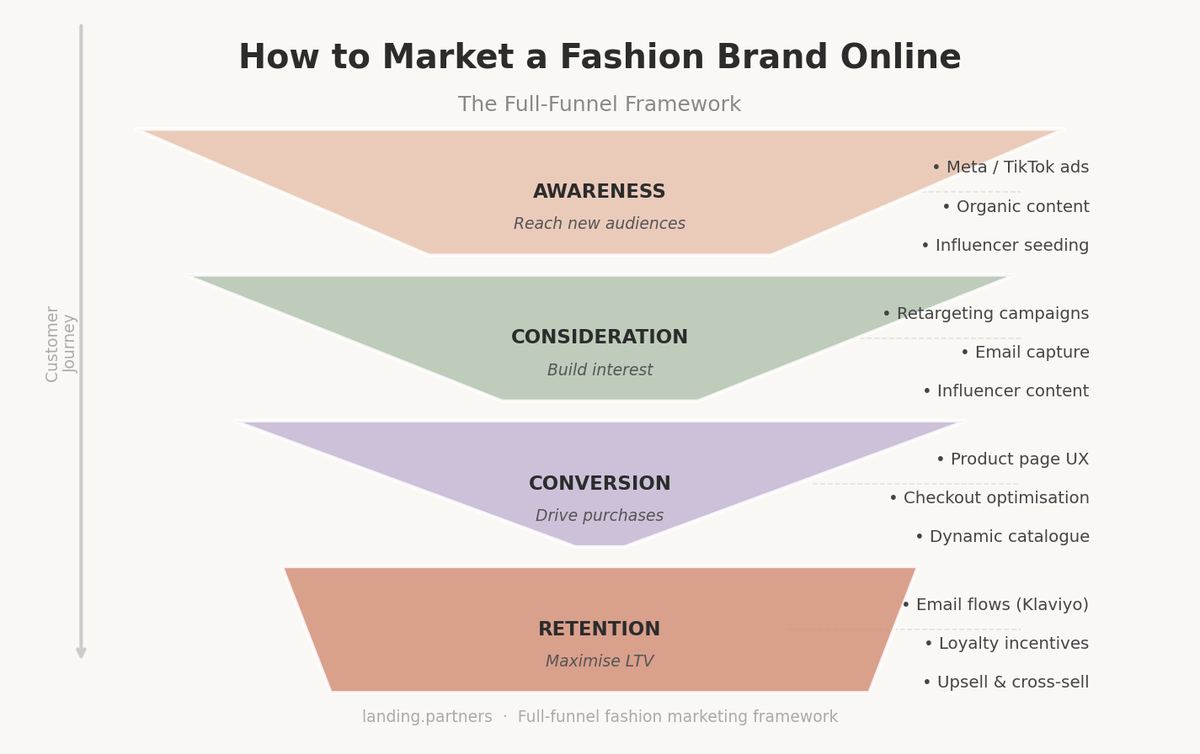
Marketing a fashion brand online isn't complicated. But it is sequential. The brands that grow profitably do things in the right order. The brands that struggle do it backwards - they run ads before their store converts, chase ROAS before they understand their margin, and spend on acquisition before they've built any retention.
Key Takeaways
- •Don't run paid acquisition if your store isn't selling organically yet. Ads amplify what's already there - they don't fix what's broken.
- •MER (Marketing Efficiency Ratio) is a more reliable north star than ROAS. Total revenue ÷ total ad spend. Simple, cross-channel, unmanipulated.
- •There is no universal benchmark for fashion. CR, email revenue %, ROAS targets - they all depend on your price point, margin, and market. Be cautious of any number that isn't specific to your situation.
- •Seasonality in fashion is extreme and brand-type dependent. A kidswear brand has very different peak months than a women's fashion brand or a gifting brand.
- •Build your email list from day one - but flows only become meaningful once you have enough subscribers to generate real volume.
Start With the Foundation: Your Store Has to Sell Before Your Ads Can Scale
Before any paid media conversation, we look at the store. Every time. Because ads don't create demand - they direct it. If your store doesn't convert organically, paid acquisition won't fix that.
The right question isn't 'what's my conversion rate?' - it's 'do people who find me without ads actually buy?' A luxury brand at €300 AOV will convert very differently than a streetwear brand at €80. Comparing your CR to an industry benchmark tells you almost nothing.
The real test: look at your organic traffic and direct visitors. If those people aren't buying, you have a store problem - not a traffic problem. Fix the store before you scale spend.
Not sure what's holding your store back? Request a free webshop analysis - we'll tell you exactly what to fix.
Store readiness checklist:
Product photography that shows fit, fabric, and detail - not just editorial shots
Size guides that reduce return anxiety
Reviews or social proof on product pages
Mobile experience that loads fast
Clear returns policy
Email capture on-site with a real offer
Your average order value also needs to be understood before you set any ad budgets. A brand at €80 AOV with 50% margin has €40 to work with per order. A brand at €200 AOV with 65% margin has €130. These two brands cannot have the same CAC target - even if they're in the same fashion category.
Phase 1 (0–€250K Revenue): The Only Thing That Matters
At this stage, one thing matters: finding proof that people will buy your product at your price point, repeatedly, from strangers who don't know you yet.
This is not the phase for brand awareness campaigns, TikTok experiments, or influencer gifting. It's the phase for ruthless focus on finding your first real customers and understanding what made them buy.
Run Meta Ads as your primary channel - broad targeting with strong creative. Keep spend modest. Measure everything against blended MER (total revenue ÷ total ad spend), not platform-reported ROAS.
On email at this stage: start building your list from day one - popup, checkout capture, a simple welcome email. But don't invest heavily in flows until your list has real volume. A complex automation setup with 200 subscribers doesn't move the needle. List growth first, flows later.
Not sure what to prioritise at your current stage? Book a free intro call - 30 minutes, and we'll give you a clear picture of what to focus on.
Ads don't create demand - they direct it. If your store doesn't convert organically, paid acquisition won't fix that. Fix the store before you scale spend.
Phase 2 (€250K–€1M Revenue): Build Systems, Not Just Campaigns
By €250K, the question shifts: 'Can we get customers?' becomes 'Can we get them profitably, at scale, consistently?' This is where most fashion brands stall - because scaling spend without scaling systems produces chaos.
The key move in Phase 2 is installing proper measurement. MER becomes your primary KPI. Set a target MER by month - adjusted for seasonality - and manage total spend against it.
By now you should also be getting serious about email. Once your list has meaningful volume, flows compound over time: welcome series, abandoned cart, post-purchase. The right benchmark isn't a percentage of total revenue - that number is inflated by Klaviyo's attribution model, which credits any purchase within a 5-day window to the last email opened, even if the customer was already going to buy. Evaluate flows by their own metrics: open rate, click rate, revenue per recipient - not blended email revenue share.

Creative production also becomes a competitive advantage here. The brands that win on Meta at this stage produce 8–12 new creative assets per month - fast, authentic content that answers real buyer questions. For a breakdown of which formats and hooks perform best, see our Meta ad creative playbook for fashion brands.
Phase 3 (€1M–€2M Revenue): Scale Paid Media and Protect Margin
At €1M+, you're no longer finding product-market fit - you have it. The challenge becomes scaling spend without crushing margin, and maintaining efficiency as you enter new audiences and markets.
Typical Phase 3 channel mix: Meta 60-80% · Google Shopping & PMax max 10% · TikTok 10-20%
Single-channel dependency at this stage is a risk.
International expansion typically starts here too. A brand entering a new market will see higher CAC and lower repeat purchase rates - that's normal. Expecting a new market to perform like your home market in year one is one of the most expensive mistakes a scaling brand can make.
Phase 4 (€2M+ Revenue): Go International
At €2M+ in annual revenue, your home market is no longer your primary growth lever. The brands that maintain healthy growth beyond this point are the ones that treat international expansion as a strategic priority - not an afterthought.
This doesn't mean scaling everywhere at once. International expansion requires patience and sequencing. The first step is identifying which markets have natural demand for your product - often evidenced by organic international orders already coming in - and doubling down there before opening new fronts.
The core shift at Phase 4: you're no longer optimising for efficiency in one market. You're building a portfolio of markets, each at a different maturity stage, each requiring different CAC expectations and MER targets. A market you entered 6 months ago will perform differently than your home market of 4 years - and that's expected.
Phase 4 international priorities:
Market selection: Start with markets where you already see organic demand. Look at your existing customer data before spending on acquisition.
MER by market: New markets need lower MER expectations in year one. Set targets per market, not blended across all. A blended MER that looks weak may be masking strong home market performance.
Creative localisation: Language is table stakes. The deeper question is whether your visual language and product positioning resonate with the new market's aesthetic and cultural context.
Logistics: Returns, delivery times, and local payment methods are conversion factors, not just operational details. Solve these before scaling spend.
The brands that succeed internationally aren't necessarily the ones with the biggest budgets - they're the ones who do the groundwork first. Premature international scaling is one of the most common ways fast-growing brands stall.
Planning international expansion? Book a free growth call - we've guided multiple brands through market entry across BE, NL, DE, FR, UK and US.
The Fashion Marketing Calendar: It Depends on What You Sell
Fashion has extreme seasonality - but 'peak months' are not universal. They depend entirely on what you sell.
Seasonality by brand type:
Women's fashion / streetwear: January sales, July sales, BFCM, October Q4 ramp. Structural low months: April–June.
Kidswear / teenswear: September (back-to-school) is often the biggest month - larger than BFCM for many brands.
Gifting brands (jewellery, accessories): Valentine's Day, Mother's Day, and December drive the calendar. Less impacted by solden rhythms.
Jewellery: A mix - gifting seasons drive volume, fashion weeks and new collections drive AOV spikes.
The spread between peak and low months in fashion can be 3–5x. Budget planning that ignores this will either leave money on the table at peak or burn cash in slow months.
Best efficiency we've seen in our portfolio: a cycling streetwear brand at BFCM - MER nearly 15, CAC under €6. Every euro of ad spend returned nearly €15 in revenue. Brands that are underfunded going into their peak period leave serious money on the table.
The spread between peak and low months in fashion can be 3-5x. Budget planning that ignores this will either leave money on the table at peak - or burn cash in slow months. Increase budgets 2-3 weeks before your peak, not during it.
Practical rule: increase budgets 2–3 weeks before your peak - not during it. Have creative ready before the period starts, not while it's running.
The KPIs That Actually Tell You If It's Working
Platform-reported ROAS is one of the most easily manipulated metrics in digital marketing. Attribution windows can be set wide or narrow. Campaign objectives can be optimised to maximise reported conversions. Any agency that wants to make ROAS look good can make it look good - and many do. Under-attribution is a real and growing problem too. As iOS privacy changes and browser restrictions have reduced signal quality, Meta is genuinely missing conversions it used to capture. Sometimes it over-attributes, sometimes it under-attributes - you don't fully control what it's measuring. If you're only looking at platform ROAS, you may be cutting budget on campaigns that are actually working. This is why cross-referencing with MER gives you a ground truth that attribution models can't distort.
The metrics we track across all client accounts:
MER - Total revenue ÷ total ad spend. Simple, unmanipulated, cross-channel.
New Customer CAC - What you're paying to acquire a net-new customer - not a returning buyer.
Email performance per flow - Open rate, click rate, revenue per recipient. Not blended email revenue share, which is distorted by Klaviyo's attribution.
Repeat purchase rate - What % of customers come back within 12 months.
A note on email benchmarks specifically: any 'X% of revenue from email' statistic you see online is almost certainly overstated. Klaviyo's default attribution window credits purchases to emails even when the customer was already going to buy. For campaigns especially, this inflation is significant. The number looks good in the dashboard - but it doesn't reflect the actual incremental value of your email programme.
Want to know what your actual MER and new customer CAC look like - and how they compare to brands at your stage? Request a free Meta campaign analysis.
The Most Common Mistakes We See Fashion Brands Make
1. Running ads before the store sells organically. If people who find you without ads don't buy, paid traffic won't fix that. Our CRO guide for fashion brands covers the exact fixes. Ads send traffic - your store has to close the sale.
2. Using platform ROAS as the primary KPI. We've seen accounts where Meta reports strong ROAS but blended MER tells a very different story. Always cross-reference with actual revenue.
3. Applying universal benchmarks to a specific situation. CR benchmarks, email revenue percentages, ROAS targets - these mean nothing without knowing your price point, margin, and stage. A luxury brand at €300 AOV operates very differently than a streetwear brand at €80.
4. Treating all months the same. Spending the same budget every month ignores the 3–5x spread between peak and low season. Budget should flex with opportunity.
5. Scaling internationally before the home market is efficient. New markets need time to build purchase intent and repeat behaviour. Patience is a financial discipline.
FAQ
Every brand's situation is different. The frameworks in this guide are starting points - your actual targets depend on your margin, price point, market, and stage. If you want to know what the right approach looks like for your specific brand, that's exactly the conversation we have. Book a free audit or intro call - no commitment, just a clear picture of where you stand and what to focus on next.