Fashion Brand Growth Stages: What to Focus On at Every Revenue Level
Most fashion brands don't fail because they chose the wrong channel. They fail because they applied the right tactics at the wrong stage. When you reach the stage where Google becomes relevant alongside Meta, our Google Ads guide for fashion ecommerce shows how to structure Shopping and Performance Max campaigns.
Key Takeaways
- •What works at €100K actively hurts you at €1M. Stage-appropriate strategy is everything.
- •Phase 1 (0-€250K): one channel, list growth, store fundamentals - nothing else.
- •Phase 2 (€250K-€1M): email flows live, Meta structured, CRO starts.
- •Phase 3 (€1M-€2M): systems over hustle. Retention is the growth lever.
- •Phase 4 (€2M+): scale paid media, diversify channels, then international expansion.
- •The biggest bottleneck at every stage is different - and most brands misdiagnose it.
We've worked with fashion brands from their first €50K in revenue to beyond €10M. The single most consistent pattern: the brands that stall are almost always applying strategies that belong to the next phase, while ignoring the fundamentals of where they actually are.
A brand at €150K trying to run TikTok Ads, Google Shopping and a full Klaviyo flow stack simultaneously will burn budget and energy. A brand at €2M still manually testing every creative with no structured system will plateau and wonder why.
This guide maps the four growth phases we use internally at Landing Partners, what matters most at each, and - just as important - what to stop doing.
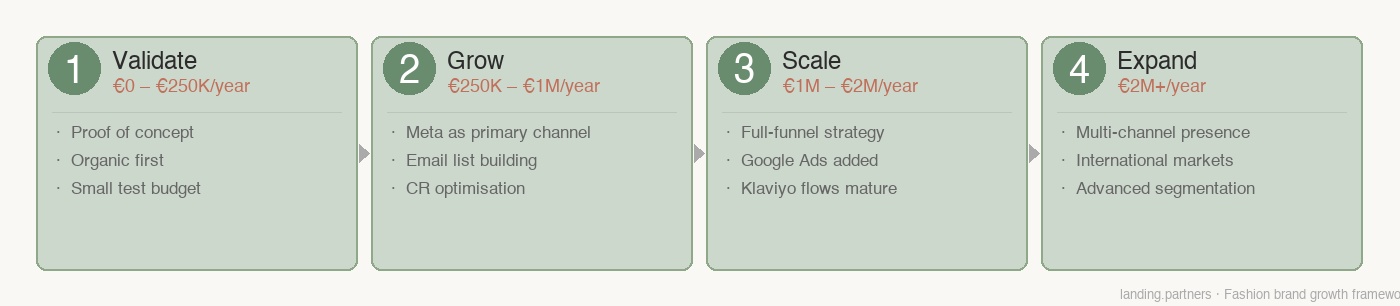
Phase 1: €0 to €250K - Prove the Product, Build the Foundation
At this stage, most of the work is not marketing. It's store quality.
The question isn't 'how do I get more traffic?' - it's 'does my store convert the traffic I already have?' We see this repeatedly in audits: brands spending €2K/month on Meta while their product pages have two photos, no reviews, and a checkout with six steps on mobile.
Fix that first. Paid acquisition can't compensate for a store that doesn't sell.
What to focus on at Phase 1:
One conversion rate problem at a time. Mobile checkout, product images, size information. Pick the highest-impact fix and do it properly before moving on.
Email list building. This is Phase 1's most undervalued activity. A well-placed pop-up, a welcome incentive, a reason to subscribe. You're not running flows yet - you're building the audience that makes flows worthwhile.
One paid channel, tested properly. For most fashion brands, Meta is the right starting point. Test it with enough budget to actually learn (minimum €1,500/month), rather than spreading €300 across five channels and learning nothing from any of them.
Organic content that does real work - not just beautiful photography, but content that answers buyer questions and builds trust before the first purchase.
What to ignore at Phase 1: complex Klaviyo flow stacks, TikTok Ads, Google Shopping, influencer campaigns at scale, attribution modeling.
Not sure if your store is ready before you scale spend? Book a free webshop analysis - we'll tell you exactly what's blocking your conversion rate.
The biggest bottleneck at Phase 1: the store, almost always. Not the channel mix. Not the email strategy. The store. We see brands skip this and pay for it with months of wasted ad spend.
Phase 2: €250K to €1M - Professionalize the Channels
Something shifts at around €250K. The store converts reasonably well, you have a proof of concept, and you're starting to see repeat customers. This is the moment to build infrastructure - not add more channels.
Meta Ads need structure now. Not just boosted posts or single campaigns - ROAS-tracked campaigns with clear testing logic, proper audience segmentation, and a creative testing process you can repeat. At Phase 2, we introduce MER (Marketing Efficiency Ratio) alongside platform-reported numbers, because ROAS alone doesn't show you the full picture.
Email becomes meaningful once your list hits 1,000+ subscribers. Before that, flows have limited statistical value. At Phase 2, you build the core flows: welcome series, abandoned cart, post-purchase, browse abandonment. The goal isn't revenue maximization yet - it's systematic coverage of the buyer journey.
Based on our work with 40+ fashion brands: the welcome series and abandoned cart flow together account for roughly 60-70% of total flow revenue at this stage. Start there, not with winback or VIP flows.
CRO becomes a priority at Phase 2. Your ad budget allocation also becomes more strategic at this stage. You now have enough traffic to run meaningful tests. Product page improvements, checkout optimization, and social proof placement consistently move conversion rate by 15-30% when done properly - without touching ad spend.
What to focus on at Phase 2:
Meta Ads with proper campaign structure and a creative testing rhythm - not ad hoc testing.
Welcome series and abandoned cart flows live and tracked by revenue per recipient, not just open rate.
First A/B tests on product pages or checkout.
Weekly review of MER across all channels combined.
AOV improvement - upsells, bundles, free shipping thresholds. Small AOV increases compound significantly at scale.
What to ignore at Phase 2: TikTok Ads before Meta is profitable. Google Ads for fashion ecommerce before email flows are running. International expansion before the home market is consistent.
Not sure which Phase 2 priorities belong on your roadmap right now? Book a free growth call - we'll map it out for your specific situation.
The biggest bottleneck at Phase 2: creative quality and creative volume. Most fashion brands underinvest in content production and then wonder why Meta results plateau. The algorithm needs material to work with - and good creative is what makes the difference between a profitable Phase 2 and a frustrating one.
Phase 3: €1M to €2M - Systems Over Hustle
This is the phase where most fashion brands stall - not because of lack of ambition, but because of lack of systems.
At Phase 3, you're generating enough revenue that manual decision-making becomes a bottleneck. You can't personally review every creative, every campaign, every email. The brands that make it through Phase 3 are the ones that build repeatable processes - not the ones that simply work harder.
Retention becomes the primary growth lever at this stage. CAC is rising across every channel. The brands managing Phase 3 well are focused on second and third purchases - not just acquisition. Post-purchase flows, loyalty mechanics, collection-drop email sequences, and reactivation campaigns all get real attention and real budget here.

The full Klaviyo stack makes sense now: welcome, abandoned cart, browse abandonment, post-purchase, back-in-stock, winback, and - if the data supports it - VIP segmentation. You have the subscriber volume for all of these to perform meaningfully. To benchmark how your flows should perform at this stage, see our Klaviyo email benchmarks for fashion brands.
Meta Ads get more sophisticated at Phase 3. You're not just testing - you're building a creative system. A content calendar for ad production, clear feedback loops between performance data and creative briefs, and a structured approach to scaling winning creatives rather than constantly testing from zero.
Google Ads and TikTok Ads can enter the mix at Phase 3 - but only after Meta and email are running efficiently. Adding new channels before the core is strong is one of the most common Phase 3 mistakes we see. Both channels suffer when they're added to a system that isn't yet stable.
In our client base, brands that reach €2M and beyond almost universally have strong retention metrics - repeat customer rate above 25%, and email flows contributing meaningfully to revenue per recipient. The brands that stall at €1.5M typically have excellent acquisition but weak retention. They're filling a leaking bucket.
What to focus on at Phase 3:
Full email flow stack live and optimized - not just set-and-forget.
Creative production system with predictable output, not ad hoc briefs.
A reporting dashboard that gives weekly visibility into MER, retention rate, and LTV trends.
CRO as an ongoing programme, not a one-time project.
Google Ads or TikTok as a secondary channel - but not both simultaneously.
The biggest bottleneck at Phase 3: decision speed and creative bandwidth. As complexity grows, decision latency kills momentum. The brands that push through Phase 3 build the processes that make fast decisions possible - without the founder needing to approve every single thing.
Phase 4: €2M+ - Scale, Diversify, and Consider International
At Phase 4, the fundamentals are solid and the systems are running. The question shifts from 'what should we do?' to 'where do we invest to keep growing?'
Paid media scales more aggressively here. Meta budgets can increase significantly when the creative system is working - we've seen brands move from €15K/month to €60K/month within 12 months at this phase with stable or improving MER, when creative volume and quality support the scale.
International expansion typically makes sense at Phase 4 - not before. We see brands attempt it at Phase 2 regularly, and the results are almost always the same: diluted attention, split budgets, and slower growth in both markets. The home market needs to be operationally stable before you add the complexity of a new geography.
When the moment is right, the order we usually recommend for Belgian and Dutch brands: Germany or France first, then UK, then US. Each market requires localized creative, adapted email sequences, and - in some cases - different product positioning. The investment required is real, and doing it from a position of home market strength is what makes it work.
Channel diversification at Phase 4 means finding where your customer is beyond Meta. For some fashion brands that's TikTok. For others it's Pinterest, Google Shopping, or influencer partnerships at meaningful scale. The principle is the same: build from a position of strength, not because a channel is trending.
Thinking about the next phase for your brand? Book a free growth strategy call - we'll map the roadmap specific to where you are right now.
The biggest bottleneck at Phase 4: organizational capacity and creative quality at scale. The brands that stall here run out of creative bandwidth before they run out of market opportunity. Building the team and production infrastructure to support aggressive scaling is as important as the channel strategy itself.
The One Pattern That Kills Growth at Every Stage
After working with brands across all four phases, the most consistent pattern is this: brands applying the tactics of the next phase while skipping the fundamentals of the current one.
A brand at €150K running full-funnel Meta campaigns with custom audiences and retargeting - but a checkout that loses 70% of sessions on mobile.
A brand at €800K adding TikTok Ads and Google Shopping - but no abandoned cart flow, and a welcome series that sends one email.
A brand at €1.5M building an international expansion plan - but no retention system, no repeat purchase data, and a team that's already stretched at capacity.
The brands that scale cleanly do the less glamorous work first. They fix the store before they scale spend. They build the email list before they build the flows. They stabilize one channel before adding the next.
Stage discipline is not a constraint. It's how you build something that actually scales.
Frequently Asked Questions
Every fashion brand's growth path is different. The right strategy depends on your margin, your price point, your market, and where you actually are right now - not where you want to be. If you want to know exactly what belongs in your roadmap at your current stage, book a free growth call. We'll map it out for your specific situation.