What We've Learned from 100 Fashion Brands: The Patterns Behind Every Successful Scale-Up

After working with over 100 fashion brands across Belgium, the Netherlands, Germany, France, and the UK, certain patterns repeat themselves with remarkable consistency. One consistent finding: brands that add Google Shopping campaigns alongside Meta at the right stage see a meaningful uplift in total revenue without cannibalising paid social.
Some brands scale reliably. Others plateau — we break down exactly what to focus on at each revenue stage. Some burn through ad budget without compounding results, or hit a ceiling they can't explain. The difference is rarely luck, market timing, or even creative quality. It comes down to the same structural choices, made at the same moments, in the same sequence.
This is what we've observed.
Key Takeaways
- •Brands that scale always have email infrastructure in place before they scale paid media - without exception
- •The content quality of ads determines the growth ceiling, not the targeting strategy
- •Poor store conversion rate is the most common hidden problem - and the most expensive one to ignore
- •Brands that internationalise too early almost always stall: home market first, always
- •The highest-performing brands track 5-7 focused KPIs - not 20+ vanity metrics
- •Seasonal planning is brand-type specific — use our full-year fashion email calendar. One size does not fit all brand types.
- •The agency or team a brand chooses at the scaling phase has an outsized impact on outcome
How We Compiled These Observations
Landing Partners was founded in 2019. Since then, our team has worked with brands at every stage - from pre-revenue fashion startups to established European labels doing €5M+ online. We've onboarded accounts that were already profitable and accounts that were spending €20K per month with nothing to show for it.
What follows is not a statistical study. It's a practitioner's synthesis - the patterns we've seen repeat often enough that we now use them as diagnostic tools during every onboarding audit.
We've anonymised everything. No brand names, no identifying details. But the patterns are real.
Pattern 1: Brands That Scale Successfully Always Have Email Infrastructure First
Without a single exception in our client base, every brand that successfully scaled paid media to €20K/month or beyond had a functioning email system in place before they scaled.
By 'functioning' we don't mean complex. We mean: a welcome series, an abandoned cart flow, and a list of at least 1,000 engaged subscribers. That's the baseline.
Why does this matter for paid media? Because email is your retention layer. When you run paid ads without it, every customer you acquire is a one-time transaction. You pay to acquire them, they buy once, and they're gone. Your CAC never gets amortised across a second, third, or fourth purchase.
Brands that skip this step typically see their blended ROAS look acceptable in the short term - because the first purchase numbers appear in the attribution window. But their LTV is flat, their repeat purchase rate stays below 20%, and scaling ad spend produces diminishing returns.
The sequence that works: build the list, build the flows, then scale paid media. Always in that order.
Not sure where your email system stands before scaling ads? Book a free email audit - we'll review your flows and list health in one call.
Every brand that successfully scaled paid media to €20K/month or beyond had a functioning email system in place before they scaled. Welcome series, abandoned cart flow, 1,000+ engaged subscribers - that's the baseline.
Pattern 2: Creative Quality Determines the Ceiling of Paid Media - Not Targeting
This is the insight that surprises brand founders the most when they first hear it. They assume that The myth: Meta ads performance is primarily a targeting problem. We wrote about the real Meta benchmarks and what actually drives ROAS for fashion brands. 'We need better audiences.' 'Should we use broad targeting or interest stacking?' 'Can we get better lookalikes?'
In reality, creative is the variable that determines the ceiling. Targeting has become largely table-stakes - Meta's algorithm is sophisticated enough that audience selection rarely explains the difference between a brand that scales and one that doesn't.
What we consistently observe: brands with strong Meta ad creative — clear product presentation, a compelling hook in the first two seconds, content that feels native to the feed - outperform brands with weak creative regardless of targeting strategy. And brands with weak creative can't be saved by sophisticated audience work.

The practical implication: if your Meta ads aren't scaling, audit the creative before auditing the targeting. Look at your hook rate (the percentage of people who watch beyond 3 seconds). Look at your click-through rate at the creative level. If those numbers are weak, the problem is the ad itself. We've documented the specific hooks and formats that work in our Meta ad creative playbook for fashion brands.
Fashion has specific creative requirements that generic paid social advice misses. Products need to be seen clearly. The brand aesthetic needs to read immediately. Motion and pacing need to match the target customer's content expectations. UGC works for some fashion sub-segments (streetwear, contemporary) and actively hurts others (luxury, occasion wear).
One thing brands consistently underestimate: getting the right creative out there - produced at the right volume, refreshed at the right cadence, briefed correctly - is an operational challenge as much as a creative one. Most brands we onboard are running 3-4 creatives per campaign. The ones scaling are running 15-20, testing systematically, and retiring fatigue within 4-6 weeks. That requires infrastructure, not just inspiration.
Creative Strategy at Landing Partners: We help fashion brands build the creative infrastructure they need to win on paid media - without burning out their team or blowing their production budget. What that looks like in practice: a creative audit of your existing ads, a content plan mapped to your campaign calendar, visual direction your team can execute against, copy frameworks for your core ad types, and monthly creative reviews with specific, actionable feedback. We don't produce your content - we coach and direct, so your team produces better creative, faster. Learn more about Creative Strategy or get free ad creative ideas to see the kind of thinking we bring.
Pattern 3: Store Conversion Problems Are Invisible Until You Look
The most expensive mistake we see - and it's extremely common - is scaling paid media spend on top of a store with a CVR problem.
Here's why it's so dangerous: a weak CVR is invisible at low spend. If you're spending €3,000/month, the waste is manageable. But if you scale to €15,000/month with a store converting at 0.8% instead of 1.8%, you're spending 2.5x more than necessary to generate the same revenue. The numbers in Meta Ads Manager might still look 'acceptable' because attribution windows obscure the real picture.
How we diagnose this: we compare paid traffic CVR to organic/direct CVR. If organic traffic converts at 2.1% and paid traffic converts at 0.6%, there's usually a landing page or product page problem specific to cold-traffic visitors. If both are low, it's a store-wide issue.
The most common conversion killers we find in fashion specifically: sizing information that creates uncertainty (a shopper who's unsure about fit won't buy), insufficient product photography (fashion requires multiple angles, on-body shots, and fabric detail), social proof that's too thin or too generic, and a checkout flow that introduces friction at the payment step.
Fix the store before you scale spend. This is not a nice-to-have. It's the highest-ROI work available.
Wondering if your store has a conversion problem? Request a free webshop analysis - we'll benchmark your CVR and identify the three biggest friction points.
Creative is the variable that determines the ceiling on Meta. Brands with weak creative can't be saved by sophisticated audience work. Audit the creative before auditing the targeting.
Pattern 4: Internationalisation Too Early Is the Most Common Strategic Mistake
We've seen this pattern consistently across brands in Belgium, the Netherlands, and Germany. A brand reaches €300K-500K in its home market and starts to feel the ceiling. The founders conclude: 'We need to go international.'
In the majority of cases, this is the wrong move at that moment. Not because international expansion is a bad idea - it's often an excellent idea at the right time. But the right time is usually when home market unit economics are genuinely optimised, not when home market growth feels hard.
When you enter a new market, you restart almost everything: creative relevance (what works in Belgium often doesn't land in Germany), customer acquisition costs (you have no retargeting pool, no social proof in-language, no email list), logistics and return complexity, and localisation requirements. Your CAC typically doubles or triples in the first three months of a new market.
Brands that internationalise too early typically spread budget too thin, fail to build momentum in any single market, and return to the home market having depleted resources and confidence.
Our benchmark: a brand should be achieving consistent month-over-month revenue growth in its home market, have a repeat purchase rate above 25%, and have a clear understanding of its customer acquisition cost before entering a second market. At Landing Partners, we define Phase 4 growth (€2M+) as the stage where international expansion becomes the primary strategy.
Below that threshold: go deep in the home market first.
Pattern 5: High-Performing Brands Track Fewer Metrics, Not More
There's a consistent pattern among the brands in our client base that perform best: they track a small number of metrics with religious discipline, and they ignore most of what's available in their dashboards.
The typical struggling brand tracks 20+ metrics across Meta Ads Manager, Google Analytics, Klaviyo, and Shopify. The numbers contradict each other (as attribution systems always do), decisions become paralysed, and every week becomes a debate about which number is 'right'.
The high performers track: total online revenue, MER (marketing efficiency ratio - total ad spend divided by total revenue), new customer acquisition rate, repeat purchase rate, and email revenue by flow. That's it. Everything else is secondary.
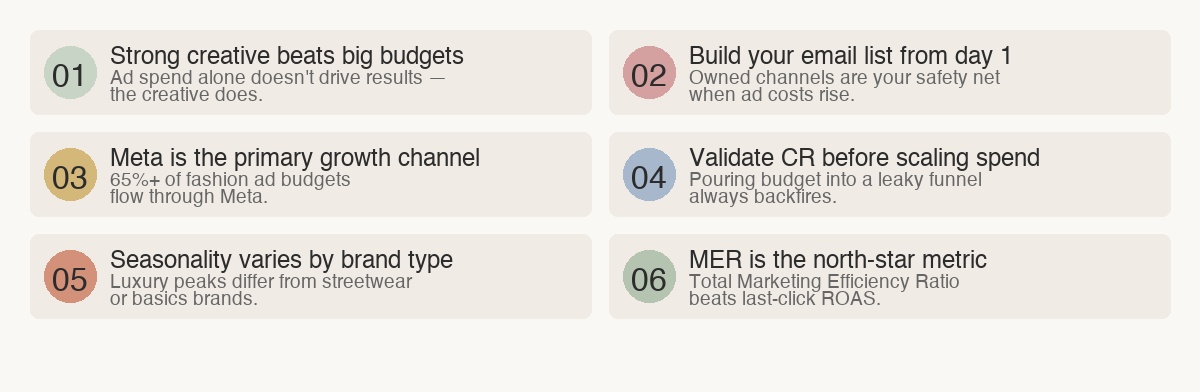
Why MER rather than channel-level ROAS? Because ROAS is easy to manipulate - by adjusting attribution windows, campaign objectives, or what counts as a conversion. Any agency can make ROAS look good if they want to. MER is harder to game: it's total ad spend divided by total revenue, full stop. It forces honest accounting.
If your MER is 5x - you're spending €1 and generating €5 in total revenue - your marketing system is working regardless of what any individual channel reports.
Pattern 6: Seasonal Planning Is Brand-Type Dependent - One Calendar Doesn't Fit All
Generic marketing advice treats fashion seasonality as monolithic: prepare for BFCM, run a summer sale, launch a Christmas campaign. In practice, different fashion brand types have entirely different seasonal profiles.
Women's contemporary fashion and streetwear follow the classic fashion calendar: January sales, the SS collection launch, July sales, AW launch, and BFCM/Q4. Low periods in April-June and August.
Kidswear and teenage fashion have a completely different profile. September back-to-school is often the single biggest revenue period of the year - larger than BFCM. Brands that treat September as a secondary period consistently underinvest at their most important moment.
Gifting-oriented brands - jewellery, accessories, lifestyle fashion - have three primary peaks: Valentine's Day, Mother's Day, and December. BFCM matters, but it competes with a shorter, higher-AOV gift-buying window.
Luxury fashion is less driven by promotional calendars and more driven by collection launches and fashion week proximity. Heavy promotional activity in this segment can actively damage brand perception.
The practical implication: before you build your annual media calendar, define which seasonal profile matches your brand. Then plan your ad budget, email calendar, and creative production schedule around that - not around a generic 'fashion calendar' from a blog post.
Pattern 7: The Agency or Team You Choose at the Scaling Phase Has an Outsized Impact
This is an uncomfortable observation to make from the position of an agency. But it's one of the most consistent patterns we see.
The brands that compound their growth over 18-24 months almost always have a clear answer to 'who owns performance marketing?' - and that owner has genuine fashion ecommerce experience, not just general paid social expertise.
Fashion is a specific discipline. ROAS benchmarks are different from DTC health brands or software. Creative strategy is different. The seasonal dynamics are different. Customer LTV patterns are different. An agency or hire that's excellent at performance marketing for, say, a SaaS company will often make expensive mistakes in fashion - not out of incompetence, but because the intuitions developed in one category don't transfer cleanly.
The question to ask when evaluating an agency: 'Can you show me five fashion brands you've worked with, what their situation was when you started, and what happened over 12 months?' If they can't answer that question clearly, they don't have the reference base to navigate fashion-specific problems.
The other common mistake: bringing in a generalist freelancer at the €500K-2M phase. At that stage, the decisions being made - creative strategy, funnel architecture, email segmentation, international expansion timing - are complex enough that a single generalist will hit their ceiling quickly. This is the phase where specialist support typically pays for itself.
Evaluating whether your current setup is right for your next growth phase? Book a free growth call - we'll give you an honest assessment.
The Shared DNA of Every Fashion Brand That Successfully Scales
When we look across the brands in our experience that have successfully grown to €2M+, the commonalities are striking:
They have a healthy store conversion rate before they scale ad spend.
They have a functioning email infrastructure - welcome series, abandoned cart, post-purchase - before paid media becomes their primary growth channel.
They understand their seasonal profile and plan around it, not around generic fashion calendars.
They track a small number of meaningful metrics (MER, new customer rate, repeat rate) and make decisions from those - not from the attribution theatre inside any single ad platform.
They don't internationalise until the home market is genuinely optimised.
They have strong creative - native to the platform, clear on product, compelling in the hook.
And they have the right people - whether internal or agency - who understand that fashion ecommerce has its own logic.
None of this is particularly surprising in hindsight. But it's striking how consistently the brands that struggle are missing one or more of these elements - and how rarely they know it before an outside audit.
What This Means in Practice
If you're reading this as a fashion brand founder or marketing lead, the diagnostic questions are straightforward:
Does your store convert cold traffic at a rate above 1.2%? If not, fix this before increasing ad spend.
Do you have at least 1,000 engaged email subscribers and a welcome + abandoned cart flow live? If not, build this before scaling paid media.
Do you know your MER for last month? If you can only tell me your Meta ROAS, you're flying with partial instruments.
Is your home market growing consistently month-over-month? If not, going international will compound the problem, not solve it.
Is your creative - the actual videos and images in your ads - reviewed and refreshed every 4-6 weeks? If not, you're probably running fatigued creative without knowing it.
These aren't complex questions. But most fashion brands we speak to for the first time can't answer all five with confidence.
FAQ
Every brand's situation is different. The patterns described here are observations from our work, not universal laws. What growth looks like for your specific brand depends on your margin, price point, customer base, and market. If you want to know where your brand sits relative to these patterns - and what the next right move looks like - book a free strategy call. We'll give you a direct, honest answer.