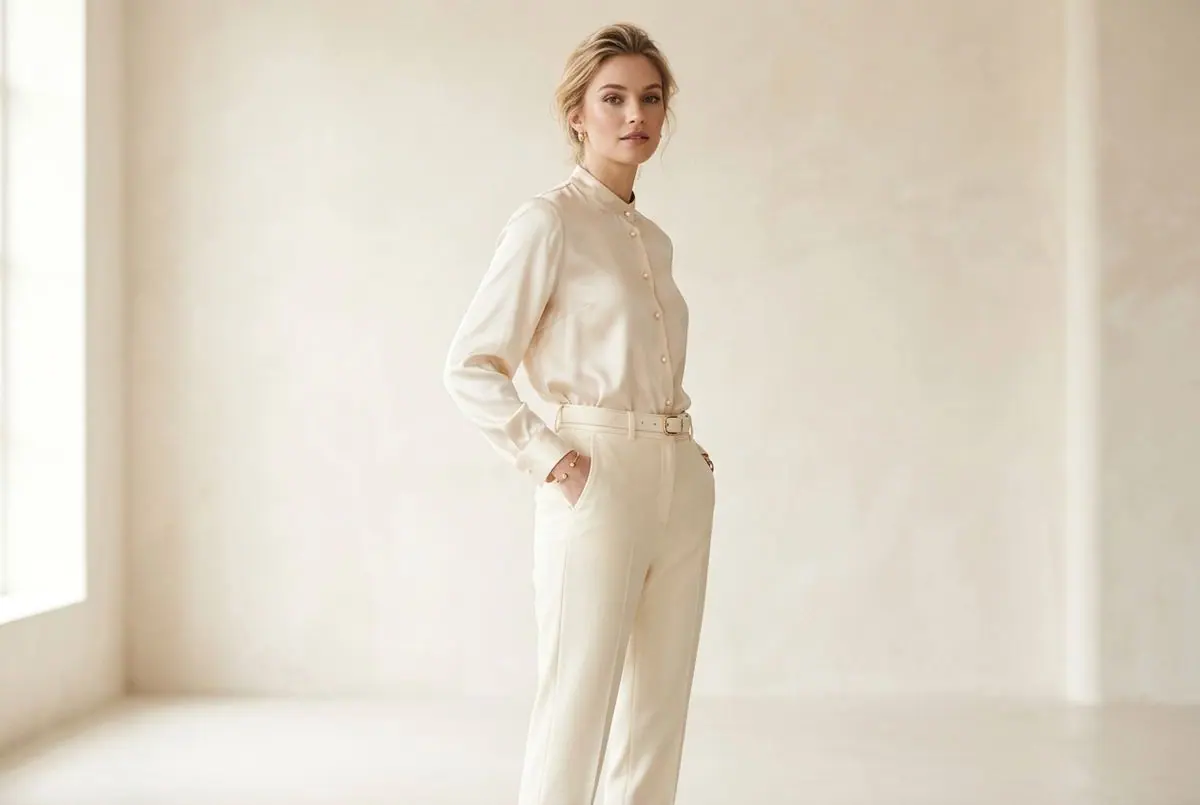
Why the Rules Change Above €150 AOV
Most performance marketing advice is written for fashion brands selling at €60-120 average order value. Urgency tactics, flash sales, broad creative testing, aggressive retargeting - all of it is calibrated for a buyer who makes a relatively low-stakes purchase decision.
Above €150 AOV, none of that logic holds.
We work with premium and luxury fashion brands across Belgium, the Netherlands, and the broader European market. The biggest mistake we see from founders stepping into the premium segment is applying mid-market thinking to a premium product. A €220 silk blouse is not a €75 T-shirt that costs more. It is a fundamentally different purchase, made by a fundamentally different buyer, through a fundamentally different decision process.
The economics shift too. At €80 AOV, you need volume to make paid media work. At €220 AOV, you need margin, loyalty, and LTV. Your CAC can - and should - be higher. Your ROAS target can be lower. Your email frequency needs to drop. Your creative has to work harder on trust and desire than on immediacy.
Understanding this distinction is the starting point for building a premium fashion brand that scales.
The Premium Fashion Buyer: Who They Are and How They Decide
The buyer of a €200+ fashion item is research-intensive. They do not impulse-buy a silk coat from an Instagram ad. They see it, save it, Google the brand, read reviews, check the brand's Instagram, perhaps revisit the product page twice more - and then, weeks later, they buy.
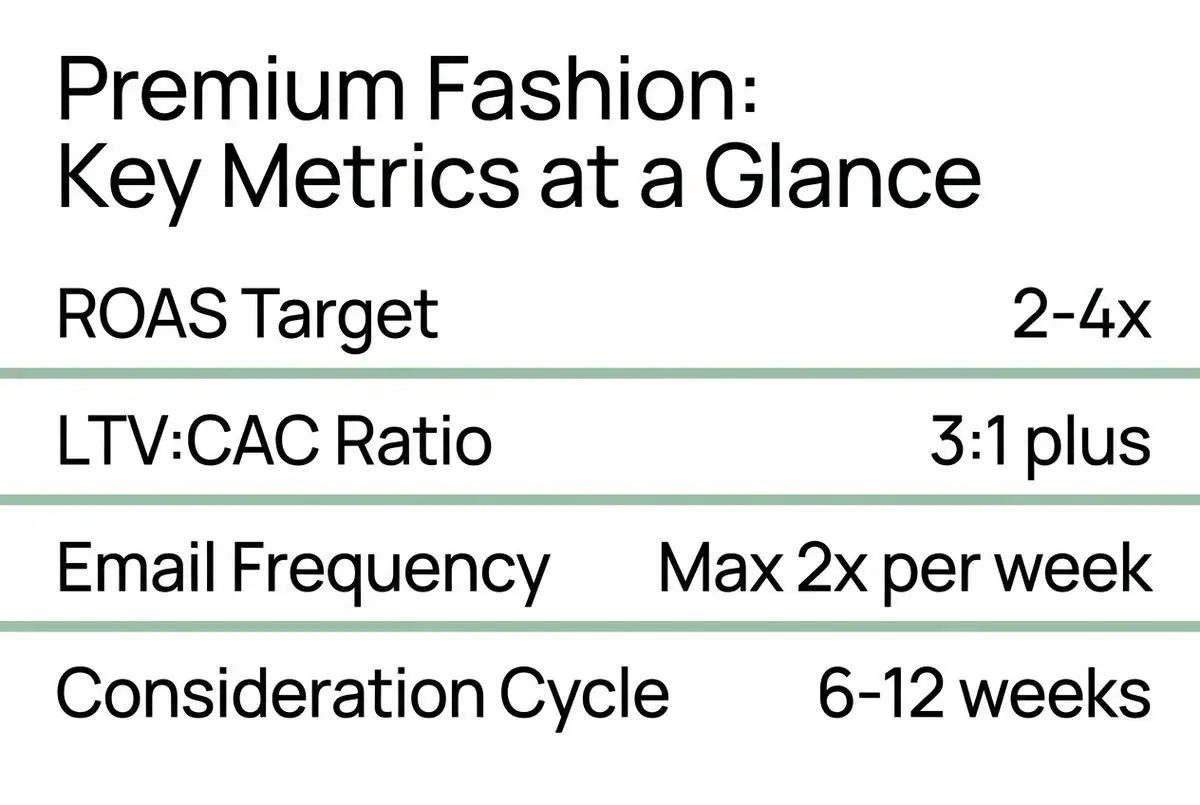
The average consideration cycle for a premium fashion purchase runs 6-12 weeks. We see this pattern consistently across the premium brands we work with. First touchpoint to conversion is rarely under four weeks. Often it is eight.
What this means for your marketing:
- Your Meta campaigns cannot be evaluated at 7-day ROAS. You are building brand memory, not triggering impulse.
- Your retargeting windows need to be longer - 60 to 90 days minimum, not the standard 14-28.
- Your Klaviyo flows are a long-game. One email after three days of silence is not a premium brand experience.
- Your attribution will look broken by conventional metrics. It is not broken - it is accurate for your buyer.
Running a premium fashion brand and unsure whether your Meta and Klaviyo setup reflects how your buyers actually decide? Book a free call and we will tell you exactly what we see.
Meta Ads for Premium Fashion: Creative, Targeting, and What Breaks
Meta Ads can absolutely work for premium and luxury fashion. But the setup and creative logic are different from mid-market fashion - not marginally different, fundamentally different.
Creative: lead with aspiration and craft, not urgency
Mid-market fashion creatives often lean on urgency cues - limited time, price reductions, social proof in the form of large numbers. None of these work for premium. A luxury buyer does not want to feel like they are rushing to a sale. They want to feel like they have discovered something rare.
What works in premium fashion creative on Meta:
- Editorial lifestyle photography - slow, considered, beautiful. Think campaign imagery, not product shots.
- Material close-ups - the weight of a fabric, the texture of leather, the drape of silk. These details are what a premium buyer notices.
- Brand storytelling - who made this, where, why it was designed the way it was. Heritage and craft convert for premium.
- UGC that looks editorial - not "unboxing" energy, but considered styling from a real person who clearly cares about what they wear.
What does not work: countdown timers, "Only 3 left!" copy, product-only shots on white backgrounds, heavy discount messaging.
Targeting: broad is not always right for premium
There is a common view that Meta's algorithm handles targeting best when left to wide audiences. For many brands this is true. For premium fashion, the creative itself acts as the targeting signal - but the account setup still matters.
We typically start premium fashion campaigns with a defined interest audience to ensure the algorithm's initial learning phase is calibrated on quality signals. Moving to broader audiences works better once you have a clear winner creative and enough conversion data for Meta to find your buyer profile.
Lookalike audiences built from your top 10-20% buyers by LTV are among the strongest assets you can have for premium fashion Meta campaigns. Build these early and use them consistently.
ROAS targets for premium fashion: set them correctly or you will stop the right campaigns
This is where we see the most damage done to otherwise sound premium fashion strategies. A brand with a €220 AOV and strong repeat purchase behaviour looks at a 2.5x reported Meta ROAS and panics. At €80 AOV, 2.5x might be too low. At €220 AOV with a LTV:CAC ratio of 3:1 or higher, 2.5x can be completely healthy.
For premium fashion brands with LTV above 2.5x CAC, a platform-reported ROAS of 2-3x is often sustainable and correct. The number that matters is MER across all channels, not what Meta reports in Ads Manager.
Set your ROAS target based on your actual unit economics - your margin, your repeat purchase rate, your LTV. Not based on industry benchmarks designed for a different business model.
How to Calculate the Right ROAS Target for Your Premium Fashion Brand
The right ROAS target for your brand is a function of your margin and your acceptable payback period. Here is the framework we use:
1. Start with your gross margin - for a premium fashion item at €220 selling price, if your COGS is €65, your gross margin is ~70%.
2. Factor in your LTV multiple - if the average customer buys twice over 18 months at €220, your LTV is €440. CAC of €80 gives you a 5.5:1 LTV:CAC, which is healthy.
3. Set your MER target first - total revenue divided by total marketing spend. For most premium fashion brands we work with, a healthy MER sits between 3x and 5x, depending on the phase of growth.
4. Work backwards to a channel ROAS floor - your Meta ROAS floor is not a performance target, it is the minimum below which the channel is clearly loss-making even accounting for attribution gaps.
Meta's platform ROAS consistently overstates actual impact, particularly for premium brands where the path to purchase is long and multi-touch. Use MER as your primary steering metric. Platform ROAS is a directional signal, not the truth.
Not sure what MER target makes sense for your premium fashion brand at your current revenue stage? Book a free call - we will help you set the right numbers for your margin and growth phase.
Klaviyo for Premium Fashion: Less Frequency, More Depth
Email marketing for premium fashion is one of the areas where mid-market playbooks fail most visibly. The instinct is to email frequently - two or three times per week, every campaign, every promotion. For a brand selling at €60 AOV, that frequency can work if the content is good. For a brand selling at €250 AOV, it erodes the brand perception and unsubscribe rates spike.
Premium buyers have a higher intolerance for irrelevant or frequent communication. They expect to hear from a brand they love - but only when there is something worth saying.
Email frequency guidelines for premium fashion
We recommend a maximum of two campaign sends per week for premium fashion, and only during active collection launches or key moments. Outside of those windows, one send per week or less is appropriate. The content standard is higher: each email needs to feel considered, not automated.
Flows: the 6-12 week consideration cycle requires patience
The welcome series for a premium fashion brand should not sell hard on day three. A premium new subscriber needs to understand the brand, its world, its craft, before they are ready to be converted. A welcome series of 5-7 emails spread over 4-6 weeks is appropriate for premium - versus the standard 3-email/7-day approach for mid-market.
The abandoned cart flow similarly needs adjustment. Do not trigger an abandoned cart email after one hour. Wait 4-6 hours. Do not lead with a discount. Lead with a reminder of what the product is - a well-photographed image, a line about the material or craft, a clear path back to the product. Add a discount only if earlier non-discount emails have not converted after several days - and even then, keep it small and position it as an exception, not a rule.
For premium fashion clients we work with, abandoned cart flows without a discount outperform discount-led flows on net revenue per recipient, even when the conversion rate is slightly lower, because the higher margin offsets the lower volume. Protecting margin matters at premium price points.
Klaviyo attribution note
Be careful reading Klaviyo revenue attribution for a premium brand. Klaviyo's default 5-day click attribution window credits purchases that would have happened anyway - particularly for campaigns sent to engaged subscribers who were already deep in the consideration process. Use flow-specific metrics (open rate, click rate, revenue per recipient) to judge performance, not total attributed revenue.
CRO for a Premium Fashion Webshop: Trust Beats Tactics
Standard CRO playbooks recommend: add urgency, add social proof, simplify checkout, reduce friction. Most of that advice is correct for mid-market fashion. For premium, trust is the primary conversion driver, not urgency.
A premium buyer arriving on your product page is not going to be converted by a countdown timer or a "bestseller" badge. They are going to be converted by confidence that this brand is legitimate, the product is exactly what they expect, and the purchase experience will match the brand's positioning.
Product page elements that build trust for premium fashion
- High-resolution material and detail photography - multiple angles, including close-ups of fabric texture, hardware, lining
- Clear origin and craft information - where it was made, by whom, with what materials
- Detailed size and fit guidance - premium buyers are not returning items; they need confidence before buying
- Honest, specific product descriptions - weight of fabric, exact measurements where relevant, care instructions
- Visible customer service quality signals - easy returns, response time, human contact details
- Authentic social proof - real reviews with photos, not generic five-star ratings without context
CRO tactics that backfire for premium fashion
- Countdown timers and scarcity overlays on product pages
- Pop-up discounts triggered immediately on landing
- "Customers also viewed" grids with random other products
- Heavy promotional badge overlays on hero images
- Checkout pages that feel generic or unbranded
The premium buyer expects a premium experience end to end. Any element that feels cheap or generic undermines the purchase at the moment of decision.
Sale Strategy for Premium Fashion: Protect the Brand Aura
Discounting is the most dangerous tool in a premium fashion brand's arsenal. Used wrongly, it trains buyers to wait, erodes perceived value, and makes it progressively harder to sell at full price.
The brands that damage themselves most are those that run frequent or deep discounts. We have seen premium brands at €200+ AOV drop to an effective AOV of €140 within 18 months because their buyer base learned to expect sales. Rebuilding that pricing authority is very difficult.
In our experience across premium fashion clients, brands that discount more than 4 times per year at 20%+ depth see measurable erosion in full-price conversion rate within 12-18 months. The damage is slow, hard to attribute, and hard to reverse.
Guidelines for sale strategy at premium price points:
- Maximum 2-3 sale moments per year, aligned with genuine seasonal transitions (end of winter, end of summer)
- Discount depth no greater than 20-25% for premium brands. Deeper discounts signal desperation.
- Never discount hero products or current season pieces. Reserve sales for end-of-season or archive items.
- Communicate sale exclusivity carefully - "Archive sale" or "Past season edit" preserves the brand narrative better than "SALE 30% OFF"
- Do not run sale emails to your full list. Segment: send to non-purchasers and lapsed customers first, not to your loyal full-price buyers who do not need the incentive.
If you are unsure how to structure your sale strategy without damaging your premium positioning, we can help you think through the timing and communication. Book a free call with our team.
Benchmarks: What to Expect at Premium Price Points
We are deliberately cautious with benchmarks, because the right numbers for your premium fashion brand depend entirely on your margin, your repeat purchase rate, your geographic market, and your growth phase. What follows is a directional framework, not a universal target.
ROAS and MER
Platform-reported ROAS of 2-4x is a reasonable range for premium fashion Meta campaigns in a growth phase. MER across all channels (including email, organic, and referral) of 3-6x is a healthy signal for a brand at €1M-€5M revenue. These numbers are not ceilings - many premium brands operate at higher efficiency. But they are a reasonable floor below which you should investigate, not panic.
LTV:CAC ratio
For premium fashion, a healthy LTV:CAC sits above 3:1. Brands we work with at €200+ AOV with strong repeat purchase rates often see LTV:CAC of 4:1 to 6:1, because the repeat buyer makes up so much of the total revenue. Building this requires a strong post-purchase experience and Klaviyo retention flows, not just acquisition.
Email open and click rates
Premium fashion email lists tend to have higher open rates than mid-market, because the subscriber base is smaller and more intentional. Open rates of 35-50% for flows and 25-40% for campaigns are reasonable indicators of a healthy premium list. If you are consistently below 25% on campaigns, your send frequency is likely too high or your segmentation is too broad.
Consideration cycle and repeat purchase timing
Expect 6-12 weeks from first touchpoint to first purchase. Expect 8-16 weeks between first and second purchase. These timelines are longer than mid-market, but the second purchase is often at full price and often at a higher AOV than the first.
Common questions
Why is my Meta ROAS lower for my premium fashion brand than it was for a lower-priced product I sold before?
This is expected. Premium fashion has a longer consideration cycle, which means more attribution is lost in the standard 7-day click window. A buyer who saw your ad in week one and converted in week six will not appear in your Meta ROAS. Use MER as your primary measure. Also review your 28-day click attribution window in Meta Ads Manager - it often tells a meaningfully different story for premium brands.
Should I run Advantage+ Shopping Campaigns for my premium fashion brand?
It depends on your creative volume and conversion data. Advantage+ Shopping works best when it has enough quality conversion signals to learn from. For premium fashion brands below 50 purchases per week, we typically recommend a more structured manual campaign setup first, building to Advantage+ once you have a proven creative set and enough data. Broad automation with insufficient signal tends to underperform for premium - the product is too considered a purchase for the algorithm to find buyers without guidance.
How do I handle email opt-ins for a premium fashion brand without offering a discount?
Content-led opt-ins consistently outperform discount pop-ups for premium fashion brands. Early access to new collections, an editorial style guide, a look behind the making of a product - these attract the right subscriber who wants to be part of the brand world, not the buyer who opted in for 10% off and will unsubscribe after using the code. A smaller, more engaged list with higher intent buyers is worth significantly more than a large list built on discount incentives.
Is it worth running Google Ads for a premium fashion brand alongside Meta?
Yes, but structure matters. Branded search campaigns are essential - you need to capture the buyer who was influenced by Meta or word of mouth and is now searching your brand name. Shopping campaigns work for premium when the product feed is properly optimised with high-quality images and accurate attributes. Performance Max requires careful monitoring for premium brands, as it can pull budget toward lower-intent placements that do not suit the premium buyer journey.
How often should I email my premium fashion subscribers?
Outside of active collection launches, once per week is the upper limit for campaign sends. During a collection launch or a key seasonal moment, two sends per week for 2-3 weeks is acceptable. For flows, match the timing to the consideration cycle - welcome series spread over 4-6 weeks, abandoned cart with a 4-6 hour first delay. Quality over frequency is the principle. Every email should feel intentional.
Every premium fashion brand's situation is different. The right ROAS target, email frequency, sale strategy, and Meta setup depend on your margin, your price point, your buyer, and your stage. If you want to know what the right approach looks like for your specific brand - book a free call with our team.