
Advertising a makeup brand on Meta is a fundamentally different puzzle than advertising skincare. When your hero product is a foundation that comes in 32 shades, the question your buyer is asking is not 'should I buy this?' - it is 'which shade is mine?' That question is the single biggest barrier between a click and a conversion for colour cosmetics brands.
We run paid media for makeup and colour cosmetics clients alongside skincare and fashion brands. The contrast is stark. A skincare buyer evaluates ingredients, skin type and results. A makeup buyer evaluates shade match, finish, formula and how it looks on someone who resembles her. The entire creative and conversion strategy has to be built around that reality.
Why Makeup Is Harder to Advertise Than Skincare
Skincare has one primary purchase barrier: does this product work for my skin type and concern? Makeup has two: does this product work, and does this specific shade work for me? The second barrier is what makes colour cosmetics advertising genuinely difficult.
A serum brand can show one hero video - an ingredient breakdown, a before-and-after, a founder explaining the formula - and drive conversions across its entire audience. A foundation brand has to solve shade anxiety for every single viewer. If someone watches your ad and thinks 'looks great but I have no idea if shade 32N would match me', they leave. That friction is where conversion is lost.
The shade catalogue challenge in paid media
Most makeup brands start by advertising their product as a category - 'our foundation' rather than 'shade 08W Warm Ivory'. That approach works at low budget and low SKU count. Once you have 20+ shades and meaningful spend, you are leaving money on the table. Buyers who have already identified their shade convert dramatically faster when they see that shade specifically called out in the ad or on the landing page.
Based on our work with colour cosmetics clients: ads that reference a specific shade or shade range in the copy outperform generic 'shop all shades' messaging by a significant margin on click-through rate - particularly in retargeting, where the buyer already knows what they are looking for.
Meta Ads for Makeup Brands: Catalogue Architecture and Creative Strategy
Dynamic Product Ads with shade-level entries
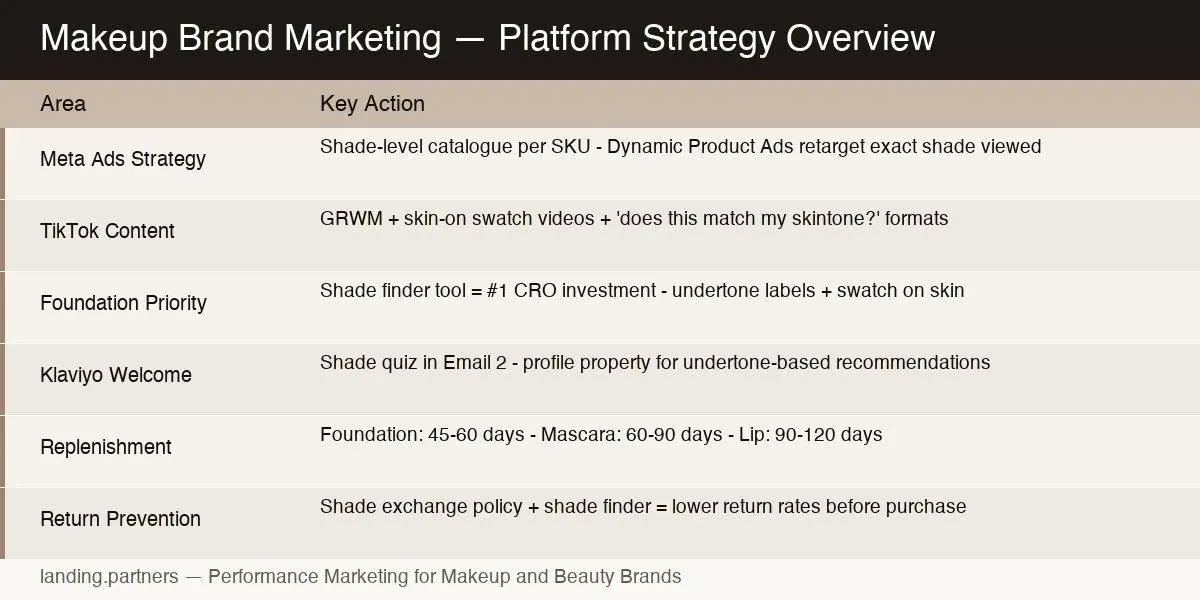
For high-SKU makeup brands, the most important structural decision in Meta is how you set up your product catalogue. Most brands create one catalogue entry per product - 'Foundation X'. The better approach for makeup is one catalogue entry per SKU, meaning one entry per shade.
This enables Dynamic Product Ads (DPA) to show someone the exact shade they viewed on your site, not just the product category. A buyer who spent 45 seconds on 'Foundation X - Shade 12C Cool Beige' and then left should see an ad for that exact shade, not a generic product image.
Setup requires your Shopify product feed to pass shade as a distinct variant attribute. Klaviyo's Meta integration can then segment retargeting audiences by shade category - warm tones, cool tones, deep tones - which allows you to show shade-relevant creative to each segment.
Not sure how to structure your makeup catalogue for Meta DPA, or whether your current setup is losing you retargeting revenue? Book a free Meta audit and we will review your catalogue architecture and creative setup.
Group-level advertising for awareness
At the top of the funnel, shade-level targeting is less relevant - you are reaching people who have not yet interacted with your brand. Here, product group advertising works well: advertise your foundation collection, your lip range, your eye palettes as categories. The goal is interest and click, not shade-specific conversion.
The creative at this level should show range. If you can show a 30-second video with five different people wearing five different shades of the same product, you signal inclusivity and shade breadth without overwhelming the viewer with a catalogue.
Shade-communication in creative
Swatch content is the most common creative format for makeup brands and also the most abused. A flat lay of 32 foundation swatches on a white background is practically useless as an ad creative - it tells a buyer nothing about how the product looks on skin. What converts is swatches on actual skin tones.
The creative formats we see working consistently for makeup in Meta:
• Skin-on swatch videos: creator or model applies multiple shades directly to their arm or face, comparing matches. Short, close-up, with the shade name called out in text overlay.
• Side-by-side shade match: two people with different undertones each finding their shade from the same collection. Demonstrates range without a product spreadsheet.
• Application process: a 15-second video showing the texture, blend-ability and finish of the product on skin. Foundation and concealer buyers want to know how it applies before they commit.
• Finish comparison: matte vs. satin vs. dewy in 10 seconds. Buyers who know their preferred finish will self-select.
In our colour cosmetics accounts, video creatives that show the product on at least two different skin tones significantly outperform single-model creatives in cold audience CTR. The viewer needs to be able to place themselves in the ad.
TikTok for Makeup Brands: The Platform Built for Colour Cosmetics
TikTok is the primary discovery platform for makeup in 2026. Beauty is the largest product category on TikTok Shop globally, and makeup specifically - because of the visual, transformation-driven nature of the content - outperforms almost every other category on organic reach. The platform was effectively built for what makeup content does naturally.
The content formats that perform
GRWM (Get Ready With Me) remains the highest-reach format for makeup on TikTok. A 60-90 second routine video where a creator applies a full look using your products, with shade names called out and transitions between steps, drives both organic reach and purchase intent. When boosted as a Spark Ad, it performs as native content rather than an advertisement.
Swatch content on TikTok has a specific visual grammar that differs from static swatches: close-up on skin, creator applying shades in sequence, sometimes with voiceover explaining the undertone of each shade. The best swatch content for TikTok is 15-30 seconds, shows 3-6 shades, and names each one clearly.
'Does this match my skintone?' content is the format with the highest engagement-to-conversion ratio we see for foundation brands. A creator with a specific undertone (cool, warm, neutral, deep, fair) tests whether your foundation works for them. Viewers with similar colouring self-identify, which drives qualified traffic. This format also generates the most useful comments - people asking about their specific undertone - which doubles as market research.
TikTok Shop for makeup
In-app purchase on TikTok Shop works extremely well for certain makeup categories: lip products, single-use items, affordable accessories and serums. For foundation - where the shade decision is complex and the AOV is higher - we generally recommend driving traffic to your webshop where you have a shade finder, virtual try-on and full product detail.
The exception is LIVE Shopping for makeup. A well-run makeup LIVE session - where the host applies products in real time, answers shade questions from the audience and demonstrates on different skin tones - can convert at very high rates for foundation and blush. The real-time Q&A element specifically solves the shade-anxiety problem that prevents conversion in static ads.
If you are running TikTok ads for a makeup brand and want to know which creative formats and shade communication strategy will work for your specific catalogue, book a free strategy call. We can review your current creative output and identify the biggest gaps.
Foundation Advertising: The Hardest SKU to Sell Online
Foundation is the most complex product in makeup to advertise effectively. It has the most shades, the highest purchase anxiety, the highest return rate and the most varied skin type requirements. Every other makeup category is simpler. Get your foundation advertising right and everything else follows.
Shade matching as your primary conversion lever
The single highest-impact CRO investment for a foundation brand is a shade finder. A tool that asks three to four questions - skin tone, undertone, coverage preference, finish preference - and recommends a specific shade reduces purchase anxiety more than any discount. Buyers who use a shade finder convert at significantly higher rates than buyers who navigate a shade dropdown independently.
On the product page, the elements that matter most for foundation:
• Swatch image on at least three different skin tones, not on a white background
• Undertone labelling (cool, warm, neutral) clearly visible in the shade selector
• Filter by undertone as a UX feature - buyers who know their undertone should not have to scroll 32 options
• Video showing the product being applied on skin, not just the packaging
• Return or exchange policy clearly visible near the shade selector - the buyer needs to know they are not stuck if they guess wrong
In our colour cosmetics client accounts, adding clear undertone labelling to shade selectors reduced return rates linked to 'wrong shade' reasons. Foundation buyers who use a shade finder on-site have a measurable uplift in conversion rate compared to those who navigate shades manually.
Inclusivity as a commercial strategy
A foundation range that covers a meaningful breadth of skin tones is not just a brand value statement - it is a commercial advantage. Buyers with deeper complexions have historically had poor experiences with limited ranges, which means they do less brand-switching and are more loyal when they find a brand that actually works for them.
In your ad creative, representing the full range of your shades is not virtue signalling. It is the most accurate way to communicate your product's reach to the maximum number of potential buyers.
Klaviyo for Makeup Brands: Shade-Based Flows and Replenishment Logic
The Klaviyo setup for a makeup brand should be built around two things that fashion and skincare Klaviyo guides consistently miss: the shade dimension of every purchase, and the replenishment cycle of colour cosmetics.
Welcome series with shade quiz
Your welcome series should include a shade quiz as early as Email 2. A new subscriber who has not yet purchased needs to be helped toward their shade before they can convert. The quiz result - even a simple undertone identifier - goes into Klaviyo as a profile property. From that point, every product recommendation email can show them shades relevant to their profile.
This is the equivalent of what a beauty counter associate does: before recommending anything, she asks about your skin tone and undertone. Doing this digitally in the welcome series creates the same effect.
Replenishment flows triggered on exact SKU
Unlike skincare, where you can often trigger replenishment by product line, makeup replenishment must be triggered at the exact product and shade level. A buyer who purchases Foundation X in Shade 12C Cool Beige should receive a replenishment email that links directly to that shade, not to 'Foundation X' as a generic product.
Typical replenishment timing for makeup based on usage frequency:
• Foundation and concealer: 45-60 day trigger (standard 30ml bottle at daily use)
• Mascara: 60-90 day trigger (3 months is the recommended replacement window)
• Lip products: 90-120 day trigger (usage varies significantly)
• Setting powder: 60-90 day trigger
These timings should be adjusted based on your specific product sizes and customer purchase history in Klaviyo.
Post-purchase review request - the shade dimension
Reviews for makeup are most valuable when they include skin tone information. Your post-purchase review request email (sent 14-21 days after delivery) should specifically ask the buyer to mention their shade and skin tone in their review. Reviews that say 'I am NC25 warm beige and shade 12C is a perfect match' are worth significantly more to future buyers than generic five-star reviews.
Return Management for Makeup Brands
Makeup return rates are a real business problem. Unlike fashion, where sizing is the main return driver, makeup returns are driven by shade mismatch and formula disappointment. Both are largely preventable.
Shade-related returns
Every shade-related return is a CRO failure somewhere in the funnel. Either your product images did not show the shade accurately, your shade names were confusing, your shade finder was absent or inaccurate, or your ad creative did not communicate the shade range clearly enough.
The fix is pre-purchase, not post-purchase. Invest in shade finder tools, accurate swatch photography on multiple skin tones, and swatch video content before you invest in return management software. Stopping the wrong purchase is always cheaper than processing the return.
Exchange policy as a conversion tool
An easy shade exchange policy - where a buyer who gets the wrong shade can exchange for a different shade without returning the full product - removes the primary purchase risk for new customers. Communicate this prominently near the shade selector on product pages and in abandoned cart flows.
Every makeup brand we work with that has added a shade exchange policy to their abandoned cart email has seen a measurable lift in cart recovery rate. If you want to know how to structure your recovery flows for a colour cosmetics brand, get in touch here.
Benchmarks: What to Expect from Meta and TikTok for Makeup Brands
Benchmarks for makeup brands differ from skincare and fashion because of the shade complexity and the visual nature of the category. These are directional figures from our colour cosmetics client work.
Colour cosmetics on Meta: CPM for beauty audiences tends to run higher than fashion in European markets, driven by strong competition in the category. Foundation brands that invest in shade-diverse creative consistently outperform on CTR vs. single-model creative. Cold audience ROAS for makeup typically lands lower in the first 30 days than skincare, because the shade decision extends the path to purchase - retargeting ROAS is where makeup brands recover their efficiency.
On TikTok, makeup creative has longer organic lifespans than most categories - a well-performing GRWM video from six months ago can still drive meaningful traffic. This makes TikTok particularly cost-effective for makeup brands willing to invest in quality creator content: one strong video can generate sustained return for months rather than weeks.
For makeup-specific benchmarks that reflect your price point, shade range and current creative setup, the only reliable reference is your own account data alongside comparable brands. We are happy to benchmark your performance if you share your account details.
Every makeup brand's situation is different. The right shade strategy, creative approach and Klaviyo setup depends on your specific range, price point and current conversion rate. If you want to know what the right approach looks like for your colour cosmetics brand, book a free call with us.