Iron and B12 Supplement Marketing: How to Advertise Deficiency-Driven Supplements to Women, Vegans and Athletes Without Disease Claims

Iron deficiency affects 1 in 5 women of reproductive age in Europe. B12 deficiency is rising fast - driven by plant-based diets, GLP-1 use, and aging. Both are high-intent supplement categories with large, motivated audiences actively searching for solutions.
And yet they are among the hardest supplements to advertise on Meta and TikTok.
The reason: the most obvious claims - "helps with iron deficiency", "for people with anaemia" - are exactly the claims that get flagged as health condition targeting. The audience you want to reach is self-aware about their deficiency. But the platforms don't let you address it directly.
We work with supplement brands across these categories, and the vocabulary problem is real. Here is how we solve it - and what the full marketing stack looks like for a brand selling iron or B12.
Key Takeaways
- •Iron and B12 are deficiency-driven categories with high purchase intent - but platform advertising policies make direct targeting difficult
- •EFSA-approved health claims exist for both nutrients and form the foundation of compliant Meta and TikTok creative
- •The highest-converting audiences are women aged 25-45, plant-based consumers, and GLP-1 users - each requiring different creative angles
- •Klaviyo education flows are critical: most buyers need 2-4 weeks before they feel results, and they drop off without proactive communication
- •Bioavailability differentiation (bisglycinate vs. sulfate for iron; methylcobalamin vs. cyanocobalamin for B12) is the most effective brand differentiator in a crowded market
The Iron and B12 Market in 2026: Why This Category Is Growing - And Why Brands Get It Wrong
Iron deficiency is the most prevalent micronutrient deficiency globally. In Europe, estimates suggest 20-30% of premenopausal women have insufficient iron stores, with a meaningful percentage in clinically deficient range. B12 deficiency follows a different but equally significant pattern: the plant-based movement, the rise of GLP-1 medications (which reduce dietary intake and can impair B12 absorption), and the general aging of European populations are all pushing B12 deficiency higher.
**This is not a niche category.** The total addressable market for iron and B12 supplementation in Europe runs into the billions.
So why do so many supplement brands struggle to scale in this space?
Three reasons come up repeatedly when we audit iron and B12 brands:
1. They lead with the deficiency - and get flagged
Ads referencing "iron deficiency", "anaemia", or "B12 deficiency" routinely get rejected or limited in delivery on Meta. The platform treats these as health condition targeting. Brands that lead with the symptom - which is the most intuitive approach - hit a wall immediately.
2. They compete on price in a commoditised form factor
Most iron supplements are ferrous sulfate in a standard capsule. Most B12 supplements are cyanocobalamin at a standard dose. Without form differentiation, the conversation defaults to price - and that is a race to the bottom no DTC brand can win against mass market.
3. They underestimate the education burden
Iron and B12 results take weeks to materialise. A buyer who feels no different after 10 days quietly stops. Without a structured Klaviyo education sequence, churn at the 30-day mark is brutal.
Getting these three things right is the entire game in this category.
Iron deficiency affects an estimated 1 in 5 premenopausal women in Europe. B12 deficiency is rising sharply among vegans, GLP-1 users, and adults over 50 - three of the fastest-growing consumer segments in the supplement market.
The EFSA Claims Framework: What You Can - and Cannot - Say in Europe
The European Food Safety Authority (EFSA) has approved specific health claims for iron and B12. These claims are legally permitted on supplements in Europe and form the foundation of compliant advertising.
Approved EFSA claims for iron:
Iron contributes to normal cognitive function. Iron contributes to normal energy-yielding metabolism. Iron contributes to normal formation of red blood cells and haemoglobin. Iron contributes to normal oxygen transport in the body. Iron contributes to the reduction of tiredness and fatigue. Iron contributes to normal function of the immune system.
Approved EFSA claims for vitamin B12:
Vitamin B12 contributes to normal energy-yielding metabolism. Vitamin B12 contributes to normal functioning of the nervous system. Vitamin B12 contributes to normal psychological function. Vitamin B12 contributes to normal red blood cell formation. Vitamin B12 contributes to the reduction of tiredness and fatigue.
**These are the claims you build your advertising around.** Not deficiency treatment. Not anaemia correction. Normal function support, energy, tiredness reduction.
The distinction matters enormously in practice. "Helps people with anaemia" gets flagged. "Contributes to the reduction of tiredness and fatigue" does not. They describe adjacent territory - but the platform compliance behaviour is completely different.
Every supplement brand we work with starts here: map your entire claim architecture to EFSA-approved language before you write a single ad. This is not just compliance - it is your creative foundation. Book a free call if you want a compliant claim review for your brand.
The Four Target Audiences for Iron and B12 - And How to Reach Each One
Iron and B12 have distinct audience segments, and each requires a different positioning angle, creative hook, and Klaviyo flow.
Audience 1: Women of reproductive age (iron's largest segment)
Menstruation is the primary driver of iron loss in women under 50. This audience is often self-aware: they have had blood tests, they know their ferritin is low, they have tried tablets that upset their stomach. **They are already in-market. Your job is to differentiate your product, not educate on the need.**
The creative angle that works: stomach-friendly iron. Bioavailability. Form differentiation (bisglycinate vs. sulfate). "Finally, an iron supplement that doesn't make you nauseous" is not a disease claim - it is a product comparison claim, and it converts extremely well for this audience.
On Meta, this audience responds to: before/after energy narratives (using EFSA language), comparison hooks against standard ferrous sulfate, and educational content about why form matters. UGC from women describing their experience with standard iron supplements is consistently one of the highest-performing creative formats in our accounts.
Audience 2: Plant-based and vegan consumers (B12's primary driver)
B12 is found almost exclusively in animal products. Every plant-based consumer is at risk of deficiency without supplementation - and most know it. This audience does not need convincing that B12 matters. They need to choose between options.
The creative angle that works: this is a lifestyle supplement, not a medical one. "Part of your plant-based stack" is a frame that performs well. Methylcobalamin vs. cyanocobalamin differentiation resonates with the informed subset of this audience. **The vegan community is also highly social** - referral and community angles work particularly well for B12 in this segment.
On TikTok, this audience is reachable through plant-based lifestyle content. Pairing with vegan creators who discuss their supplement stack - with B12 as a non-negotiable - consistently generates quality traffic at efficient CPMs.
Audience 3: Athletes and active lifestyle consumers (iron + B12 together)
Iron is critical for oxygen transport. B12 supports energy metabolism. Both are relevant to performance, and the sports nutrition angle allows brands to reach this segment without any deficiency framing whatsoever.
The creative angle that works: endurance, oxygen, recovery. "Supports normal oxygen transport in the body" is an EFSA claim that maps naturally to athletic performance narratives. This is not a stretch - it is the literal mechanism. The creative just needs to make the connection clear without claiming treatment of any condition.
Audience 4: GLP-1 users (the fastest-growing new segment)
GLP-1 medications like Ozempic and Wegovy suppress appetite significantly. Reduced food intake means reduced micronutrient intake - and both iron and B12 are commonly depleted in GLP-1 users. This is a new, fast-growing segment that very few supplement brands have yet addressed with dedicated creative.
**The creative angle that works:** "If you're on a GLP-1, your micronutrient needs change." This is not a disease claim. It is a lifestyle context claim that speaks directly to an audience that is already supplement-aware and has specific, urgent nutrition needs.
GLP-1 medication use in Europe has grown over 300% since 2023. Users represent one of the highest-intent new supplement audiences - with elevated deficiency risk across iron, B12, magnesium, and zinc simultaneously.
Meta Ads for Iron and B12: The Vocabulary That Works (and What Gets Flagged)
Meta's policy on health supplements is nuanced. The platform does not ban supplement advertising - it restricts ads that imply treatment of health conditions or use personal health attribute targeting. Iron and B12 exist in a grey zone: the condition (deficiency) is common, but referencing it in ad copy creates policy risk.
Here is the vocabulary framework we use across iron and B12 accounts:
Energy and fatigue framing (iron + B12):
Works: "supports your energy levels", "contributes to the reduction of tiredness", "for days when you need to perform", "your daily energy foundation"
Risky: "helps with chronic fatigue", "if you're constantly tired", "combats anaemia-related exhaustion"
Oxygen and blood framing (iron):
Works: "supports normal oxygen transport", "contributes to normal red blood cell formation", "iron as your body intends it"
Risky: "for people with low haemoglobin", "treats iron-deficiency anaemia", "boosts your iron stores"
Nervous system and cognition framing (B12):
Works: "supports normal cognitive function", "for mental clarity and focus", "contributes to normal nervous system function"
Risky: "reverses nerve damage from B12 deficiency", "for people diagnosed with B12 deficiency"
**The creative formats that outperform in our iron and B12 accounts:**
Educational video: 30-60 second explainers on why form matters (bisglycinate vs. sulfate for iron; methylcobalamin vs. cyanocobalamin for B12). These perform especially well with the informed-buyer segment and generate high save rates - a strong signal of purchase intent.
UGC testimonials: Real customers describing increased energy, better focus, or improved workout recovery using EFSA-compliant language. The most effective format when the customer mentions switching from a cheaper competitor.
Comparison hooks: "Not all iron supplements are created equal." This frame immediately implies form differentiation without any disease claim - and it pulls qualified buyers who already know they need iron but are evaluating options.
If you are running iron or B12 ads and hitting policy restrictions, the issue is almost always vocabulary, not category. We have scaled iron and B12 accounts to five-figure monthly spends without a single ad rejection. Book a free call to review your creative approach.
TikTok for Iron and B12: Community, Creator Strategy and What Converts
TikTok's supplement advertising policies are broadly similar to Meta's - health condition claims are restricted. But the organic content landscape on TikTok is far more permissive, and the creator model allows brands to reach iron and B12 audiences through genuinely informative content at low cost.
The plant-based and vegan community on TikTok is substantial. Content around B12 supplementation, what vegans eat, and plant-based health routines generates millions of views. A brand that can get placement in this content - either through Spark Ads amplifying organic creator content, or through affiliate creators who genuinely take B12 and discuss it - has access to a pre-educated audience at CPMs that are often significantly lower than Meta.
For iron, the dominant communities are women's health (menstrual health, hormonal balance, energy), sports and fitness (endurance athletes, runners), and general wellness. The tone differs between them:
Women's health TikTok: conversational, personal, frank discussion of menstrual symptoms. Creators here will discuss low ferritin openly. Spark Ads from creators in this community using EFSA-compliant language work extremely well.
Sports and fitness TikTok: performance-focused, data-driven, skeptical of marketing claims. Creators with credibility (registered dietitians, sports nutritionists, athletes with following) perform better than lifestyle creators in this segment. The ROI on finding the right specialist creator is high.
**Creator brief priorities for iron and B12 on TikTok:**
For iron: Focus on form (bioavailability), stomach tolerability, and energy impact described in personal terms. Avoid any clinical framing.
For B12: Focus on the plant-based lifestyle context, the form difference (methylcobalamin superiority), and the energy + cognitive benefits described in daily life terms.
TikTok's women's health community - hashtags like #hormonehealth, #lowferritin, #irondeficiency awareness - collectively generates hundreds of millions of views monthly. The audience self-selects for purchase intent. Compliant Spark Ads in this community can reach iron supplement buyers at CPMs well below Meta averages.
Klaviyo for Iron and B12: The Education Flow That Keeps Buyers Beyond Day 30
This is where most iron and B12 brands haemorrhage revenue. The product works. But the buyer does not feel a dramatic difference in the first 10 days - especially with iron, where true restoration of iron stores can take 6-12 weeks of consistent supplementation.
Without proactive email communication, what happens at day 10-14 is predictable: the buyer questions whether it is working, loses motivation, stops taking it, and does not reorder.
**The Klaviyo education flow we build for iron and B12 brands follows a specific timeline:**
Day 1-2: Welcome + expectation setting
The most important email in the entire flow. Set the right expectations immediately: "Iron restoration is a process, not a quick fix. Most people begin to notice a difference in energy around week 3-4. Here is what is happening in your body right now." This single email dramatically reduces early churn in every account we have applied it to.
Day 5-7: Form and bioavailability education
Why the form they chose matters. For bisglycinate iron: why it is gentler on the stomach and better absorbed than sulfate. For methylcobalamin B12: why the active form is directly usable by the body. This email reinforces the purchase decision and reduces regret-driven returns.
Day 14: The check-in
"How are you feeling?" with an honest acknowledgment that results take time. Include a quick habit-reinforcing tip (take iron with vitamin C, take B12 in the morning). This is also an opportunity for a review request from early responders.
Day 21: The "moment of truth" signal
This is the critical inflection point. Research consistently shows that iron supplementation effects on energy and fatigue become noticeable for most people around week 3. Frame this week as the moment to watch. "Most of our customers notice a real difference around now." This email keeps buyers engaged through the most common dropout window.
Day 30: Reorder prompt + subscription upsell
The first reorder prompt should come before they run out - typically at day 30 if they bought a 30-day supply. Frame it around continuity of results: "Your body is still building its iron stores. Stopping now means starting over." The subscription upsell here converts at a meaningfully higher rate than on the product page at first purchase.
Day 45-60: Long-term education and loyalty
Blood test encouragement ("ask your GP to check your ferritin at your next visit" is EFSA-compliant advice that also demonstrates product confidence), recipe and lifestyle content related to dietary iron sources, and loyalty programme introduction if applicable.
The brands that build this flow before scaling their Meta spend outperform those that do not - consistently. Email is what turns a single iron or B12 purchase into a subscription. Book a free Klaviyo audit to see where your retention is leaking.
Form Differentiation: The Most Effective Brand Differentiator in This Category
In a market where dozens of brands sell iron supplements, and most of them look identical, form is the clearest differentiator - and it is entirely grounded in science, which makes it inherently credible.
Iron form differentiation:
Ferrous sulfate is the most commonly prescribed and most widely sold form of iron. It is effective but frequently causes gastrointestinal side effects: constipation, nausea, stomach cramps. This is the dominant consumer complaint in every iron supplement review thread online.
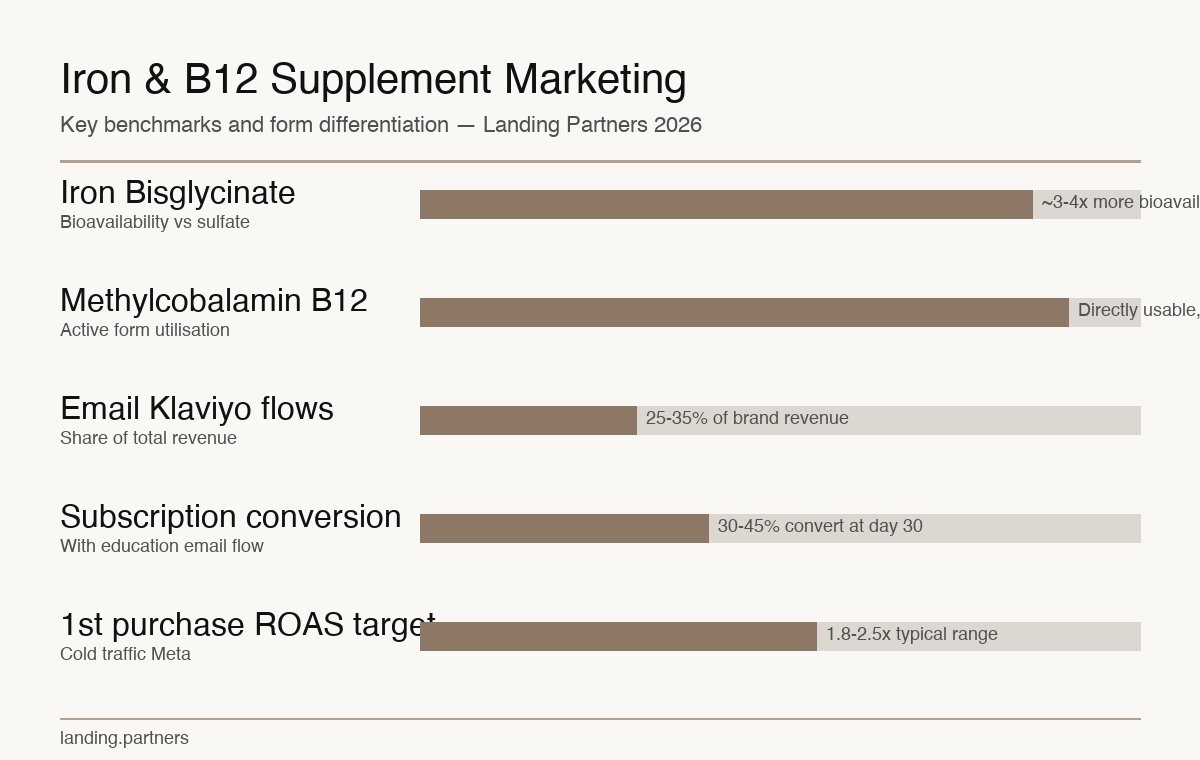
**Iron bisglycinate (ferrous bisglycinate):** Chelated form with significantly higher bioavailability (typically 3-4x compared to sulfate) and dramatically lower GI side effects. This is the claim that converts. "Gentle iron" and "stomach-friendly iron" are not hollow marketing - they describe a real and meaningful product difference.
Iron liposomal: Emerging form with strong bioavailability and tolerability data. Premium price point. Works well for a brand targeting the informed, higher-spending health consumer.
B12 form differentiation:
Cyanocobalamin is the standard, cheap form used in most mass-market supplements. It is effective for most people but requires conversion by the body before use.
**Methylcobalamin:** The active, bioavailable form of B12. Does not require conversion. Preferred by practitioners and by consumers who have done their research. For a B12 brand targeting the plant-based or biohacker audience, methylcobalamin is a non-negotiable ingredient choice - and it is a differentiator that can be featured prominently in creative.
Adenosylcobalamin: The mitochondrial form. Increasingly mentioned in biohacker circles. Niche but growing.
The practical marketing application: **your form is your differentiator**. Feature it in your product name, your hero image, your ad hooks. "Not all B12 is the same" opens the door to a high-converting education narrative that justifies your price premium without ever having to compete on volume discounting.
CRO for Iron and B12 Product Pages: Making Clinical Claims Readable
Iron and B12 product pages have a specific conversion challenge: the most persuasive claims are technical, and the most accessible claims are vague. Finding the balance between scientific credibility and consumer clarity is the CRO task.
**What works on iron and B12 product pages:**
Lead with outcome, follow with mechanism. "Reduce tiredness and fatigue" as the headline. "Iron bisglycinate - 3x more bioavailable than standard iron, with no stomach discomfort" as the subheadline. The outcome hooks, the mechanism justifies.
Third-party validation. Registered dietitian recommendations, EFSA claim badges, or dermatologist input (for beauty supplement iron brands) all outperform generic testimonials in this category. The consumer is already skeptical - they have tried supplements that did not work. Credibility signals matter more here than in lower-scrutiny categories.
Comparison table. A side-by-side comparison of your form vs. standard forms, on bioavailability and tolerability, is one of the highest-impact CRO additions for iron and B12 brands. It educates, differentiates, and addresses the price objection (why pay more) simultaneously.
Manage the timeline expectation on the page. A timeline graphic showing "week 1-2: iron begins to replenish" through "week 6-8: most people report significant improvement in energy" reduces buyer hesitation and sets up the Klaviyo education flow correctly.
Based on our client accounts, iron and B12 brands that feature form differentiation (bisglycinate vs. sulfate; methylcobalamin vs. cyanocobalamin) in their primary product page headline see meaningfully higher conversion rates compared to brands leading with dose or price. The mechanism claim is the conversion driver.
Benchmarks: What to Expect from Iron and B12 Supplement Advertising
Iron and B12 sit in a mid-tier position in the supplement advertising landscape. They are not as difficult to scale as weight loss or hormone products, and not as easy as collagen or probiotics.
What we see across our accounts in this category:
**ROAS:** First-purchase ROAS on Meta for iron and B12 supplements typically runs between 1.8-2.5x on cold traffic. The category economics only work at scale with a strong subscription model: repeat purchasers at 60-90 day intervals are what make unit economics positive. A first-purchase ROAS of 1.8x can be profitable if 35-45% of buyers convert to subscription.
**Email revenue:** Klaviyo revenue for iron and B12 brands with a complete flow architecture typically represents 25-35% of total revenue - but this figure is highly dependent on the subscription rate. Flow revenue (especially the reorder and subscription upsell flows) consistently outperforms campaign revenue in this category. As with all supplement Klaviyo accounts, treat campaign ROAS figures with appropriate skepticism - the attribution window inflates campaign credit significantly.
**Subscription conversion:** A well-structured post-purchase Klaviyo flow converts 30-45% of initial buyers to subscription at day 30. Without email, subscription conversion on the product page alone is typically under 15%.
**Repeat purchase window:** For iron, the natural reorder window is 30-60 days (typical iron course length). For B12, it is similar - most buyers think in monthly supply terms. Brands that build subscription programs around these natural windows see significantly higher LTV.
Every brand's situation is different. Iron and B12 marketing performance depends heavily on your form, price point, audience, and subscription infrastructure. If you want to know what the right approach looks like for your specific brand - book a free call with our team.