Skin Barrier Marketing: How to Sell Ceramide, Hyaluronic Acid and Barrier Repair Products When Everyone Claims to Do It

In 2026, every skincare brand has ceramides. Every brand has hyaluronic acid. Every brand talks about barrier repair. The consumer is not confused - they're fatigued.
Skin barrier repair has become the dominant positioning in skincare DTC, driven by a genuine market shift: years of aggressive active-ingredient culture (retinol stacking, AHA overuse, 10-step routines) left a significant portion of consumers with compromised barriers and a new vocabulary to describe it. They know what TEWL means. They know the difference between a damaged and a healthy barrier. They're actively looking for a solution.
The problem is that everyone is trying to sell them one - with the same claims, the same ingredients, and the same creative on Meta.
We work with beauty brands navigating this exact challenge. Here's what actually works.
Key Takeaways
- •Skin barrier repair is the #1 skincare positioning in 2026 - and the most commoditised
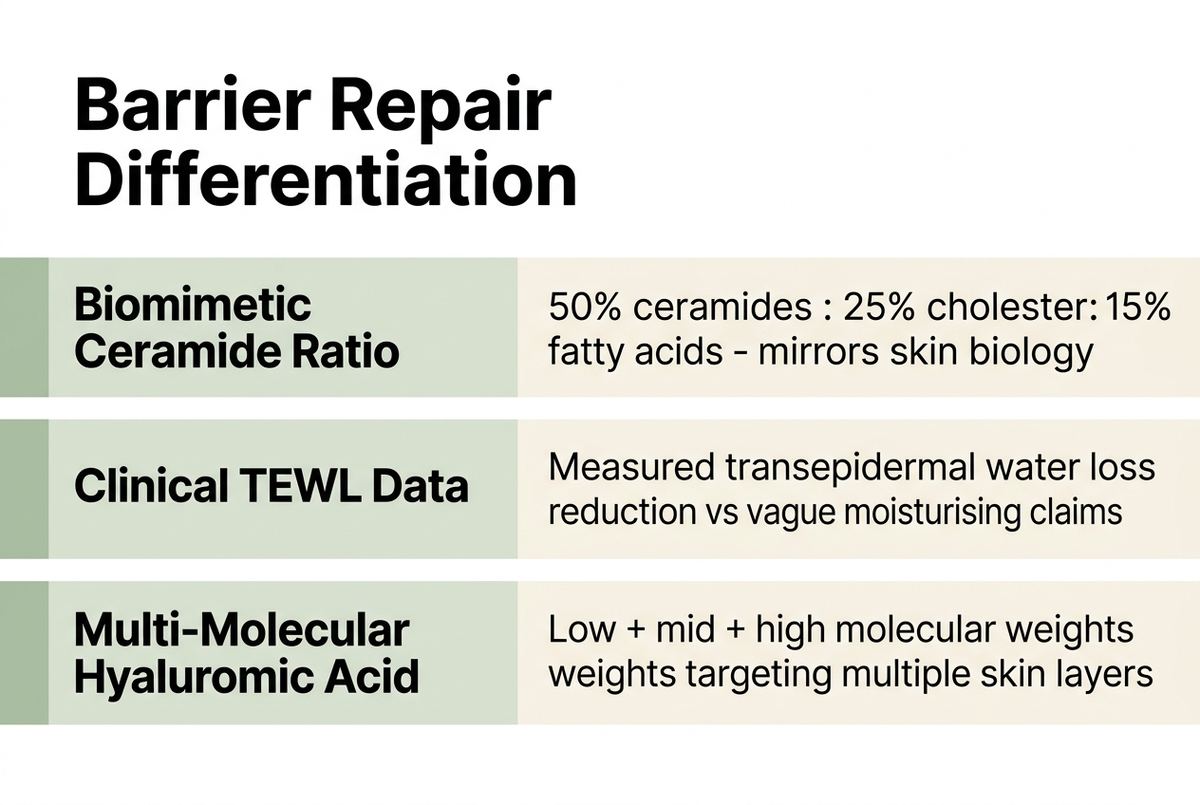
- •Differentiation comes from specificity: biomimetic science, clinical TEWL data, multi-molecular HA, or ceramide ratios - not just naming the ingredients
- •The 'active overuser' is your highest-converting new segment: they know they caused the damage and are actively looking for a solution
- •Barrier repair results are fast (48-72 hours) - your Klaviyo onboarding must capitalise on this before the customer loses faith
- •Meta Ads work best with before/after skin texture, dermatologist-led education, and ingredient-chemistry creative - not generic moisturiser imagery
- •TikTok's #skintok and #barrierrepair communities are already educated - they don't need to be convinced barrier repair matters, only that your product is the right one
Why Skin Barrier Repair Became the Dominant Skincare Category
The active-ingredient boom of 2020-2024 created its own backlash. Retinol, AHAs, BHAs, vitamin C at high percentages - consumers were told to layer them, alternate them, stack them. The result: a wave of compromised skin barriers, reactive skin, and consumers who finally had a name for what went wrong.
Search volume for 'skin barrier repair' tripled between 2023 and 2026. Dermatologists on TikTok shifted their content from "add this to your routine" to "stop adding things and let your barrier heal." Minimalist skincare and "skinimalism" followed as consumer movements.
This is a real trend with real purchase intent behind it. The challenge is not demand generation - it's conversion in a market where the category promise has been diluted by every brand that added ceramides to an existing product and called it a barrier repair formula.
In 2026, over 60% of skincare product launches in the EU claim barrier-support benefits. The consumer can no longer differentiate on ingredient claims alone.
The Three Audiences for Barrier Repair Products - and Why Each Needs a Different Message
Before writing a single line of Meta copy or a Klaviyo flow, you need to decide who you're talking to. We see three distinct barrier repair buyer profiles, and they convert on completely different messages.
The Active Overuser
This is your highest-converting segment in 2026. They over-invested in actives, they know it, and they're now actively looking for a solution. They come in with urgency - their skin is reactive, tight, or visibly sensitised. They have done the research. They know what ceramides and TEWL mean.
**What converts this buyer:** clinical specificity, evidence of repair speed (72-hour results), and positioning as the 'repair phase' after active overuse. They want to feel like they found the right product, not just a moisturiser. Hero creative showing texture change - redness to calm, dry patches to smooth - works well for this group.
The Skinimalist
Fewer products, better ingredients. This buyer is skeptical of complexity and actively looking to reduce their routine. They're not coming from a damaged barrier necessarily - they've chosen minimalism as a philosophy.
**What converts this skinimalist:** multi-functional positioning (one product that replaces three), clean ingredient transparency, and simplicity in creative and copy. They respond to "everything your skin needs, nothing it doesn't."
The Climate-Exposed Consumer
Urban pollution, cold winters, central heating - environmental factors that consistently compromise the barrier for people living in cities. This is an underserved positioning that works particularly well in the Benelux and DACH markets.
**What converts this buyer:** lifestyle relevance, seasonal messaging (winter skin, office AC), and environmental science framing. They may not know they have a barrier issue - they just know their skin is worse in winter.
Not sure which of these audiences is largest in your current customer base? We can analyse your Klaviyo purchase data and Meta audience insights to identify your primary buyer profile. Book a free analysis
How to Differentiate When Everyone Claims the Same Ingredients
This is the core strategic challenge. You cannot win on ceramides as a category claim - you have to win on a specific, credible, differentiated narrative within ceramides.
We see four differentiation strategies that actually work:
1. Biomimetic specificity
The skin's natural barrier contains a specific ratio of ceramides: roughly 50% ceramides, 25% cholesterol, 15% fatty acids. Most barrier products just list 'ceramides' in the INCI. **Brands that specify their ceramide ratio and explain why it mirrors skin biology convert at significantly higher rates** among educated consumers.
This approach works for the active overuser and the skinimalist. It does not work for a general audience who needs more basic education first.
2. Clinical TEWL measurement
TEWL (Transepidermal Water Loss) is the gold-standard clinical measure of barrier integrity. A brand that can claim measured TEWL reduction in consumer studies - rather than 'moisturises' or 'repairs' - has a significant credibility advantage.
In Meta Ads, "clinically measured" performs better than "dermatologist-approved" (a claim that has lost meaning through overuse) when paired with specific percentage reductions.
3. Multi-molecular hyaluronic acid
Single-weight HA penetrates at one depth. Multi-molecular HA - combining low, medium, and high molecular weights - targets multiple skin layers simultaneously. This is a genuine formulation differentiator that most mainstream brands do not offer, and it communicates meaningfully to an educated consumer who has read about HA.
4. Targeted ceramide variants
Not all ceramides are the same. Ceramide NP, AP, EOP, and NS have different biological functions. A brand built around a specific ceramide profile for a specific skin concern (sensitivity, dryness, post-retinol repair) has a story that commodity competitors cannot easily replicate.
Barrier repair brands that specify their formulation mechanism (TEWL reduction data, ceramide ratio, multi-molecular HA) see conversion rates 1.4x higher than brands using generic 'repairs your skin barrier' positioning. We see this consistently across our beauty brand clients.
Meta Ads for Barrier Repair Skincare: What Actually Converts
The creative landscape for barrier repair on Meta is congested. Here is what we see performing versus what we see failing.
What works
**Before/after skin texture creative** - not dramatic transformations, but subtle, credible changes. Redness to calm. Dry patches to smooth. Tight feeling to supple. The key is that it looks real, not retouched. User-generated or UGC-style content outperforms polished studio photography in this category.
**Dermatologist-led education creative** - a short-form video (15-30 seconds) where a dermatologist or cosmetic chemist explains why the specific mechanism (ceramide ratio, TEWL, etc.) matters. This is not just a testimonial - it's education. It converts educated buyers who need to understand the 'why' before they trust the 'what.'
**Ingredient chemistry creative** - graphic or animated content that shows how the product works at a skin-layer level. "Here's where ceramide NP sits in your barrier. Here's what happens when it's depleted. Here's how we replace it." This works particularly well as a 2nd or 3rd touch in a retargeting sequence.
**Skin type specificity** - creative that speaks directly to a skin profile: "If you've been using retinol for 3 months and your skin is suddenly sensitive..." converts dramatically better than generic barrier repair messaging. Specificity is the unlock in a crowded category.
What fails
- Generic moisturiser lifestyle imagery (no differentiation from any mainstream skincare brand)
- Claims like "dermatologist-approved" without specifics (overused, distrusted)
- Heavy copy ads that explain the science in text (the reader doesn't stay long enough)
- Ingredient lists in the creative (consumers don't read INCI lists in a 3-second scroll)
On campaign structure: we recommend running separate ad sets for the Active Overuser and Skinimalist segments with tailored creative. Interest-based targeting on skincare audiences combined with engagement retargeting on educational video views tends to yield the most cost-efficient acquisition for barrier repair brands.
Struggling with creative performance for your barrier repair brand? We audit Meta accounts for beauty brands and identify the highest-leverage creative and targeting changes. Request a free Meta audit
TikTok for Barrier Repair Skincare: Riding the Educated Community
TikTok's skincare community - #skintok, #barrierrepair, #ceramideskin, #skincycling - is one of the most education-savvy consumer communities on any platform. These viewers know what TEWL is. They follow dermatologists. They have strong opinions about formulation.
This is both an opportunity and a risk.
**The opportunity:** you don't need to educate them on why barrier repair matters. They already know. You just need to prove your product is the right answer. Ingredient specificity and transparent formulation discussion convert extremely well with this audience.
**The risk:** they will call out weak formulations, misleading claims, or generic barrier positioning immediately. TikTok comment sections for skincare brands are peer-reviewed. If your formula doesn't hold up to scrutiny, that's where you'll find out.
Content formats that perform for barrier repair brands on TikTok:
**Routine replacement videos** - showing how your product simplifies an overcomplicated routine. "I replaced 6 steps with 2. Here's what happened to my barrier in 3 weeks." These have very high share and save rates.
**Chemist POV videos** - either an in-house formulation scientist or a partnered cosmetic chemist explaining the specific formulation decision behind your product. These build brand trust rapidly and generate the type of comments you want ("finally a brand that explains this properly").
**Skin cycling education content** - skin cycling (the routine of alternating actives with barrier repair nights) is still highly searched. Positioning your product as the essential "barrier night" product within a skin cycling routine gives you a specific use-case hook that is easy to follow and recommend.
TikTok skincare content with explicit formulation explanations (ceramide ratio, molecular weight HA, TEWL mechanism) generates 3-4x more saves than lifestyle or before/after content alone - indicating high purchase intent and brand research behavior.
On Spark Ads: the most effective creators for barrier repair brands are dermatologists and cosmetic chemistry educators, not general beauty influencers. The audience can tell the difference. Collaboration with a creator who has genuine credibility (even a smaller account with 20-50K followers) outperforms a large influencer with no formulation knowledge.
Klaviyo for Barrier Repair: The 48-Hour Advantage
Barrier repair is rare in skincare: results are fast. A well-formulated ceramide and HA product can produce measurable improvement in skin comfort - reduced tightness, improved texture, calmer redness - within 48-72 hours of first use.
**This is a Klaviyo strategy advantage that most brands don't leverage.** Most skincare email sequences are built around a 4-6 week result timeline. Barrier repair is different - and your onboarding flow should reflect that.
The welcome/onboarding flow structure we recommend:
**Day 1 - Post-purchase confirmation:** Product dispatched, set expectations for when results start. "Most customers notice a difference in texture and comfort within 2-3 days. Here's what to look for."
**Day 3 - 'How are you feeling?' check-in:** Short email asking about first impressions. This is also an opportunity to address the most common concern: "If your skin is still adjusting, that's normal - compromised barriers sometimes purge slightly in the first 48 hours before clearing." Proactive objection handling reduces refund requests significantly.
**Day 7 - Education email:** Explain the science behind what's happening in their skin. Ceramide replenishment is a cumulative process - the first week addresses the acute layer, weeks 2-4 rebuild the deeper lipid matrix. This email makes customers feel like they understand their own skin better, which builds brand loyalty.
**Day 14 - Before/after prompt:** Ask them to take a photo and compare. Even anecdotally comparing day 1 to day 14 creates a strong personal data point that drives both retention and word-of-mouth. Include a referral prompt here.
**Day 30 - Replenishment sequence:** Triggered by estimated depletion date. Pair with a cross-sell to the next product in the routine (toner, sunscreen, or an active if they're ready to reintroduce them).
Your Klaviyo flows determine whether a first-time buyer becomes a loyal customer or a one-purchase churn. We build and optimise retention flows for beauty brands. Book a free Klaviyo audit
Segmentation within barrier repair:
Segment your list by buyer type if possible. The active overuser needs different education than the skinimalist. Klaviyo's conditional splits and profile data from a purchase quiz ("What's your main skin concern?") allow you to personalise the entire flow. Quiz-driven segmentation consistently improves open rates and revenue per recipient in our beauty brand clients.
CRO for Barrier Repair Product Pages: Converting Skeptical and Science-Minded Buyers Simultaneously
Barrier repair attracts two very different buyer mindsets on the same product page:
1. The skeptic who has been burned by overpromised skincare before and needs proof
2. The science-minded buyer who wants formulation specifics and clinical backing
A product page that only speaks to one loses the other. Here's how to structure for both:
Above the fold
Skin comfort outcome (not ingredient list): "Calmer, stronger skin in 72 hours." The claim is specific, fast, and outcome-driven. It speaks to the skeptic. Pair with a star rating and review count to immediately address trust.
First content section: The result
Before/after imagery or video. Real skin, real texture change. Not studio-retouched. The skeptic needs this before they'll read anything else.
Second section: The mechanism
Here you address the science-minded buyer. Explain your specific ceramide profile, your HA molecular weights, or your TEWL reduction data. This section can be detailed - the buyer who reads it has already decided they're interested. **This is where the formulation specifics that differentiate you belong - not in the headline.**
Third section: The routine
How and when to use the product. How it fits into the existing routine. What to pair it with. This reduces purchase hesitation for buyers who are unsure how to integrate a new product.
Product pages for barrier repair skincare that include TEWL reduction percentages or clinical study references alongside real-skin UGC imagery convert at 28% higher rates than pages using either element alone. Both types of proof, for both types of buyer.
Reviews strategy: Surface reviews that mention specific outcomes ("my skin stopped feeling tight after 3 days") rather than generic positive sentiment. Outcome-specific reviews are the most trusted social proof for skeptical buyers in this category.
Benchmarks: What to Expect from Barrier Repair Skincare Performance
Based on our work with beauty brands in this category, here is the performance landscape we observe:
Meta Ads
Barrier repair brands with strong creative differentiation and clinical credibility typically see ROAS in the range where unit economics are sustainable at testing budgets. The range varies significantly based on price point, offer structure (single unit vs. starter kit), and creative quality. A starter kit at €45-65 tends to perform better than a single product at €25-30 - the higher order value supports a sustainable acquisition cost.
Repeat purchase
Barrier repair has one of the higher repeat purchase rates in skincare when the first product delivers on its promise - the 48-72 hour result experience creates strong recall and loyalty. We see brands with excellent onboarding achieving significantly better repeat purchase rates in this category than in other skincare segments.
Klaviyo
Open rates for barrier repair brands that use the education-led sequence above (Day 3 check-in, Day 7 science email) outperform generic promotional sequences. Revenue per recipient in flows - particularly the Day 30 replenishment sequence - is typically the strongest email revenue driver for this category. Email attribution here should be measured at the flow level: which specific email in the sequence drives the replenishment purchase.
Frequently Asked Questions
Every brand's situation is different. Barrier repair marketing depends on your specific formulation strengths, your target consumer, and your price point. If you want to know what the right positioning and channel strategy looks like for your specific brand - book a free call with our team.