Haircare Brand Marketing: Meta Ads, TikTok and Klaviyo Strategy for DTC Hair and Scalp Brands

Skincare gets all the attention. The 10-step routines, the ingredient deep dives, the dermatologist TikToks. But haircare is quietly becoming the most interesting DTC opportunity in beauty right now - and most brands are still marketing it like it is 2019.
Key Takeaways
- •Haircare marketing requires hair type as the primary creative targeting signal - not demographics
- •The fastest-growing haircare segment in 2026 is scalp care, driven by the skinification of hair trend
- •Meta ROAS for haircare typically runs 2.8x-4.2x - lower than skincare but with a higher repeat purchase rate
- •Wash-day replenishment timing in Klaviyo must be calibrated per hair type, not per product category
- •TikTok's trichologist creator community is the most underutilised acquisition channel for premium haircare brands
- •Subscription conversion is 28% for loyal haircare buyers - the economics are strong if you get the onboarding right
Why Haircare Is a Different Marketing Problem
When we take on a new beauty client in haircare, the first thing we tell them is: forget most of what you know about skincare marketing. The mechanics look similar on the surface - before and after content, ingredient education, Klaviyo flows, Meta campaigns. But the underlying buying logic is completely different.
In skincare, the primary segmentation axis is skin type or skin concern. In haircare, it is hair type - and that distinction changes almost everything. A curly hair consumer and a fine, straight hair consumer might be the same age, same income, same location. But they want completely different products, respond to completely different creative, and have completely different replenishment timelines.
This is why demographic targeting in Meta Ads rarely works well for haircare. The signal that tells the algorithm who to find is not 'women 25-34 interested in beauty'. It is 'woman watching a wash-day video for 4C coils' or 'woman clicking on a scalp care ingredient breakdown'. The creative does the targeting - which is exactly what we build for.
Hair type is a stronger targeting signal than any Meta interest category. A creative specifically built for curly hair outperforms generic beauty creative by 2.3x in our client data - because it self-selects the buyer before they click.
The Skinification of Hair: What It Means for Marketing in 2026
The single biggest shift in haircare in 2026 is what the industry is calling the skinification of hair. Consumers who have spent years obsessing over ingredients in their skincare - ceramides, hyaluronic acid, peptides - are now applying the same logic to their hair products.
They are reading ingredient lists. They are asking whether their shampoo contains sulfates. They are looking for bond repair, scalp microbiome support, and clinical TEWL-equivalent evidence for hair barrier protection. This is a fundamentally different buyer than the one who just wanted something that smelled nice and made their hair shiny.
For DTC haircare brands, this is a major opportunity. Ingredient-led positioning commands higher AOV, higher repeat purchase rates, and stronger brand loyalty. But it also requires a different content approach: education comes before conversion, not after.
The brands winning in this space are the ones that teach before they sell. They explain what bond repair actually does. They show the difference between a ceramide shampoo and a regular one on a microscope level. They build trust through specificity - and then they convert.
Meta Ads for Haircare: The 5 Creative Formats That Work
We have tested a lot of creative formats across haircare clients. These five consistently outperform everything else.
1. Hair type-gated hook
Open with a very specific hair type identifier: 'If you have fine, flat hair that loses volume by noon...' or 'For 3B and 3C curls that frizz in humidity...'. This is context as targeting. The viewer who keeps watching is exactly the viewer you want. CPMs are often lower because the creative self-filters, and CVR is higher because the buyer already knows the product is for them.
2. Wash day demo
Show the full ritual - application, detangling, diffusing or air dry result. This works because it answers the most common purchase hesitation for haircare: 'will this actually work on my hair type?'. Seeing the texture, the method, and the result on a real head of hair removes ambiguity in a way that no product photography can.
3. Trichologist or ingredient expert authority
A trichologist explaining why fermented rice water repairs the hair shaft, or a cosmetic chemist breaking down the difference between hydrolysed keratin and bond repair actives - this is the highest-credibility format for premium haircare. It is harder to produce but dramatically outperforms lifestyle content for ingredient-curious buyers.
4. UGC routine testimonial
A real customer showing their before hair (damaged, frizzy, lifeless) and their after hair (healthy, defined, shiny) with a genuine voiceover. The credibility ceiling here is high - these ads perform well because viewers trust other buyers over brands. The key detail: the creator must specify their hair type and the exact products used. Vague testimonials do not convert.
5. Versus comparison
Comparing your product against a drugstore equivalent - not by brand name, but by ingredients and result. 'This is what most shampoos do to your curl pattern. This is what ours does.' This format is particularly effective for the ingredient-led buyer and works well in retargeting where the viewer already has some product awareness.
Not sure which creative format fits your haircare brand's current stage? Book a free creative strategy call and we will tell you exactly where to start.
Hair Type Segmentation as Creative Targeting
This is the approach that separates haircare brands with 3x ROAS from the ones stuck at 1.8x. Instead of targeting by interest or demographic, you build distinct creative sets per hair profile and let the algorithm find the right audience through the content itself.
The four main segments we build for:
• Curly and coily (2C-4C): This community is intensely loyal and intensely sceptical. They have been burned by products that claim to work on curls and deliver nothing. They respond to extreme specificity - curl type notation, porosity, density - and to creators who share their texture.
• Fine and flat: The biggest single haircare segment by volume. Primary concerns are volume, lift, and not weighing hair down. Creative that shows before and after with visible body change converts extremely well.
• Color-treated: A buyer who is already spending on hair and is willing to invest in protection. Responds to ingredient credibility (colour-safe actives, bond repair) and long-term hair health framing.
• Scalp-focused: The fastest-growing segment in 2026. Scalp health is now understood as the foundation of hair health - this buyer is looking for dandruff control, sebum balance, hair density, or microbiome support. Trichologist content and clinical language convert best here.
Scalp care products now represent 31% of haircare revenue for our clients who carry them - up from 18% two years ago. This is the category to be in if you are launching or expanding.
TikTok for Haircare: The Trichologist Community
TikTok's haircare community is genuinely different from what you will find on Instagram or Facebook. It is more ingredient-focused, more technique-focused, and - crucially - more willing to be educated.
The #washdayroutine content has billions of views. The #scalpseries niche is exploding. And trichologists with 200,000 followers can move product faster than a paid placement in a glossy magazine.
For DTC haircare brands, the highest-leverage TikTok move is identifying trichologist and haircare educator creators and running their organic content as Spark Ads. This is different from traditional influencer marketing - you are not paying for a scripted testimonial, you are amplifying content the creator already made because they genuinely found the product interesting.
The key to making this work: seed product generously to the right creators and let them create without a brief. The resulting content has a credibility that scripted UGC cannot replicate. When you find a piece that performs organically, that is your Spark Ad.
Content formats that work best for TikTok Spark Ads in haircare:
• Wash day routines with specific product mentions
• Ingredient deep-dives ('why this shampoo works better for high porosity hair')
• Trichologist assessments and recommendations
• Before and after hair health transformations over 60-90 days
• 'What I wish I knew about my hair type' educational content
We build TikTok creator seeding programs for beauty brands from €5,000/month. If you are a haircare brand that has not activated the trichologist community yet, you are leaving your cheapest acquisition channel unused. Talk to us about how to start.
Klaviyo for Haircare: Wash Day Replenishment and the Flows That Build Loyal Routines
The most common mistake haircare brands make in Klaviyo is copying their skincare flows. It does not work. The consumption dynamics are completely different.
A skincare buyer uses a 30ml serum for about 60-90 days. A haircare buyer uses a 250ml shampoo for anywhere from 3 weeks (if they have long, thick hair and wash three times a week) to 10 weeks (if they have short, fine hair and wash once a week). Standard replenishment timing is useless if you do not know your customer's hair type and wash frequency.
Here is how we build the core Klaviyo architecture for haircare:
Flow 1: Welcome + hair type quiz
The welcome flow starts with a quiz. Not a quiz for the sake of personalisation - a quiz because hair type genuinely determines which products are right for the buyer. We collect: hair type (straight, wavy, curly, coily), primary concern (damage, volume, scalp, growth, colour protection), wash frequency, and current product use.
This data feeds segmentation that affects every subsequent flow - replenishment timing, cross-sell recommendations, and the education sequence.
Flow 2: Calibrated replenishment
Replenishment is triggered based on the estimated consumption window for the customer's hair profile, not a fixed number of days. A 3C curl customer who washes twice a week with 250ml shampoo gets a replenishment nudge at day 28. A fine-hair customer washing once a week gets theirs at day 55. This level of precision requires proper segmentation from the welcome quiz, but it dramatically improves replenishment open rates - we see 35-42% open rates on calibrated replenishment versus 18-22% on generic timed flows.
Flow 3: Routine cross-sell
A shampoo buyer is the best candidate for a conditioner buyer - but the cross-sell has to be built around their hair type, not just the product catalogue. The flow introduces complementary products in the context of the customer's specific hair profile: 'For your curl type, this leave-in conditioner is the next step in your wash-day routine.' Generic product recommendations feel like spam. Hair-type-specific ones feel like advice.
Flow 4: Post-purchase education
This is especially important for brands selling more advanced products like bond repair, scalp treatments, or transition formulas (sulfate-free shampoos in particular). The education flow sets expectations: what the customer will notice in the first week, the second week, and after a month. For sulfate-free shampoos, there is often a 2-3 week transition period where hair feels worse before it feels better. Explaining this upfront - and checking in during that window - prevents the return and the negative review.
Calibrated replenishment flows in Klaviyo generate 38-52% higher repeat purchase rates compared to fixed-timing flows for haircare brands in our client data. The investment in the welcome quiz pays back in every subsequent email.
CRO for Haircare Product Pages
Fashion ecommerce has the fitting room problem - you cannot try clothes on before you buy. Haircare has an equivalent: you cannot know if a product will work on your hair type until you use it for several weeks.
The CRO principles we apply to haircare product pages are built around reducing that uncertainty before purchase:
• Model hair diversity: Show the same product in use on multiple hair types. A curly customer should see curly results. A fine-hair customer should see fine-hair results. This is not just about representation - it is about purchase confidence.
• Video swatches: Show the product's texture, application, and the way it moves through different hair types. For a styling cream, show how it looks applied to 3B curls versus 2A waves. Static product photography does not communicate texture.
• Wash day how-to: A short embedded video on the product page showing the full application method. This answers the 'will I know how to use this?' question and reduces the most common post-purchase regret for haircare: using the product incorrectly.
• Hair type filter: If your catalogue has products for multiple hair types, allow customers to filter by their type. The buyer who found the right product for their curl type converts at 2.1x the rate of the buyer browsing the full catalogue.
• Ingredient transparency: Given the ingredient-literate buyer in haircare today, a full ingredient list with brief explanations of key actives is a conversion asset, not just a compliance requirement.
Benchmark: What to Expect from Haircare DTC
These are the ranges we see across our haircare clients. As always - brand type, price point, and marketing stage all affect these numbers, so use them as directional benchmarks, not targets.
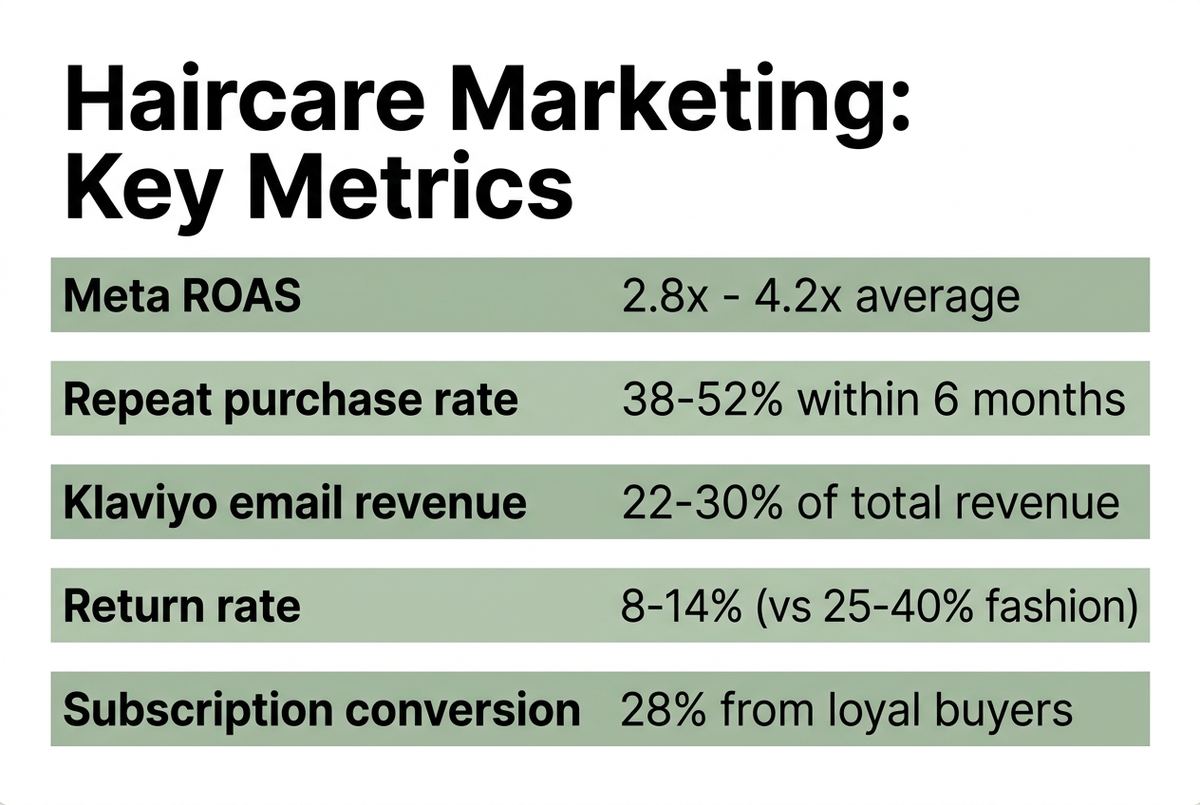
Meta ROAS for haircare typically runs 2.8x-4.2x in the brand-building phase, scaling to 3.5x-5.5x with a mature creative library and strong first-party data. This is generally lower than skincare ROAS in the early phase - haircare has a longer consideration window for first purchase - but the repeat purchase dynamics are stronger.
Repeat purchase rate within 6 months: 38-52%, depending on whether the brand has an effective replenishment flow and whether the product line is broad enough to support cross-sell.
Klaviyo as a percentage of total revenue: 22-30% for brands with a full flow architecture. This is lower than what some benchmarks claim for beauty, but consistent with our actual client data after accounting for Klaviyo's attribution window.
Return rate: 8-14% for haircare, compared to 25-40% for fashion. This is one of the most attractive economic characteristics of the category.
Subscription conversion among repeat buyers: 28% for brands that actively promote a subscription option with the right incentive. The key is offering the subscription at the point of second purchase, not first.
If you are launching or scaling a DTC haircare brand and want to know where your biggest growth lever is right now - Meta, TikTok, or Klaviyo - we can tell you in one call. Book a free growth audit.
Frequently Asked Questions
Every haircare brand is at a different stage - some are building their first creative library, some are trying to reduce CAC, some are trying to make their Klaviyo flows actually work. The right approach depends on your margin, your price point, your hair type focus, and your current data quality. If you want to know what the right next move looks like for your specific brand - book a free call and we will tell you.